
Should I keep investing in the FTSE 100?

I am happy to keep investing in the FTSE 100, but I am aware of its strengths and weaknesses, and I also look elsewhere.

The content of this article was relevant at the time of publishing. Circumstances change continuously and caution should therefore be exercised when relying upon any content contained within this article.

Young female business analyst looking at a graph chart while working from home

Image source: Getty Images

You’re reading a free article with opinions that may differ from The Motley Fool’s Premium Investing Services. Become a Motley Fool member today to get instant access to our top analyst recommendations, in-depth research, investing resources, and more. Learn More.

The news is full of stories of Inflation, rate rises, strikes, and failing companies blighting the UK economy. I have seen the UK described as a basket case, and by extension the UK stock market. Now, whether the UK economy is doomed or not is irrelevant to the point I want to make. That is a stock market or market index is not necessarily the same thing as its country’s economy. That is particularly true of the FTSE 100 index, which I am still happy to keep investing in.

FTSE 100 near its all-time high

The FTSE 100 hit 7,877.45 points on 19 June 2019. As it stands that is its record high. Right now, the index is just below that, at 7,764 points, but it has been close this week. Flirting with all-time highs suggests that the index, and by extension the companies whose stocks make it up, are doing okay. How can that be if the UK economy is apparently in the doldrums? Well, about three-quarters of the revenues of FTSE 100 companies come from outside the UK.

There are variations across the 100 or so among companies in the index. AstraZeneca gets about a tenth of its revenues in the UK. NatWest on the other hand gets about 95% of its revenue on these shores. A lot of FTSE 100 companies report in sterling. Therefore, exchange rate movements will affect their foreign earnings and thus their share prices. And an awful UK economy is definitely not a good thing for the FTSE 100, but on the whole, in terms of revenue generation, its fortunes should depend more on what’s going on in the rest of the world, rather than what’s happening in the UK.

Underperforming index

Since March 2016, the FTSE 100 has underperformed the US S&P 500, the German Dax, and the Japanese Nikkei 225. The performance lag was especially pronounced in the boom after the coronavirus global market crash in early 2020. Now, one interpretation of the underperformance is that the UK economy, particularly the effect of Brexit, has been holding the index back. But, looking more closely, it seems that the FTSE 100 held up fairly well while other indexes started to slide in late 2021 and into 2022.
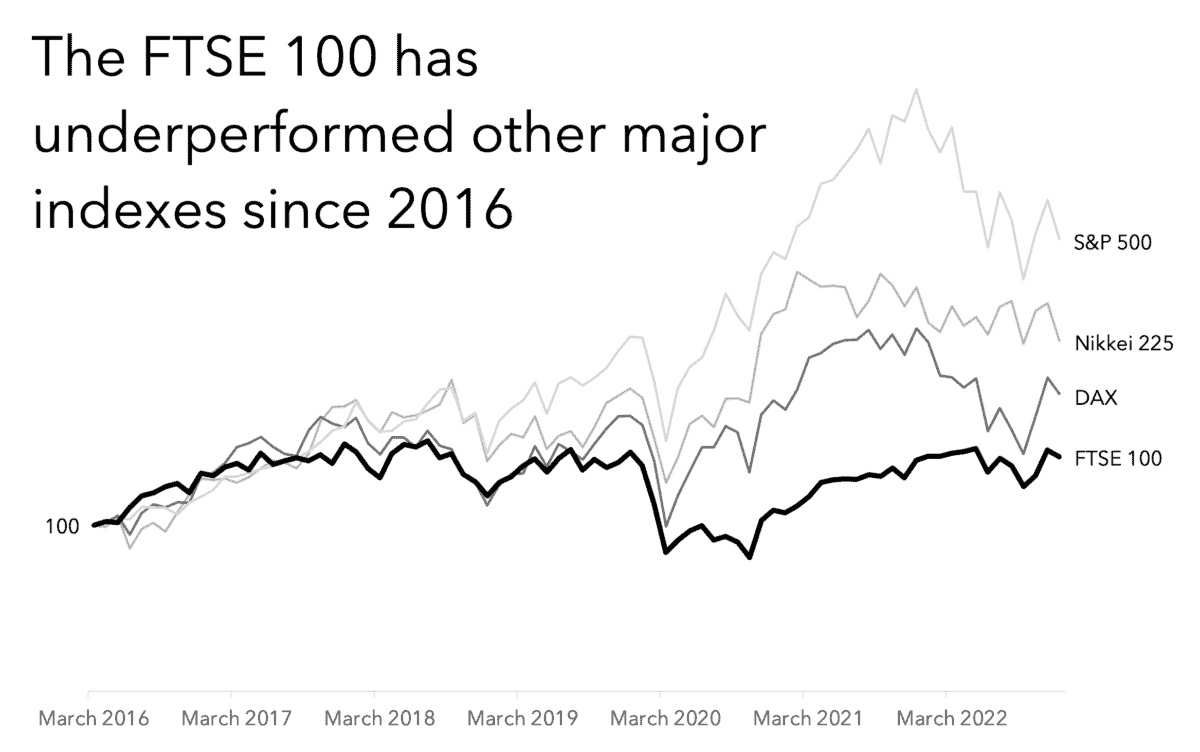
Line graphs of the FTSE 100 and other indexes price changes rebased to 100 in March 2016 showing that the FTSE 100 has underperformed since that date.

I think that has got a lot to do with the makeup of the index. It is important to know what you are buying. The FTSE 100 is heavily weighted towards the financial, consumer defensive, and basic materials (mining) industries and is a value-orientated index. It is short on growth stocks and technology names in particular.
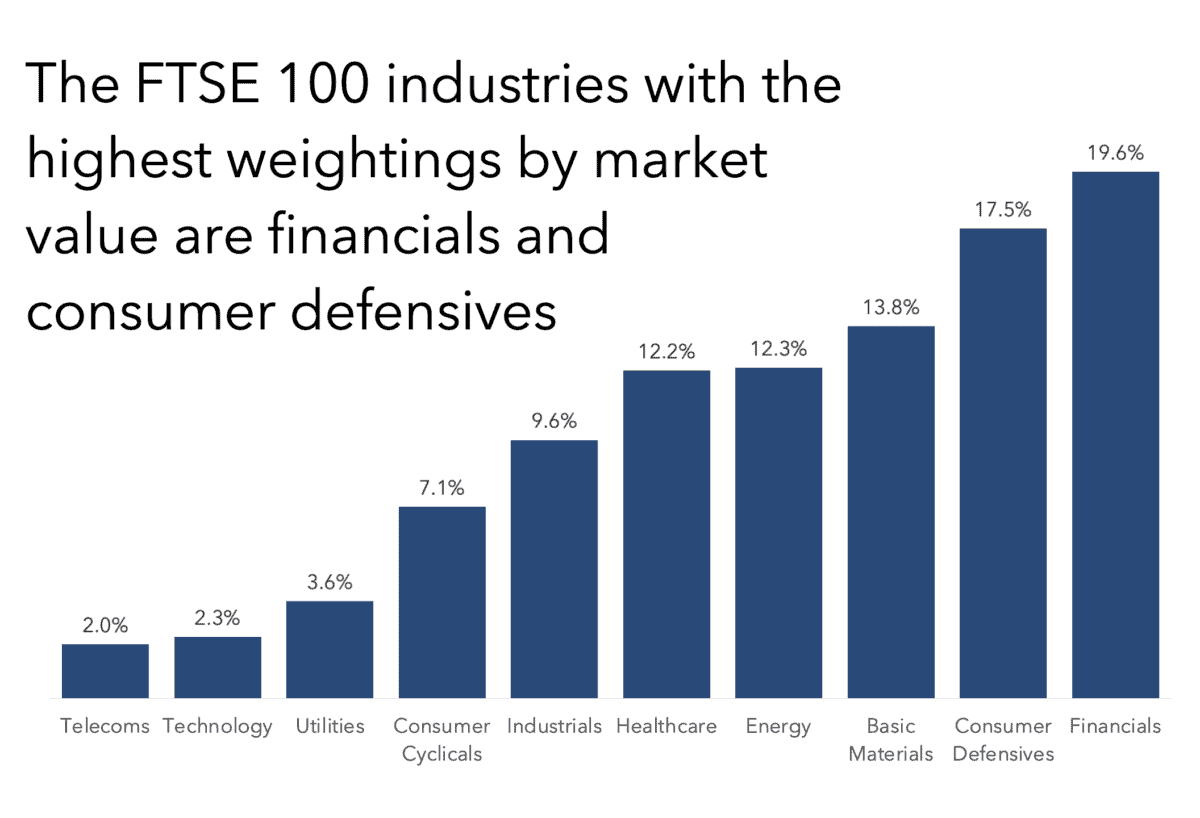
Being light on growth has been a benefit of late. But that will probably not always be the case. So while I am happy to keep investing in the FTSE 100, in the form of individual stock picks in my Stocks and Shares ISA, and through a tracker in my SIPP, I do recognise its strengths and weaknesses. Investing in it does give me exposure to the global economy, but mainly in a few, what might be called old-world industries. That’s not enough diversification for my stock portfolio, so I am happy to look outside the index as well.


James McCombie has positions in NatWest Group Plc. The Motley Fool UK has no position in any of the shares mentioned. Views expressed on the companies mentioned in this article are those of the writer and therefore may differ from the official recommendations we make in our subscription services such as Share Advisor, Hidden Winners and Pro. Here at The Motley Fool we believe that considering a diverse range of insights makes us better investors.

More on Investing Articles

Older couple walking in park
Investing Articles

How much do I need in my ISA for a £1,000 monthly passive income?

Picking high-income stocks in an ISA can be a route to securing long-term passive income. And here's one with a…

Read more »

Smiling white woman holding iPhone with Airpods in ear
Investing Articles

Prediction: in 12 months the surging Aviva share price and dividend could turn £10,000 into…

Aviva's share price has beaten the broader FTSE 100 over the last year. But can the financial services giant keep…

Read more »

Portrait of elderly man wearing white denim shirt and glasses looking up with hand on chin. Thoughtful senior entrepreneur, studio shot against grey background.
Dividend Shares

I love FTSE 100 dividend shares, but do I buy this FTSE 250 loser?

Over the past year, the UK's FTSE 100 has thrashed the once-mighty US S&P 500 index. With value investing back…

Read more »

Investing Articles

How much do you need in an ISA to target a £2,000 monthly second income?

Harvey Jones crunches the numbers to see how much investors need in a Stocks and Shares ISA to generate a…

Read more »

Passive income text with pin graph chart on business table
Investing Articles

Should investors consider Legal & General shares for passive income?

As many investors are chasing their passive income dreams, our writer Ken Hall evaluates whether Legal & General could help…

Read more »

ISA coins
Investing Articles

How to transform an empty Stocks and Shares ISA into a £15,000 second income

Ben McPoland explains how a UK dividend portfolio can be built from the ground up inside a Stocks and Shares…

Read more »

Investing Articles

I asked ChatGPT if it’s better buy high-yielding UK stocks in an ISA or SIPP and it said…

Harvey Jones loves his SIPP, but he thinks a Stocks and Shares ISA is a pretty good way to invest…

Read more »

DIVIDEND YIELD text written on a notebook with chart
Investing Articles

How much do you need to invest in dividend shares to earn £1,500 a year in passive income?

As the stock market tries to get to grips with AI, could dividend shares offer investors a chance to earn…

Read more »