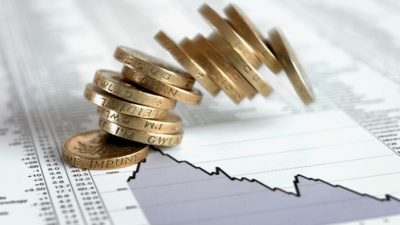
As I write these words, the FTSE 100 index is down around 15% from its recent peak of 7,103 at the end of April. It closed around 5,900 yesterday, though rebounded this morning to just over 6,000.
A fairly remarkable reversal in a few short months.
Or, put another way, we’re midway between a “correction”, defined as a 10% drop, and a “bear market”, defined as a 20% drop.
That said, while the FTSE 100 is down 9% since the start of the year, the FTSE 250 — London’s mid-cap index — is still in profit, just. Which goes to underscore the extent to which London’s main market is dominated by oil companies, miners and financial stocks.
(Which, by the way, is one reason why I always recommend novice investors to buy FTSE All-Share index trackers, not FTSE 100 index trackers. Or, if they’re feeling bullish, FTSE 250 index trackers.)
Where next?
So where is the market heading? The truthful answer is that no one knows, although that won’t prevent the usual pundits clogging the airwaves with guesses and ‘predictions’.
And I’m not going to pretend that I’m any better informed. Up? Down? Sideways? I’ve absolutely no idea.
But as an investor with a focus on income, I do know that whatever happens, right now there are opportunities to be had.
Sure, markets could fall further — but even so, an awful lot of decent stocks currently have an ‘On Sale!’ flag hoisted over them.
Pain drives down prices
And it’s not difficult to spot them. As I’ve mentioned before, oil companies and miners — and the businesses that supply these sectors — are going through a rough patch as the price of these commodities slumps, propelled by falling demand from China.
In the past six months, for instance, the share price of BHP Billiton has fallen by 40% — and it is reckoned to be one of the stronger mining companies, and among those least likely to take the axe to their dividends.
Royal Dutch Shell, which hasn’t cut its dividend since the Second World War, has seen its share price drop by 28% in the last six months. It’s now offering a forecast yield of 7.1%, on a prospective P/E of 13.
Asia is another pain point, with banks which are exposed to Asia’s economies being hit hard. Standard Chartered’s shares are down 24% over the past six months, for example. That said, the business is going through a torrid patch right now, on a number of fronts.
How about HSBC? Europe’s biggest bank? It too has been hit hard. Back when the FTSE 100 was at 7,103, HSBC’s shares were changing hands for 650p. Today, as I write these words, you can pick them up at 487p — a decline of some 25%. Offering a 6% yield, you can’t blame investors for feeling tempted.
Widespread bargains
But frankly, in today’s market, the pain is being felt almost everywhere. Defence and aerospace giant BAE Systems, for instance, is down 20% over the last six months, yielding 4.8% on a P/E of 12.
Among utilities, I’ve been mulling a taking a small stake in National Grid, down 10% over the past six months, and yielding 5.2% on a P/E of 15.
Heck, even companies such as Diageo and Unilever — which almost always seem expensive — are starting to look attractive.
Sitting on the fence
That said, it’s a safe bet that many private investors will do absolutely nothing by way of taking advantage of these low prices.
That’s because, time and again, they exhibit a kind of behavioural paralysis in situations like these — pushing the ‘buy’ button only when everything’s rosy, and sitting on their hands when it’s not.
Suppose the market goes lower still, they worry. Won’t I have made a loss? Maybe it’s better to wait until the worst is over?
But by then, of course, the bargain prices are history. The boat has sailed, and the opportunity gone.
Hamburger homilies
Warren Buffett, as usual, sums it up well.
“If you plan to eat hamburgers throughout your life and are not a cattle producer, should you wish for higher or lower prices for beef? Likewise, if you are going to buy a car from time to time but are not an auto manufacturer, should you prefer higher or lower car prices?”
As he points out, these questions answer themselves. But now ask the question again, but in the context of stock markets and share prices:
“If you expect to be a net saver during the next five years, should you hope for a higher or lower stock market during that period?”
Yet now that we have that lower stock market, it feels uncomfortable. Because, instinctively, many investors perversely want higher prices, not lower prices — so that they can feel good about what they’ve bought.
They’re mistaken. It’s better by far to lock in decent prices today, rather than hope for — or alternatively, worry about — better prices tomorrow.