
Intel (NASDAQ:INTC) has been a stock market punchbag for the last few years. But suddenly nobody’s laughing at the share price any more.
The stock soared 125.22% in April. And while some of this is a case of being in the right place at the right time, there might also be more to come.
Strong earnings
Intel’s decline in recent years has been spectacular. Despite having a bigger budget, it managed to lose ground to rivals in both chip design and manufacturing.
The company, however, has been making big progress on both fronts. And the latest earnings report was very encouraging.
Revenues for the first quarter of 2026 were $13.6bn, 7% higher than the previous year. And earnings per share came in at $0.29, which was above expectations.
Performance in the PC business was fine. But the top-performing units were Data Centre & AI (which grew 22%) and the Intel Foundry (which grew 16%).
By itself, that’s not a big surprise. But there’s no denying that the company is clearly doing well after some difficult years.
The question, however, is whether this is the start of something or just a temporary reprieve. And that’s what investors need to try and figure out
Right place, right time?
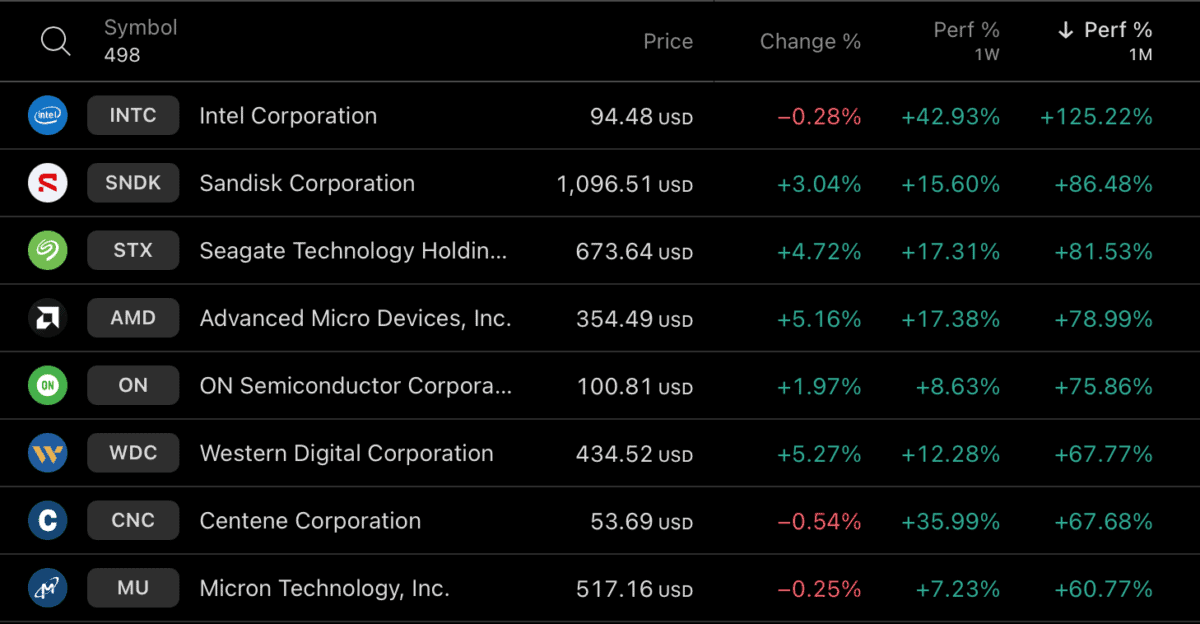
There’s been a key theme to the stock market – especially the S&P 500 – in April. Here’s a list of the top-performing stocks:
Source: TradingView
I think this is a really interesting list. The obvious connection is (AI) but there’s something else a lot of these names have in common.
Memory and storage are – ordinarily – pretty homogeneous products. But they’ve been boosted by the surge in AI data centres.
From an investment perspective, that raises a question of what happens when things cool off. And I’m wary about this.
Intel, though, is a trickier proposition. There’s a credible case for thinking that the shift from building AI models to using them could generate lasting demand.
Inferencing
This is the view of Intel’s CEO Lip-Bu Tan. And there are reasons for thinking Intel’s CPUs might be preferable to Nvidia’s GPUs when it comes to inferencing.
Building AI models needs chips that are fast. And GPUs – with their ability to do multiple things at once – are well-suited to this.
By contrast, using them requires chips that can have a lot of memory. And this is where Intel’s CPUs are more valuable and useful.
There’s also another big advantage. It’s significantly cheaper to maintain a server with CPUs than GPUs that ned to be liquid-cooled.
Given this, there’s a genuine case to be made for Intel that isn’t just about short-term demand. And that’s before getting into the firm’s foundry business, which has made huge progress.
Intel has gone from struggling to crack 7nm manufacturing to competing with its 18A and 14A lines. As a result, it’s a meaningful competitor again.
Can it continue?
There are real reasons for thinking that Intel is moving past its struggles over the last few years. And this is more than just benefiting from AI spending.
One thing I’ve learned, though, is the semiconductor industry is tough. It’s highly technical and this makes assessing competitive strength extremely hard.
Having seen how quickly things can change, I’m very wary about buying the shares. So I’m focusing on more obvious and compelling opportunities.