
Are Lloyds or Aviva shares the greatest FTSE 100 bargain?

Lloyds is regularly celebrated as one of the FTSE 100’s best value shares. But is it really a better discount buy than big-yielding Aviva?

| More on:

The content of this article was relevant at the time of publishing. Circumstances change continuously and caution should therefore be exercised when relying upon any content contained within this article.

Young black man looking at phone while on the London Overground

Image source: Getty Images

You’re reading a free article with opinions that may differ from The Motley Fool’s Premium Investing Services. Become a Motley Fool member today to get instant access to our top analyst recommendations, in-depth research, investing resources, and more. Learn More.

Lloyds Bank (LSE:LLOY) and Aviva (LSE:AV.) shares look like brilliant bargains at current prices.
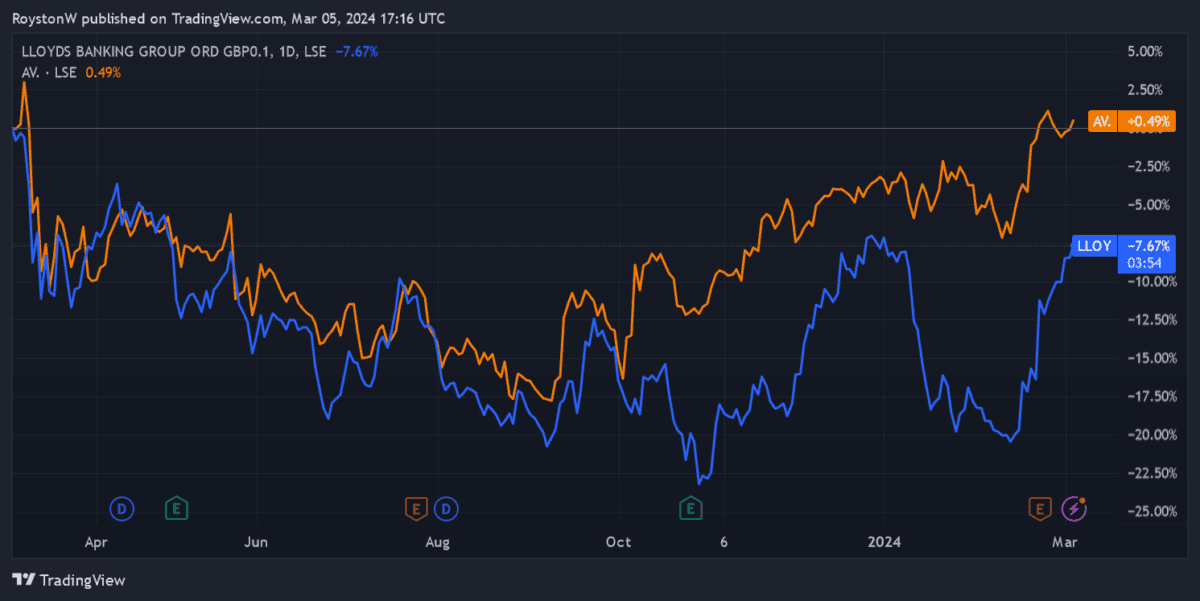
Lloyds and Aviva's share price performance.
Lloyds and Aviva’s share price performance over a 12-month period. Source: TradingView

But which is the better value stock for me to buy today? I’ll be using three key measures to assess this: the price-to-earnings (P/E) ratio; the price-to-book (P/B) ratio; and the dividend yield.

P/E ratio

Largely speaking, UK shares currently look attractively priced from an historical perspective. The FTSE 100 currently boasts an average forward P/E ratio of 10.5 times. This is well below the traditional average around 16 times.

That said, Aviva shares don’t look massively cheap today. Its earnings multiple for 2024 sits at 10.9 times, just above today’s Footsie average.

Lloyds shares, on the other hand, look far more attractive on this metric. They trade on a multiple of 8 times, some distance below that of the life insurer and the broader index.

Aviva 0: Lloyds 1

P/B ratio

Next we’ll look at how both shares look relative to the value of their assets. Their readings can be seen in the chart below:
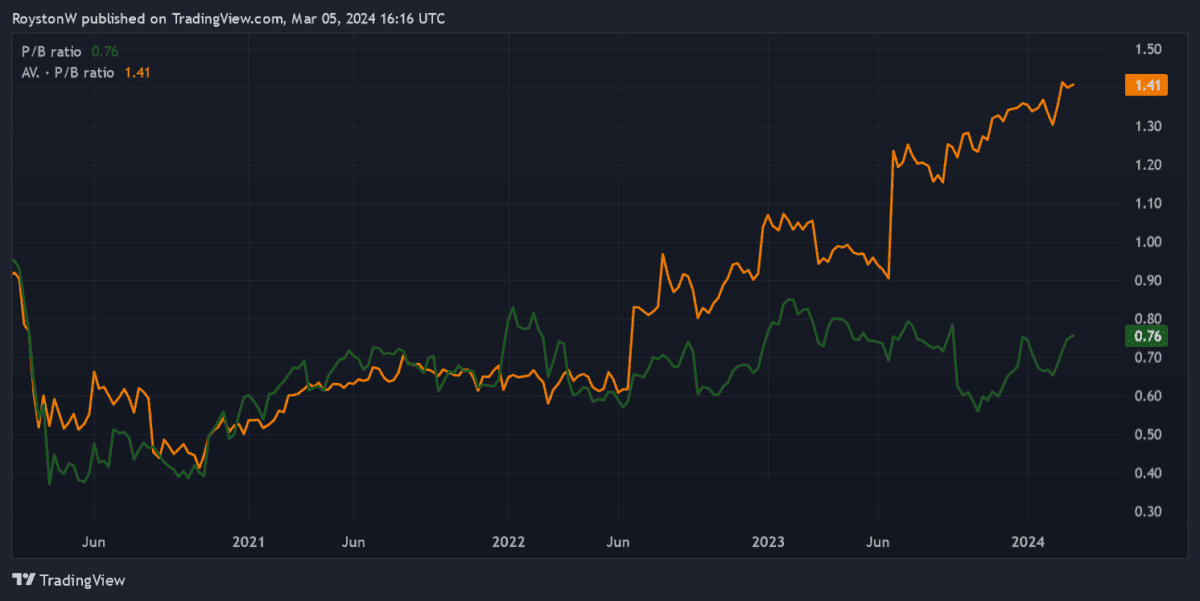
The price-to-book (P/B) ratios of Lloyds and Aviva shares.
Source: TradingView

As you can see, Lloyds carries a P/B ratio of 0.76. This falls well below Aviva’s reading of 1.41. And, critically, this falls below the threshold of 1 that indicates a share is undervalued.

Aviva 0: Lloyds 2

Dividend yield

Both Footsie companies have strong records of delivering above-average dividends. The regular premiums it collects allows Aviva to pay consistently large rewards to its customers. Lloyds meanwhile, can do the same thanks to the interest it receives on the loans it supplies.

The forward dividend yields for both shares beat the FTSE average of 3.8%. However, Aviva’s reading of 7.9% tops Lloyds’ corresponding figure of 6.4%.

While dividends are never guaranteed, both businesses look in good shape to make good on these forecasts. Lloyds has strong dividend cover (1.9 times) for 2024, while it also has a strong balance sheet (CET1 capital ratio stood at 13.7% as of December).

Aviva is also cash rich and boasted a Solvency II ratio of 202% at the mid-point of 2023. Its dividend cover sits back at 1.2 times though, I still expect it to meet current forecasts.

Aviva 1: Lloyds 2

The verdict

Based on the metrics discussed, Lloyds shares top those of Aviva in the value stakes. In fact, it may look like a slam dunk buy given its cheapness relative to the life insurance giant and the broader FTSE 100.

But I’d be reluctant to buy the Black Horse Bank for my portfolio today. Both companies face significant risks as the UK economy struggles and competition heats up in their marketplaces. But Lloyds faces a greater struggle to grow earnings in the future, in my opinion.

And the market agrees with my take, hence its lower valuation.

I actually believe that Aviva’s profits could rise strongly in the years ahead. Like many other protection and retirement product specialists, revenues could rip higher as Britain’s elderly population rapidly grows.

Furthermore, the company — unlike Lloyds — has a significant presence in overseas markets that could help it grow earnings, even if conditions in the UK remain tough.

While Lloyds looks like better value, I’d much rather buy more Aviva shares right now.

Royston Wild has positions in Aviva Plc. The Motley Fool UK has recommended Lloyds Banking Group Plc. Views expressed on the companies mentioned in this article are those of the writer and therefore may differ from the official recommendations we make in our subscription services such as Share Advisor, Hidden Winners and Pro. Here at The Motley Fool we believe that considering a diverse range of insights makes us better investors.

More on Investing Articles

Ice cube tray filled with ice cubes and three loose ice cubes against dark wood.
Investing Articles

Recently released: December’s lower-risk, higher-yield Share Advisor recommendation [PREMIUM PICKS]

Ice ideas will usually offer a steadier flow of income and is likely to be a slower-moving but more stable…

Read more »

Sunrise over Earth
Investing Articles

Meet the ex-penny share up 109% that has topped Rolls-Royce and Nvidia in 2025

The share price of this investment trust has gone from pennies to above £1 over the past couple of years.…

Read more »

House models and one with REIT - standing for real estate investment trust - written on it.
Investing Articles

1 of the FTSE 100’s most reliable dividend stocks for me to buy now?

With most dividend stocks with 6.5% yields, there's a problem with the underlying business. But LondonMetric Property is a rare…

Read more »

Investing Articles

Is 2026 the year to consider buying oil stocks?

The time to buy cyclical stocks is when they're out of fashion with investors. And that looks to be the…

Read more »

ISA coins
Investing Articles

3 reasons I’m skipping a Cash ISA in 2026

Putting money into a Cash ISA can feel safe. But in 2026 and beyond, that comfort could come at a…

Read more »

US Stock

I asked ChatGPT if the Tesla share price could outperform Nvidia in 2026, with this result!

Jon Smith considers the performance of the Tesla share price against Nvidia stock and compares his view for next year…

Read more »

Investing Articles

Greggs: is this FTSE 250 stock about to crash again in 2026?

After this FTSE 250 stock crashed in 2025, our writer wonders if it will do the same in 2026. Or…

Read more »

Investing Articles

7%+ yields! Here are 3 major UK dividend share forecasts for 2026 and beyond

Mark Hartley checks forecasts and considers the long-term passive income potential of three of the UK's most popular dividend shares.

Read more »