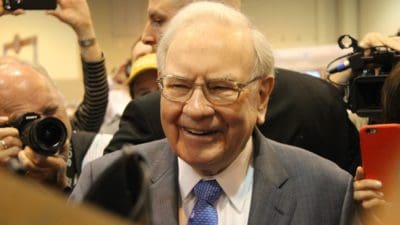
Charlie Munger might just be the unsung hero in the investing world. Don’t get me wrong, he is well known in his own right, it’s just that Warren Buffett tends to get most of the headlines. But if it wasn’t for Charlie Munger, Warren’s longstanding business partner at Berkshire Hathaway, then Buffett might not be the investor he is today.
This is because Charlie Munger influenced the hugely successful billionaire investor Buffett in a significant way. The best thing about it is that I can use the same investing trick that Charlie taught Warren all those years ago.
One more puff left in the cigar
Following in the footsteps of another famous investor in Benjamin Graham (often referred to as the father of value investing), Warren Buffett was a value investor in his earlier days. Value investing today can take many forms, but for Warren Buffett, it was often the case that he would look for beaten-down companies offering a ‘margin of safety’ – a company so cheap that it was selling for less than its intrinsic value. It didn’t matter what the long-term prospects were for the business as long as it was cheap and could be sold at a higher price in the near future: “one more puff left in the cigar,” as Warren Buffett referred to it once. In modern terminology, this type of investing is often referred to as ‘deep value’.
Now, Warren Buffett was brilliant at this, but admitted himself it was small scale and that it really didn’t build anything satisfying. Then Charlie Munger came along.
Charlie Munger, in the words of Warren Buffett, changed his views on investing towards focusing on quality companies that would work for 10 years, 20 years, or more. To quote Warren Buffett: “So he kept forcing me in the direction of saying ‘is this really a business that we want to own forever?’”
This is the philosophy that I took from the great Charlie Munger. It is captured in another one of Warren Buffett’s quotes: “It’s far better to buy a wonderful company at a fair price than a fair company at a wonderful price.”
Quality companies
I break this philosophy down into two components: first I want to buy and hold companies for the long term, but secondly, and most importantly, I make sure to look for quality companies.
So what makes a quality – or wonderful – company?
I look for two key characteristics. First is cash generation. A company must be generating cash from operations. But just as important is what the business is spending the generated cash on, and at what return to the business. For example, a business generating £1m in cash that is able to reinvest that cash at 20% consistently will be an excellent investment for a buy-and-hold investor like me.
This is where compounding really works its magic!
Metrics such as return on equity can help me gauge whether a company is quality or not. Buffett himself has been known to look for a high return on equity companies for his portfolio.
So without Charlie Munger, Berkshire Hathaway might not be the size it is today. Not because Warren Buffett isn’t a brilliant investor, but deep-value investing is hard to scale. There are only so many cigar butts out there to find!