
Is the Supply@ME Capital share price a bargain?

Supply@ME (LSE:SYME) shares have been very volatile over the past few months. But that’s not the only reason I don’t think this is a bargain stock to buy.

| More on:

The content of this article was relevant at the time of publishing. Circumstances change continuously and caution should therefore be exercised when relying upon any content contained within this article.

You’re reading a free article with opinions that may differ from The Motley Fool’s Premium Investing Services. Become a Motley Fool member today to get instant access to our top analyst recommendations, in-depth research, investing resources, and more. Learn More.

Blue question mark background and dark space

Image source: Getty Images

Supply@ME Capital (LSE:SYME) is a digitally native supply chain financing company. Any mention of supply chain financing rings alarm bells for me. Greensill Capital went bankrupt in March of this year; it provided supply chain financing. Before that, there was the collapse of Carillion. That time it was the company getting supply chain financing that ran into difficulties. 

That does not mean Supply@ME is destined for the same fate. Supply chain finance in itself was not the problem in either of these high profile bankruptcies. However, Supply@ME has a complicated business model and is financing unsold inventory, where traditional supply chain financing deals with invoiced sales. Supply@ME is also new to the stock market, having listed by way of a reverse takeover in April 2020. The UK’s financial regulator has only just allowed Supply@Me shares to trade again and seemingly given it a clean bill of health. But, I  am still approaching the stock with a high degree of caution.

How does Supply@ME make money?

It isn’t easy to get a handle on what Supply@ME does, but here is what I have been able to ascertain. Supply@ME owns shell companies that buy unsold inventory, be it raw materials or finished goods. Supply@ME packages the inventory purchases into securitised notes which it then sells to funders. The inventory sellers lease back the inventory, so it remains on their premises.
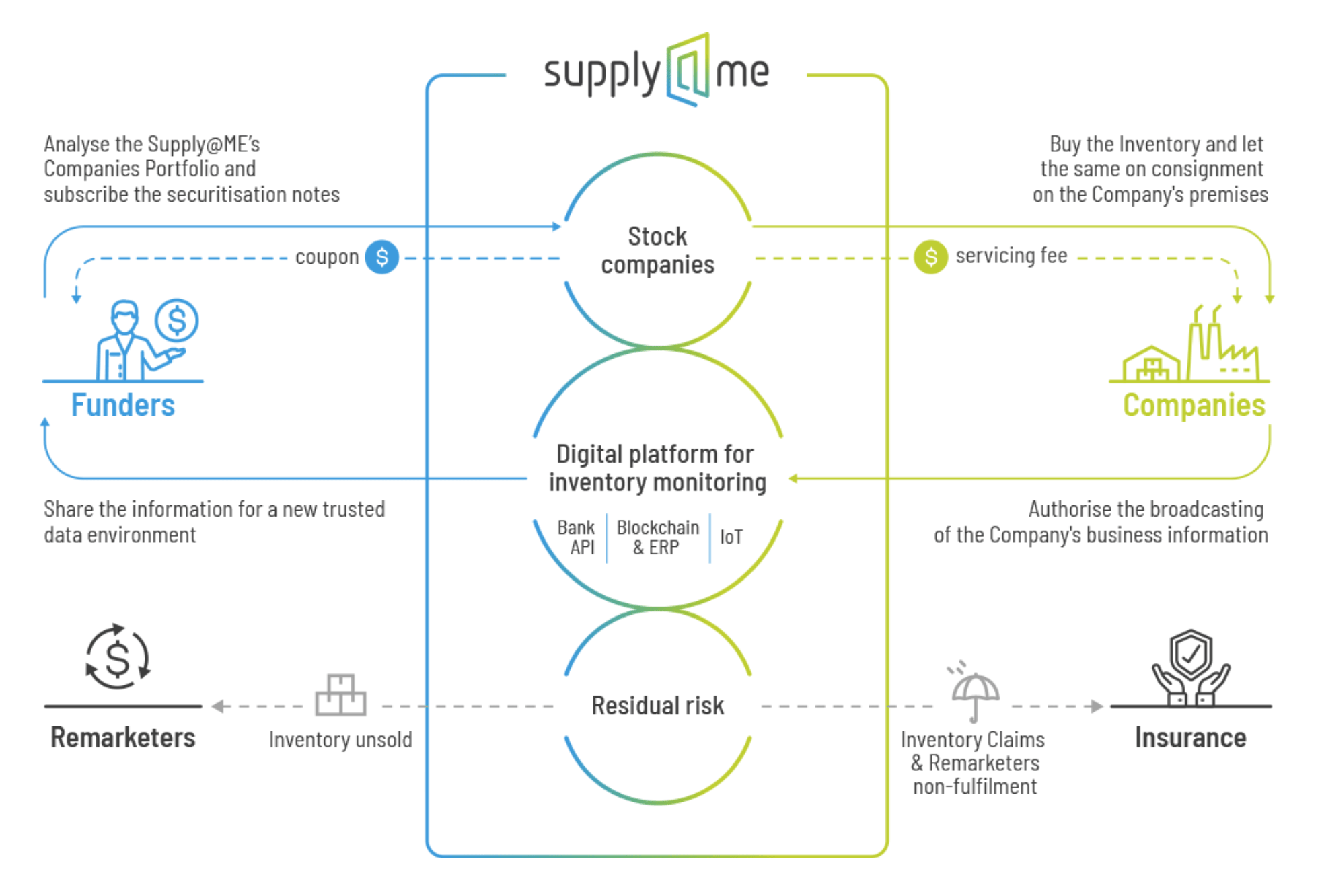
How Supply@ME Capital makes money

Source: Supply@ME Annual Report

The companies that sold the inventory to Supply@ME can repurchase it slowly, with a markup, presumably to make an actual sale to a customer themselves. Remarketers will be used if inventory remains unsold, presumably on behalf of Supply@ME. Insurance claims will be relied upon if the remarketers fail.

If this all sounds complicated, it’s because it is. And it’s going to get more complex.

Supply@ME share price

Supply@ME has acquired TradeFlow Capital Management. This Singapore-based outfit uses a fund type structure to provide non-credit financing to commodities companies with goods in transit or storage.

The acquisition was a cash and stock deal. A £5.6m issue of convertible loan notes in June 2021 covered the cash part. The creation of around 1.48bn new Supply@ME capital shares, or around 5% of its existing share count, covered the stock part. There is the possibility of nine further tranches of notes being issued, which suggests the company is not done on the acquisition front.

Supply@ME is still loss-making — 2,964m in 2020 — but revenue grew sharply from £4m in 2019 to £1,147m in 2020. The number of client companies has more than doubled. But, one single company seems to be responsible for 6% of the total amount of inventory sales which is a worry. 

I don’t doubt there is demand out there for monetising unsold inventory, which Supply@ME will continue to tap. But I do not think the Supply@ME share price is a bargain. Its business model is tough to get to grips with. The design seems to be intended to prevent Supply@ME and its customers from being in a creditor-creditee relationship. Maybe that’s the point, but it leaves me unsure who is liable if inventory remains unsold and it cannot be insured, which is possible. I can see the possibility of financial difficulties and perhaps legal wrangles. I will not be buying this stock for my Stocks and Shares ISA.


James J. McCombie has no position in any of the shares mentioned. . The Motley Fool UK has no position in any of the shares mentioned. Views expressed on the companies mentioned in this article are those of the writer and therefore may differ from the official recommendations we make in our subscription services such as Share Advisor, Hidden Winners and Pro. Here at The Motley Fool we believe that considering a diverse range of insights makes us better investors.

More on Investing Articles

Young black colleagues high-fiving each other at work
Investing Articles

With a P/E ratio of 11, could buying this stock be like investing in Meta Platforms in 2022?

I think Adobe shares today look a lot like Meta stock in October 2022. Could this be another chance for…

Read more »

Investing Articles

Should I wait for the point of maximum panic to buy UK shares?

Harvey Jones is keen to buy cheap UK shares for his Self-Invested Personal Pension. But should he jump in now…

Read more »

Close-up image depicting a woman in her 70s taking British bank notes from her colourful leather wallet.
Dividend Shares

The dividend yield of these 2 income stocks just jumped almost 25%

Jon Smith points out an income stock he feels is attractive given the recent share price slump, but also outlines…

Read more »

Rolls-Royce Hydrogen Test Rig at Loughborough University
Investing Articles

As Rolls-Royce buys its own shares, should I buy more too?

Buying Rolls-Royce shares has been one of James Beard’s best decisions. But is it possible to have too much of…

Read more »

Portrait of pensive bearded senior looking on screen of laptop sitting at table with coffee cup.
Investing For Beginners

Down 43% in a month, what on earth’s going on with the Vistry share price?

Jon Smith points out why the Vistry share price is enduring a tough period, and provides his outlook for the…

Read more »

British pound data
Investing Articles

3 UK stocks experts believe will crash and burn in 2026!

These are the most heavily shorted UK stocks in March 2026, with institutional investors projecting catastrophe. Should shareholders be worried?

Read more »

Queen Street, one of Cardiff's main shopping streets, busy with Saturday shoppers.
Investing Articles

£5,000 invested in B&M shares at the start of 2026 is now worth…

After years of catastrophic decline, B&M shares are starting to bounce back, firmly beating the stock market in 2026 so…

Read more »

Aviva logo on glass meeting room door
Investing Articles

Aviva shares now yield 6.6%. Time to consider buying?

The dividend yield on Aviva shares is currently at a very attractive level. Could the insurer be a great source…

Read more »