Share your opinion and earn yourself a free Motley Fool premium report!

We are looking for Fools to join a 75 minute online independent market research forum on 15th / 16th December.

To find out more and express your interest please click here

Does buying dips in the FTSE 100 beat regular investing?

It has been said that time in the market beats trying to time the market, but is it true?

The content of this article was relevant at the time of publishing. Circumstances change continuously and caution should therefore be exercised when relying upon any content contained within this article.

You’re reading a free article with opinions that may differ from The Motley Fool’s Premium Investing Services. Become a Motley Fool member today to get instant access to our top analyst recommendations, in-depth research, investing resources, and more. Learn More.

The FTSE 100 dropped over 3% yesterday. Today it is down by another percentage point. In times like these, the question of whether buying dips in the market beats regular investing often gets asked. The answer may appear obvious. After all, buying dips means buying cheap. Regular investing could mean buying just before a dip or when the market is expensive. Should investors not aim to buy low and sell high?

A strategy of buying low and selling high makes intuitive sense, especially when we look at the performance of the FTSE 100 index.
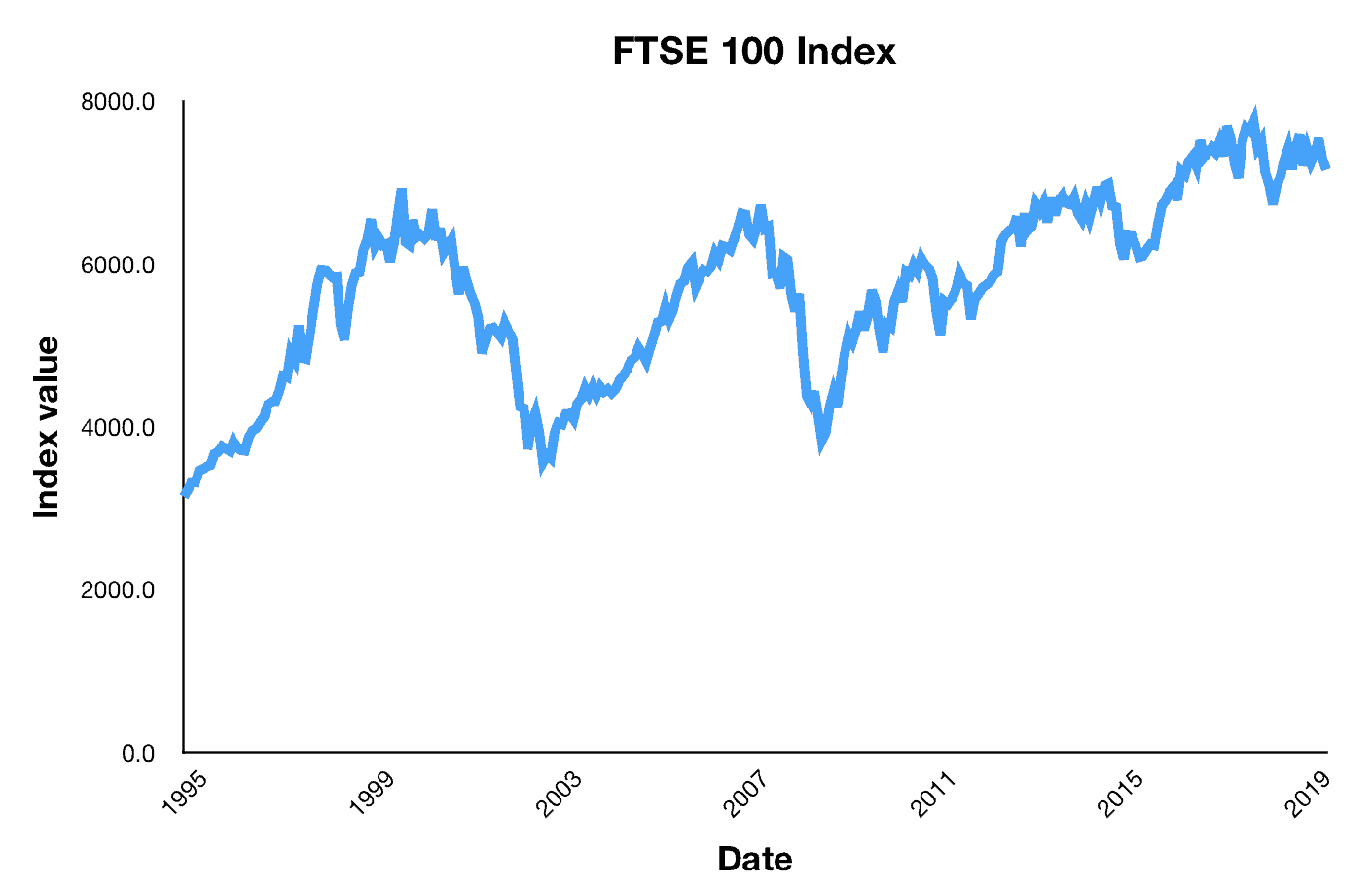
But the chart above shows the price of the index only. It does not account for the dividends that are paid by the companies in the index. The average annual dividend yield on the FTSE 100 from June 1993 to November 2018 was 3.47% or about 0.28% per month.

An investor in the FTSE 100 will receive these dividends if they buy all 100 stocks themselves or a fund that tracks the index. If dividends are being reinvested then the performance of the investment will not look like the chart above.

Dipping in

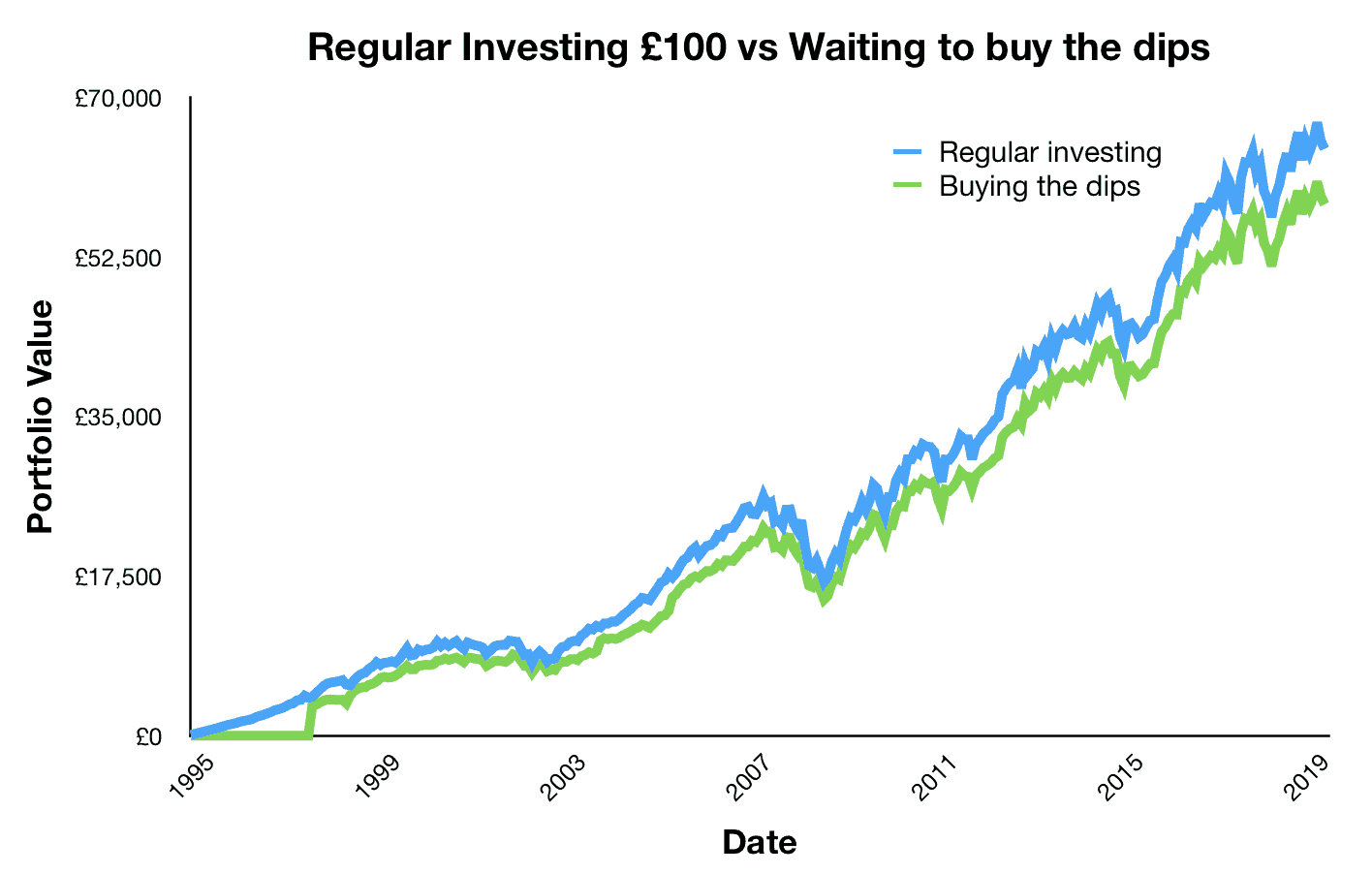
Let’s compare the two strategies. First, we will invest £100 every month in the FTSE 100 starting in March 1995 and finishing in January 2020. Second, we will look at a strategy of investing after the price of the FTSE 100 has fallen at least 5% in a month. To keep the total invested amounts similar, in the second strategy, £100 is either invested or banked until the index has fallen by 5%.

In total of £29,800 gets invested buying the dips and £30,000 in regular investments over the 25 or so years. How about the performance of the two strategies? Well, the regular investor ends up with £64,359 compared to £58,270 for the dip buyer. 
Along for the ride

Of the two strategies, regular investing comes out on top. The message is clear, don’t wait to buy the dip, just keep investing. The more time you are in the market, the more your money grows, assuming dividends are being paid and reinvested. The more you try to time the market, the less time your money has to grow.

I used data for the entire FTSE 100 for this exercise. There are some stocks that have higher dividend yields than the 3.47% average, so a diversified portfolio of those could have done even better.

Also bear in mind that this experiment was carried out with 25 years of monthly returns. The longer your investment time horizon, the more likely you are to do well. Looking back over the FTSE 100 price chart should make this point clear. If you only had two or three years to invest and you started around 1999 or 2007 you would have done badly. Long-term investing is the key to success.


Views expressed on the companies mentioned in this article are those of the writer and therefore may differ from the official recommendations we make in our subscription services such as Share Advisor, Hidden Winners and Pro. Here at The Motley Fool we believe that considering a diverse range of insights makes us better investors.

More on Investing Articles

Thoughtful man using his phone while riding on a train and looking through the window
Investing Articles

Here’s how much passive income someone could earn maxing out their ISA allowance for 5 years

Christopher Ruane considers how someone might spend a few years building up their Stocks and Shares ISA to try and…

Read more »

Man putting his card into an ATM machine while his son sits in a stroller beside him.
Investing Articles

Was I wrong about Barclays shares, up 196%?

Our writer has watched Barclays shares nearly triple in five years, but stayed on the sidelines. Is he now ready…

Read more »

Wall Street sign in New York City
Investing Articles

Up 17% in 2025, can the S&P 500 power on into 2026?

Why has the S&P 500 done so well this year against a backdrop of multiple challenges? Our writer explains --…

Read more »

National Grid engineers at a substation
Investing Articles

National Grid shares are up 19% in 2025. Why?

National Grid shares have risen by almost a fifth this year. So much for it being a sleepy utility! Should…

Read more »

Road 2025 to 2032 new year direction concept
Investing Articles

Here are the potential dividend earnings from buying 1,000 Aviva shares for the next decade

Aviva has a juicy dividend -- but what might come next? Our writer digs into what the coming decade could…

Read more »

Person holding magnifying glass over important document, reading the small print
Investing Articles

Just released: our top 3 small-cap stocks to consider buying in December [PREMIUM PICKS]

Small-cap shares tend to be more volatile than larger companies, so we suggest investors should look to build up a…

Read more »

This way, That way, The other way - pointing in different directions
Investing Articles

Is the unloved Aston Martin share price about to do a Rolls-Royce?

The Aston Martin share price has inflicted a world of pain on Harvey Jones, but he isn't giving up hope…

Read more »

Surprised Black girl holding teddy bear toy on Christmas
Investing Articles

How much do you need in a Stocks and Shares ISA to raise 1.7 children?

After discovering the cost of raising a child, James Beard explains why he thinks a Stocks and Shares ISA is…

Read more »