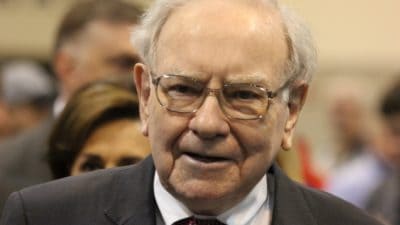
Look at Warren Buffett – probably the world’s most successful investor, ever – and it’s not difficult to see sharp distinctions between him and the average private investor.
Such as? Well, you might be thinking of his track record. Or his wealth. Or his canny knack for dispensing nuggets of investing wisdom in simple, commonsense terms.
I’m not thinking of those, however.
Instead, I’m thinking of a sharper distinction, and one that cuts right to the heart of the superior investing performance that Buffett has displayed for over 50 years.
Mumbo jumbo
Many of the private investors with whom I chat, or whose posts I read on online discussion boards, talk about buying or selling ‘shares’.
Such-and-such a share is at the lower end of its historic trading range, for example. Or that such-and-such a share might be at a breakout point. Or that such-and-such a share has a binary outcome, which they are protecting against with stop losses.
Yet investors trawling through Buffett’s annual letters to his shareholders, or reading transcripts of his various interviews and speeches will rarely find such language.
And for a very good reason: it’s largely foreign to his approach.
You sell low; Buffett buys
In fact, I’d probably go further than that.
By definition, there’s an investor on the other side of every one of Buffett’s trades, buying or selling.
And with studies showing that private investors have an alarming tendency to buy high and sell low – and at just the wrong time – I suspect that, more often than not, Buffett is profiting from trading with those very people who think in terms of breakout points, stop losses, trading ranges and all the rest of it.
So how does Buffett look at investments?
Take a look at these well-known Buffett quotes, which you’ve probably come across before:
“It’s far better to buy a wonderful company at a fair price than a fair company at a wonderful price.”
“When we own portions of outstanding businesses with outstanding managements, our favourite holding period is forever.”
“I try to buy stock in businesses that are so wonderful that an idiot can run them – because sooner or later, one will.”
“After 25 years of buying and supervising a great variety of businesses, Charlie and I have not learned how to solve difficult business problems. What we have learned is to avoid them.”
In each case, Buffett isn’t talking about buying ‘shares’, in the abstract. Instead, he’s talking about buying businesses. Real companies, managed by real people, making and selling real products.
Short-term versus long-term
And to drive the point home, now think about some of those other well-known Buffett quotes that you’ve almost certainly come across before.
About the importance of investing in businesses with strong defensive moats, for instance. Or about the difference between value and price. Or about the importance of buying into businesses that you can understand, and on which you can make sensible judgements.
In each case, Buffett is sharply differentiating between trading shares, and investing.
The trader is buying and selling pieces of paper – shares – hoping that a long series of such trades will build wealth.
The investor – to use one of Buffett’s favourite analogies – is instead taking a long-term stake in a business that he or she hopes will consistently grow its sales, profits, earnings per share, and dividends.
It’s no secret
Put another way, the investor needs to think of themselves as being what they actually are: a part-owner in a business.
In other words, behind that share certificate, or that online brokerage holding, is a real company. And as its prospects and value grow, so do those of the investors who are invested in it.
In Buffett’s eyes, it really is that simple: pick strong, durable, cash-generative, profitable and growing businesses – and buy and hold those companies over the long term.
And it’s not a secret. Anyone can do it.
Limits to knowledge
That said, picking those companies is the tricky part.
And even Buffett has made mistakes.
But again, he has some advice for ordinary investors like you and me. And contrary to what some people think Buffett says, it’s not quite as simple as ‘stick to what you know’.
Instead, it’s perhaps better encapsulated as ‘know what you don’t know, and don’t think that you know more than you do’.
Or, as the man himself puts it:
“What an investor needs is the ability to correctly evaluate selected businesses. Note that word ‘selected’: You don’t have to be an expert on every company, or even many. You only have to be able to evaluate companies within your circle of competence. The size of that circle is not very important; knowing its boundaries, however, is vital.”