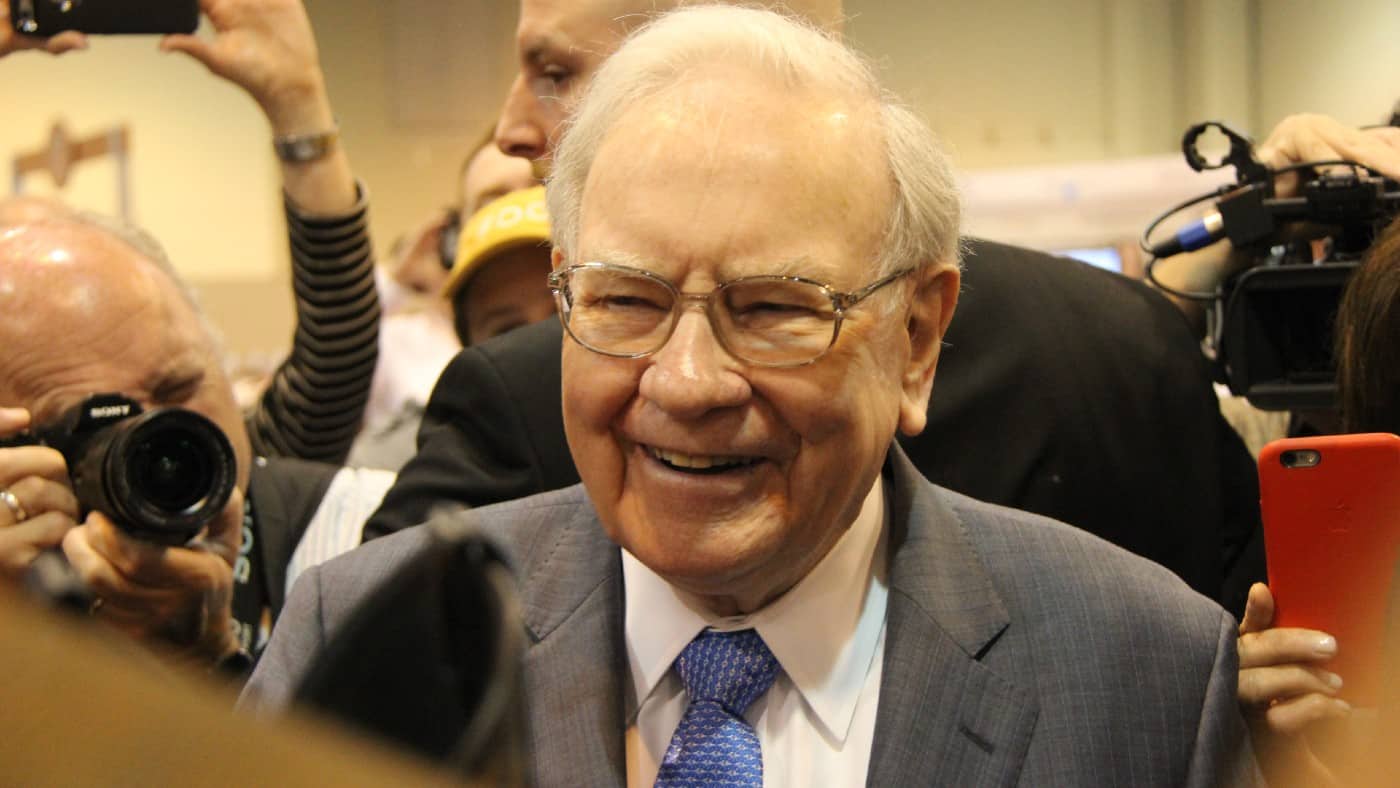
Warren Buffett’s investing journey is legendary and turned the ‘Oracle of Omaha’ into one of the world’s richest billionaires.
But to achieve financial freedom today, investors only need to build a fraction of this treasure hoard. And by following in Buffett’s footsteps, even a modest £500 monthly investment is all that’s needed to build a seven-figure net worth. Here’s how.
Buffett’s winning investment formula
Rather than chasing the latest trends or pursuing the biggest growth opportunities, Buffett chose a simpler path. He focused exclusively on finding the highest quality companies trading at a discount to their intrinsic value in industries he understood perfectly.
Even in boring sectors, tremendous buying opportunities can emerge for long-term investors who stay focused and patient while everyone else chases the hype in an attempt to get rich quick.
As Buffett puts it: “Time is the friend of the wonderful company, the enemy of the mediocre”. By investing in the boring businesses that possess a moat of durable competitive advantages that allow them to reinvest cash flows at high rates of return, the compounding process can be drastically accelerated.
This is how Buffett achieved a 19.8% average annualised return over the long run. By comparison, the S&P 500 has generated a long-term average total return of 10.6% a year – almost half.
In terms of money, investing £500 a month for 30 years at Buffett’s rate of return unlocks £10.9m of generational wealth versus the £1.3m achieved by the US stock market.
Another victorious Buffett stock pick
The billionaire investor has made plenty of massively successful investments over the course of his career, including in Coca-Cola and American Express. But another lesser-known victory is his investment in Moody’s (NYSE:MCO).
The company is a perfect example of Buffett’s moat-driven long-term strategy in action. The financial services company operates as a near-invisible duopoly, generating enormous cash flows from issuing credit ratings every time a government, company, or bank wants to borrow money by issuing bonds.
In other words, the company is a toll booth to the public debt markets that’s virtually unavoidable. Buffett recognised this unassailable advantage decades ago. And since he first inherited shares in October 2000 following a spin-off, his decision not to sell has delivered close to a 4,200% total return.
With that in mind, it’s no wonder his successor at Berkshire Hathaway, Greg Abel, has described Moody’s as a “forever” holding.
Still worth buying?
Today, Moody’s continues to rake in enormous credit rating fees. But the company has also diversified its revenue stream through data & risk analytics software solutions to generate even more predictable and recurring income.
Buffett’s thesis remains intact. And with additional expansion within the private credit market emerging, Moody’s days as a boring quality compounder look far from over.
Of course, that doesn’t make it risk-free. The emergence of powerful and cheap AI tools could disrupt its newer analytics arm. And its core ratings business is also subject to enormous cyclicality since demand for debt can vary significantly during periods of economic or geopolitical uncertainty.
Nevertheless, for investors seeking a Buffett-style quality compounder, Moody’s shares could definitely be worth a closer look.