
The UK stock market is home to the world’s first listed SpaceTech investment company. And with the space economy attracting a huge amount of interest at the moment, it could be well placed to take advantage of a 21st century space race.
However, its shares trade at a 20% discount to the fund’s net asset value. Is this a buying opportunity to consider, or is it a sign that investors remain to be convinced? Let’s see.
The first of its kind
The Seraphim Space Investment Trust (LSE:SSIT) describes itself as the “most prolific” SpaceTech investor globally. At 30 September 2025, it valued its portfolio at £284m. However, things are moving fast. During the last quarter of 2025, it reported that its top four holdings had increased in value by £69m.
But therein lies a problem. It’s difficult valuing companies whose shares are not publicly traded.
Most of the trust’s holdings are in private businesses, all of which are viewed as having the potential to “dominate globally and are category leaders with first mover advantages in areas such as global security, cybersecurity, food security, climate change and sustainability”.
Valuations are usually based on the latest funding round, which is standard practice in the industry.
The trust categorises its investments as either unicorns (valued over $1bn), soonicorns, minicorns, or seedcorns. Many of these are start-ups. And sometimes, there can be lots of hype surrounding these types of companies, which can lead to optimistic valuations and plenty of risk.
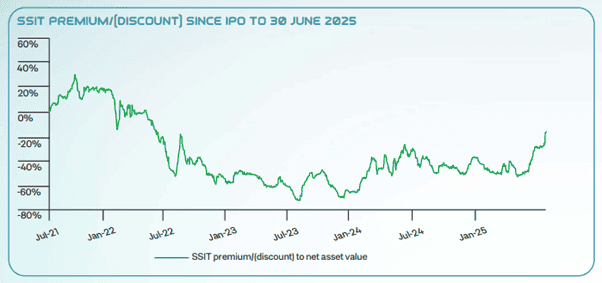
This probably explains why the trust’s shares are trading at a 20% discount (at 20 February) to its net asset value. I suspect investors are being a little cautious. But the gap’s starting to close. For a short while after its IPO in July 2021, the stock traded at a premium.
Huge growth
This could be a sign that the space business is becoming increasingly fashionable.
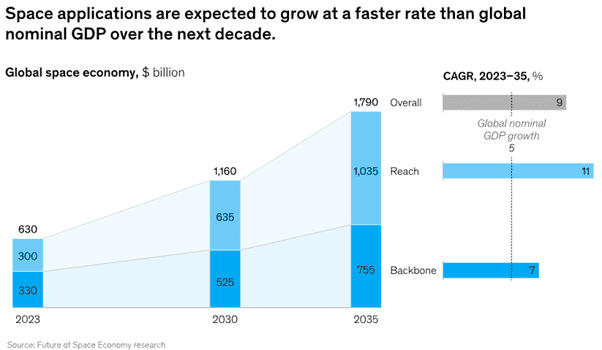
Indeed, McKinsey & Company forecasts that the global space economy will be worth $1.8trn by 2035, with ‘reach’ applications (those helping companies across a wide range of industries to generate more revenue) outperforming ‘backbone’ solutions (for example, satellites, launchers, and GPS).
Diversification’s key
Personally, I’m excited by the possibilities of space. And by taking a position in Seraphim Space Investment Trust, it’s possible to have exposure to a number of companies in different countries operating in a variety of sub-sectors, which helps spread risk.
For example, the trust’s top three holdings are based in Finland, Italy and the UK. And they comprise the owner of the world’s first and largest constellation of miniaturised satellites, the market leader in space logistics, and a developer of an antenna capable of connecting to any satellite in any constellation in any orbit.
Inevitably, with many companies in their infancy, not all will succeed. But it only takes a few to do well and the trust’s share price could take off.
I also like the fact that the trust’s most recently published balance sheet — at 30 June 2025 – shows no debt. And it had £21.5m of cash.
For these reasons, I think it’s a great stock to consider.