
According to data from Bank of America, hedge fund managers think the most likely cause of a stock market crash is inflation. This seems plausible to me, but what can investors do about it?
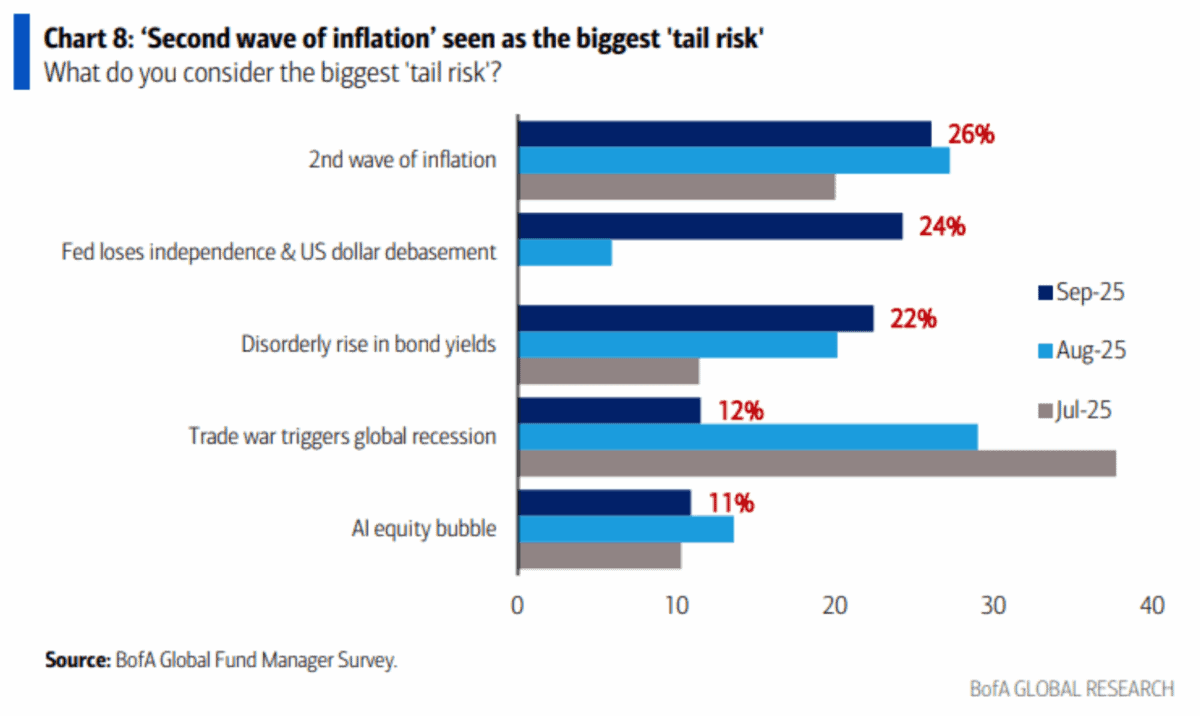
Source: Hedge Fund Tips
I own Diageo (LSE:DGE) shares in my portfolio and I think inflation’s one of the biggest issues for the company right now. But there are a few strategies available to me to offset the risk.
Hedging
Hedging involves buying something that’s likely to go up if share prices fall sharply. Exactly what that is might depend on what causes the stock market to crash.
One way of doing this is via the options market. I could either buy put options on Diageo shares directly, or I could look to bet against inflation more generally by shorting government bonds.
This though, is risky. Options have expiry dates, which means they become worthless (resulting in a loss) if the perceived threat doesn’t materialise in time.
As a way of avoiding losing money then, hedging via the options market doesn’t seem to be ideal. Fortunately, there are other strategies available to investors.
Selling
A more direct strategy involves selling in anticipation of a big downturn. This is relatively inexpensive in terms of costs, but it’s also a risky strategy.
With Diageo, I think the firm has a strong long-term position based on its scale and its portfolio of industry-leading brands. But I don’t have a view on when the share price will reflect this.
In the case of the stock market more generally, share prices often rebound strongly after a crash. This happened earlier this year when the S&P 500 recovered its April losses within a month.
The risk with selling ahead of an expected downturn is therefore also risky. Investors who get it wrong are in danger of having to buy back in at higher prices and lowering their overall returns.
Holding
My preferred plan with the stock is to wait it out. It’s a business I want to be invested in for the long term, so I don’t want to sell it and risk the share price going up instead of down.
The strength of Diageo’s brands is reflected in its unit economics. Even during a relatively difficult period, the firm has consistently achieved operating margins above 20%.
On top of this, the stock comes with a 4.3% dividend yield that’s reasonably well covered by free cash flows. So if the share price does fall, investors still get paid to wait it out
Diageo has been under pressure for some time. Despite this, I’ve been adding to my investment gradually and I plan to hold it through an inflation-induced crash, if one materialises.
Final thoughts
Whether it’s an individual stock or the market as a whole, being forced to sell at the wrong time is the way to lose money in a crash. That’s exactly what I’m looking to avoid.
Doing this involves getting myself into a situation where I have enough cash to cover any expenses without having to sell shares. That’s what makes waiting possible.
This is something that needs to be done in advance. It’s a necessary condition of holding on to investments for the long term and it’s also my plan for dealing with a stock market crash.