
Forget Cash ISAs! Here’s why I’m putting most of my money in UK shares

Subscriptions to Cash ISAs and Stocks and Shares ISAs have soared. But putting too much money in low-risk accounts could be a costly error.

| More on:

The content of this article was relevant at the time of publishing. Circumstances change continuously and caution should therefore be exercised when relying upon any content contained within this article.

ISA coins

Image source: Getty Images

When investing, your capital is at risk. The value of your investments can go down as well as up and you may get back less than you put in.

Read More

The content of this article is provided for information purposes only and is not intended to be, nor does it constitute, any form of personal advice. Investments in a currency other than sterling are exposed to currency exchange risk. Currency exchange rates are constantly changing, which may affect the value of the investment in sterling terms. You could lose money in sterling even if the stock price rises in the currency of origin. Stocks listed on overseas exchanges may be subject to additional dealing and exchange rate charges, and may have other tax implications, and may not provide the same, or any, regulatory protection as in the UK.

You’re reading a free article with opinions that may differ from The Motley Fool’s Premium Investing Services. Become a Motley Fool member today to get instant access to our top analyst recommendations, in-depth research, investing resources, and more. Learn More.

The government has released its latest annual data on Individual Savings Accounts (ISAs). And broadly speaking, it’s shown a rise in the number of subscriptions to these tax-efficient savings and investment products.
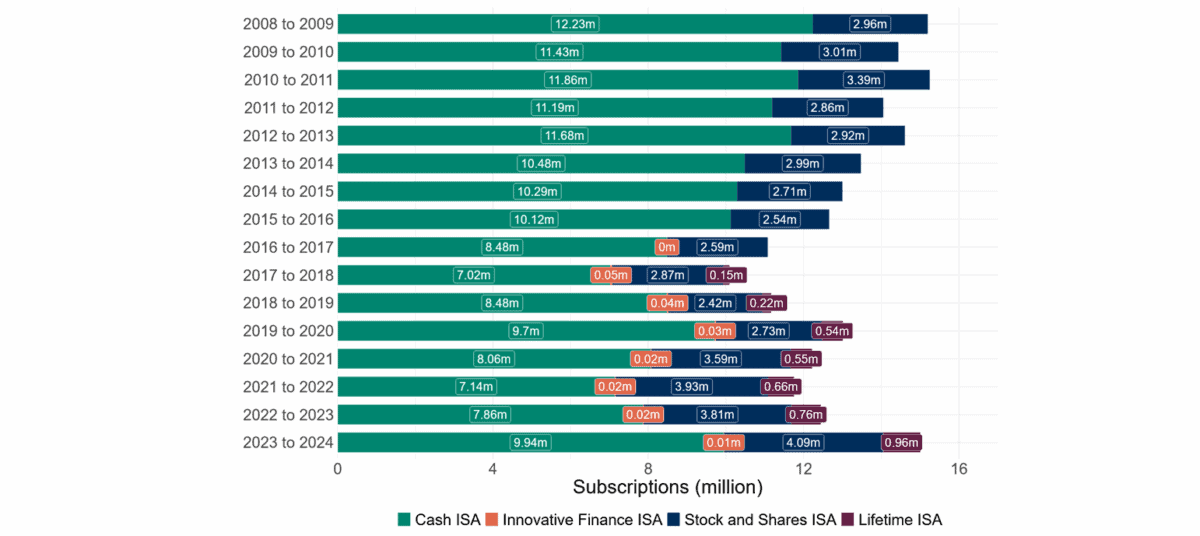
Annual subscriptions grew for Cash ISAs, Stocks and Shares ISAs and Lifetime ISAs
Source: HM Revenue and Customs

Subscriptions to Cash ISAs spiked 26% in the 2023/24 tax year, according to HMRC. Stocks and Shares ISA subscriptions rose 7%, while Lifetime ISA subscriptions leapt 27%.

A whopping £69bn was held in Cash ISAs in 2023/24 compared to £31bn in Stocks and Shares ISAs. Given their simplicity and safety, the popularity of these cash products is obvious.

But prioritising the Cash ISA as part of one’s investing strategy could be an expensive mistake over the long term. And especially with interest rates tipped to fall further over the next 12 months.

Here’s why I think an investing ISA could be a better way to consider building wealth for retirement.

Spreading things out

I hold one of each of the ISAs I’ve described. I have cash in a Cash ISA and a Lifetime ISA to manage risk across my portfolio. The former gives me access to emergency cash as and when I need it. The latter gives me a handy 25% government top-up for my contributions (which can total £4,000 a year).

These products save me from paying tax on any interest. The problem, however, is that on their own, they’re unlikely to make me enough money to eventually retire comfortably.

Please note that tax treatment depends on the individual circumstances of each client and may be subject to change in future. The content in this article is provided for information purposes only. It is not intended to be, neither does it constitute, any form of tax advice. Readers are responsible for carrying out their own due diligence and for obtaining professional advice before making any investment decisions.

This is why the lion’s share of my extra cash at the end of the month goes in my Stocks and Shares ISA and/or my Self-Invested Personal Pension (SIPP). Within these products I hold a range of shares, trusts, and funds. And like those other ISAs, I enjoy enormous tax benefits (i.e., shelter from capital gains and dividend tax).

Wealth gap

With a Stocks and Shares ISA, I can realistically target an average annual return of roughly 9%, historical data shows. With a Cash ISA, I’m more likely to make a return closer to 1%.

The power of compounding means the growth potential of both accounts is enormous. The cash account would turn £500 a month saved over 25 years into £170,335. The investing account, on the other hand, would generate a significantly greater £560,561.

Okay, buying shares involves greater risk than putting money in a cash account with a guaranteed return. But investors can effectively manage the risk to their money with a diversified portfolio of companies spanning regions and sectors.

They can also buy shares that operate in defensive industries like utilities, consumer staples, healthcare, and telecoms. These can limit portfolio volatility and provide a stable return over time.

A top stock

United Utilities (LSE:UU.) is one such share that can help investors effectively manage risk.

The business provides water and wastewater services in the North West of England, a highly supervised industry that creates regulatory risks. But the essential role the FTSE 100 company provides means it enjoys predictable earnings across the economic cycle and the means to consistently pay large dividends.

Through a mix of capital gains and dividends, United Utilities has delivered an average annual return of roughly 7% since 2015. That’s higher than the 1% that Cash ISAs have provided over the period, and could be a great stock to consider for building long-term wealth.



Should you invest, the value of your investment may rise or fall and your capital is at risk. Before investing, your individual circumstances should be assessed. Consider taking independent financial advice.

Royston Wild has no position in any of the shares mentioned. The Motley Fool UK has no position in any of the shares mentioned. Views expressed on the companies mentioned in this article are those of the writer and therefore may differ from the official recommendations we make in our subscription services such as Share Advisor, Hidden Winners and Pro. Here at The Motley Fool we believe that considering a diverse range of insights makes us better investors.

More on Investing Articles

Passive income text with pin graph chart on business table
Investing Articles

I asked ChatGPT, Gemini, and Claude for the best passive income stock to buy

ChatGPT came up with a very interesting name when Stephen Wright asked for passive income ideas. But is it the…

Read more »

Thoughtful man using his phone while riding on a train and looking through the window
Investing Articles

This growth stock down 50% reminds me of Netflix in 2009

Netflix has been one of the best growth stocks of the past two decades. This writer sees some similarities in…

Read more »

Mother At Home Getting Son Wearing Uniform Ready For First Day Of School
Investing Articles

Lloyds’ share price: with £1 in sight, is it time for cheer or fear?

As the Lloyds shares price continues to hit record highs, there could be trouble on the horizon. Mark Hartley considers…

Read more »

DIVIDEND YIELD text written on a notebook with chart
Investing Articles

9% yield! But is a huge dividend a big problem for this FTSE 250 stock?

Taylor Wimpey was relegated to the FTSE 250 earlier this year. And Stephen Wright thinks a consistent dividend might be…

Read more »

ISA Individual Savings Account
Investing Articles

How a Stocks and Shares ISA could supercharge your passive income

If the UK Budget brings an increase to dividend tax, a Stocks and Shares ISA could give dividend investors a…

Read more »

Fans of Warren Buffett taking his photo
Investing Articles

Warren Buffett’s written his final farewell. His lessons are his legacy

After 60 years at the helm of Berkshire Hathaway, Warren Buffett has written his final letter to shareholders. But how…

Read more »

Business woman creating images with artificial intelligence inside office
Investing Articles

I asked ChatGPT if an AI bubble’s about to cause a stock market crash and it said…

The latest AI is supposed to be like talking to someone with a PhD. But can it offer anything useful…

Read more »

Group of four young adults toasting with Flying Horse cans in Brazil
Value Shares

Can Diageo’s new CEO revive a share price that’s lost its spark?

Stephen Wright looks at the challenges ahead of Sir Dave Lewis as he prepares to take charge at Diageo, where…

Read more »