
AstraZeneca, a mega-cap growth stock that just got cheaper!

Our writer takes a closer look at this growth stock — which also happens to be the largest company of the FTSE 100 — after its earnings report.

| More on:

The content of this article was relevant at the time of publishing. Circumstances change continuously and caution should therefore be exercised when relying upon any content contained within this article.

UK supporters with flag

Image source: Getty Images

You’re reading a free article with opinions that may differ from The Motley Fool’s Premium Investing Services. Become a Motley Fool member today to get instant access to our top analyst recommendations, in-depth research, investing resources, and more. Learn More.

AstraZeneca (LSE:AZN) isn’t your conventional growth stock. It’s the largest company listed on the FTSE 100 but it’s also a firm that has grand plans to almost double sales over the next five years.

However, the stock fell on Thursday 25 July after the company released its H1 results, despite the science-led biopharma giant raising its guidance.

Let’s explore why.

Strong results, worried market

While investors in biotech and pharma have been very keen on fat-fighting drugs in recent years, AstraZeneca is continuing to generate very impressive growth from its oncology-focused portfolio.

In H1, the company’s revenue rose to $24.6bn, with $12.9bn in the second quarter, driven by a 22% rise in oncology.

Biopharma, which includes CVRM (Cardiovascular, Renal and Metabolism) and R&I (Respiratory & Immunology), saw revenues increase by 17%, and sales from its rare disease unit rose 15%.
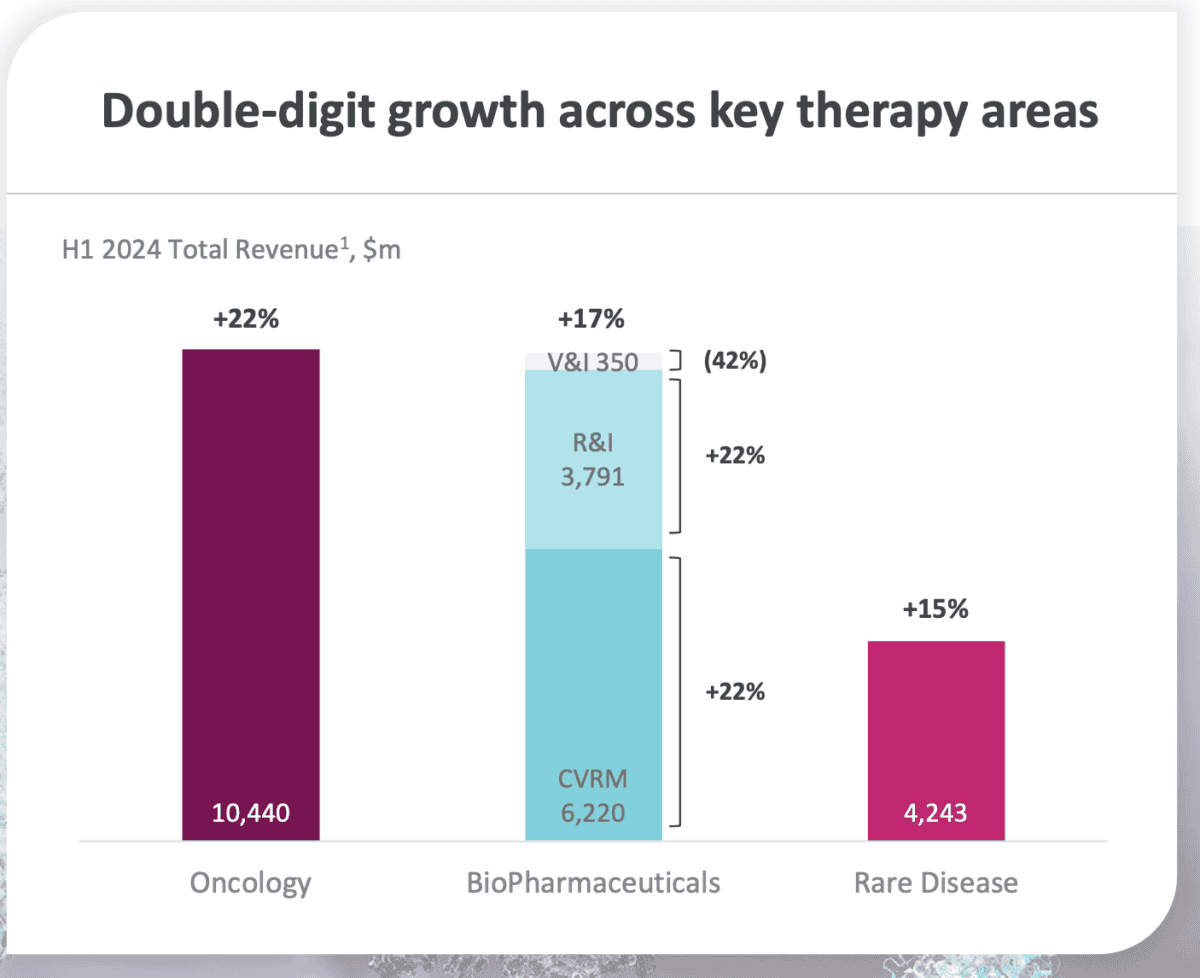
Source: AstraZeneca H1

Despite the positive revenue growth, AstraZeneca’s shares fell nearly 4% on the day of the announcement.

This decline can be partially attributed to higher-than-expected costs, which led to lower net income margins that fell to 17.2% from 19% in Q1.

The market’s reaction probably also reflects the current bearish sentiment in the equities market as a whole, where even strong earnings reports are scrutinised for any signs of weakness.

Nevertheless, AstraZeneca has upgraded its full-year guidance. It’s now expecting both total revenue and core earnings per share (EPS) to increase by a mid-teens percentage at constant exchange rates.

Serious growth plans

In the H1 report, the company pointed to some of its pipeline and new commercialisation developments that are set to push revenue higher in the years to the end of the decade.

In May, the company set out its plan to achieve $80bn in revenue by 2030, a significant leap from the $45.8bn reported in 2023.

This will be driven by 20 new medicines. CEO Pascal Soriot believes each of these new drugs or new molecular entities can deliver more than $5bn annually in peak-year revenues.

What does all this mean?

AstraZeneca is among the most expensive companies on the FTSE 100. It currently trades around 28.4 times forward earnings, putting it at a significant premium to the index average — around 12 times.

However, we pay a premium for growth. And the company’s price-to-earnings (P/E) ratio falls to 23.3 times in 2025 and 20.4 times in 2026. Remember, this is based on the current price of the stock.

If AstraZeneca is able to deliver on its revenue generation targets, then this level of earnings growth is likely to continue. In short, we could be looking at one of the fastest growing stocks on the index in terms of earnings.

Investors, however, need to decide whether they’re willing to pay a premium for that growth. And with the stock getting cheaper, that decision may have become slightly easier.

I already hold AstraZeneca shares in my pension, but I’m certainly considering buying more.

James Fox has positions in AstraZeneca Plc. The Motley Fool UK has recommended AstraZeneca Plc. Views expressed on the companies mentioned in this article are those of the writer and therefore may differ from the official recommendations we make in our subscription services such as Share Advisor, Hidden Winners and Pro. Here at The Motley Fool we believe that considering a diverse range of insights makes us better investors.

More on Investing Articles

Female student sitting at the steps and using laptop
Investing Articles

How much do you need in an ISA to target £8,333 a month of passive income?

Our writer explores a potential route to earning double what is today considered a comfortable retirement and all tax-free inside…

Read more »

Three signposts pointing in different directions, with 'Buy' 'Sell' and 'Hold' on
Investing Articles

Could these 3 FTSE 100 shares soar in 2026?

Our writer identifies a trio of FTSE 100 shares he thinks might potentially have more petrol in the tank as…

Read more »

Pakistani multi generation family sitting around a table in a garden in Middlesbourgh, North East of England.
Dividend Shares

How much do you need in a FTSE 250 dividend portfolio to make £14.2k of annual income?

Jon Smith explains three main factors that go into building a strong FTSE 250 dividend portfolio to help income investors…

Read more »

Tesla building with tesla logo and two teslas in front
Investing Articles

275 times earnings! Am I the only person who thinks Tesla’s stock price is over-inflated?

Using conventional measures, James Beard reckons the Tesla stock price is expensive. Here, he considers why so many people appear…

Read more »

Investing Articles

Here’s what I think investors in Nvidia stock can look forward to in 2026

Nvidia stock has delivered solid returns for investors in 2025. But it could head even higher in 2026, driven by…

Read more »

Investing Articles

Here are my top US stocks to consider buying in 2026

The US remains the most popular market for investors looking for stocks to buy. In a crowded market, where does…

Read more »

Investing Articles

£20,000 in excess savings? Here’s how to try and turn that into a second income in 2026

Stephen Wright outlines an opportunity for investors with £20,000 in excess cash to target a £1,450 a year second income…

Read more »

DIVIDEND YIELD text written on a notebook with chart
Investing Articles

Is a 9% yield from one of the UK’s most reliable dividend shares too good to be true?

Taylor Wimpey’s recent dividend record has been outstanding, but investors thinking of buying shares need to take a careful look…

Read more »