
When will Lloyds shares hit 60p again?

Before the pandemic, Lloyds shares frequently traded around 60p. The bank’s fundamentals have improved so why is the stock so discounted?

| More on:

The content of this article was relevant at the time of publishing. Circumstances change continuously and caution should therefore be exercised when relying upon any content contained within this article.

2024 year number handwritten on a sandy beach at sunrise

Image source: Getty Images

You’re reading a free article with opinions that may differ from The Motley Fool’s Premium Investing Services. Become a Motley Fool member today to get instant access to our top analyst recommendations, in-depth research, investing resources, and more. Learn More.

I’ve been taking advantage of the recent deterioration in the price of Lloyds (LSE:LLOY) shares to top up my holdings. The blue-chip bank is currently trading around 43p, down from highs around 54p earlier in the year.

Trading at a discount

Prior to the pandemic, Lloyds shares were frequently hovering around the 60p mark. The stock has not reached that high in the years since. And I find this particularly interesting.

After all, at the time, the UK had already voted for Brexit — a risk factor that kept the stock depressed for a while — and interest rates were near zero to stimulate growth.

Lloyds was also less profitable than it is today. The bank delivered £4.2bn in profit before tax in 2019 versus £6.9bn last year. So, why are Lloyds shares trading at a discount versus their pre-pandemic levels?

Default risks

Lloyds shares, like other banks, were pushing upwards until February when the SVB fiasco sent financial stocks into reverse.

While SVB was something of a warning for the industry, interest rates have since pushed higher, extending far beyond the Goldilocks zone.

The relationship between interest rates and bank profitability isn’t a simple one. On one side, there’s a tailwind as net interest margins have increased with rising interest rates.

On the other hand, as interest rates have extended beyond 3%, there’s been increasing concern about the capacity of individuals and businesses to make their growing repayments.

Under the bank’s worst-case forecast, expected credit losses could reach £10.1bn. To put that into context, under the base-case scenario, the bank foresees expected credit losses of £4.2bn.
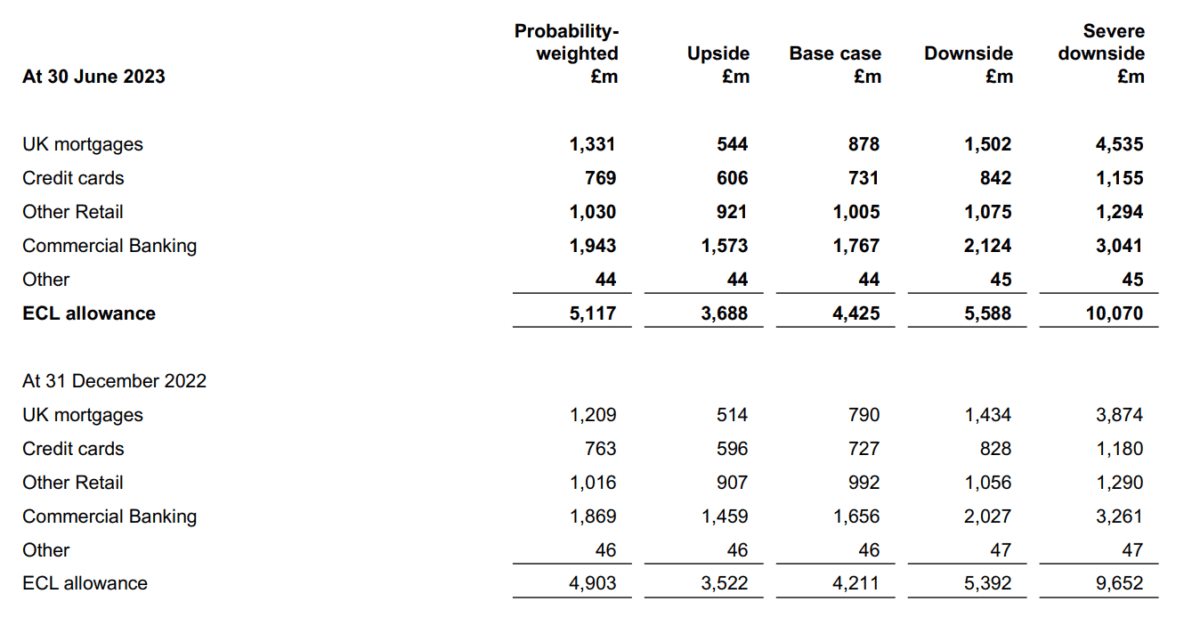
Source: Lloyds

Is it really that bad?

Since Lloyds published the above forecasts in its half-year results in late-July, there have been some broad sentiment changes.

With UK economic growth supposedly stronger than we had expected, and more signs that interest rates have peaked, it’s possible that the worst-case scenario has been avoided.

Moreover, investors may find some peace in the recent UK banks stress stress. Under the stress scenario, its Common Equity Tier 1 (a measure of liquidity) would fall to 11.6%. Lloyds was the second-best performer of all UK banks.

The recent struggles of Metro Bank may have contributed to some further concerns about the health of the UK banking sector. However, after a new deal, announced on Sunday, an SVB-esque fiasco has been avoided.

Heading to 60p

Trading at 5.5 times earnings, Lloyds isn’t expensive. In fact, it trades at a significant discount to peers including HSBC, Standard Chartered, and other non-UK focused institutions. If we were to apply a price-to-earnings ratio comparable with its international peers (8 times), the stock would be trading around 65p.

Likewise, we can see that Lloyds trades with a price-to-book ratio of 0.58 times, inferring a 42% discount versus its tangible net asset value. Risk, in my opinion, is too heavily factored into the share price.

By comparison, US institutions trade with a P/B around one. As such, if we applied a P/B of one, we’d expect to see the Lloyds share price at 75p.

So, barring any severe economic slowdowns or mass defaults, I expect to see the Lloyds share price creep towards 60p.


HSBC Holdings is an advertising partner of The Ascent, a Motley Fool company. James Fox has positions in HSBC Holdings, Lloyds Banking Group Plc, and Standard Chartered Plc. The Motley Fool UK has recommended HSBC Holdings, Lloyds Banking Group Plc, and Standard Chartered Plc. Views expressed on the companies mentioned in this article are those of the writer and therefore may differ from the official recommendations we make in our subscription services such as Share Advisor, Hidden Winners and Pro. Here at The Motley Fool we believe that considering a diverse range of insights makes us better investors.

More on Investing Articles

Investing Articles

I asked ChatGPT for the best 5 S&P 500 or FTSE 100 stocks to own in 2026 and here’s what I got

ChatGPT says that these are the best S&P 500 and Footsie stocks to own in 2026. However, Edward Sheldon isn’t…

Read more »

Mature black woman at home texting on her cell phone while sitting on the couch
Investing Articles

I asked Gemini for the perfect passive income portfolio, here’s what it said…

I'm going to be honest, I was underwhelmed by Gemini's response. This is exactly why investors shouldn't turn to AI…

Read more »

British coins and bank notes scattered on a surface
Investing Articles

Should I buy Diageo stock for the 4.7% dividend yield?

With the Diageo dividend yield now more than the FTSE 100's, our writer is wondering if he should buy the…

Read more »

Investing Articles

Using figures not hunches: these FTSE 250 stocks could beat the market in 2026

Dr James Fox thinks far too many of us invest on gut feelings rather than data. Here he explores two…

Read more »

Investing Articles

Here are the latest predictions for the Lloyds share price in 2026

Dr James Fox takes a closer look at analysts' forecasts for the Lloyds share price with the stock already high…

Read more »

Investing Articles

What’s cheaper than Nvidia stock as we move into 2026? Tesla, Alphabet, Micron?

Dr James Fox takes a closer look at Nvidia stock as we move into 2026. The stock has come under…

Read more »

Investing Articles

FTSE 100 banks: which one is best value for 2026?

Dr James Fox uses quantitive metics to compare FTSE 100 banks and explores which might be best value going into…

Read more »

Investing Articles

Up 425% in 2025, surely this FTSE 100 superstar can’t repeat the feat in 2026?

Holding Fresnillo has been a wild ride, but even after incredible growth, this FTSE 100 miner could deliver more for…

Read more »