
We have some exciting news to share! The Motley Fool UK has now become an independent, UK-owned company, led by our long-serving UK management team — Mark Rogers, Chris Nials and Heather Adlington. In practical terms, it’s the same team you know, now fully focused on serving our UK readers and members.

Just as importantly, our approach remains unchanged: long-term, jargon-free, and on your side. We’ll be introducing a new name and brand over the coming weeks — we're very excited to share it with you and embark on this new chapter together!

Should I buy Made.com shares after the IPO?

On 16 June, Made.com listed on the London Stock Exchange via an Initial Public Offering. Here, Ed Sheldon looks at the investment case for the stock.

| More on:

The content of this article was relevant at the time of publishing. Circumstances change continuously and caution should therefore be exercised when relying upon any content contained within this article.

You’re reading a free article with opinions that may differ from The Motley Fool’s Premium Investing Services. Become a Motley Fool member today to get instant access to our top analyst recommendations, in-depth research, investing resources, and more. Learn More.

A young woman sitting on a couch looking at a book in a quiet library space.

Image source: Getty Images

On 16 June, furniture and homewares group Made.com (LSE: MADE) listed on the London Stock Exchange via an Initial Public Offering (IPO). Like a few other recent UK IPOs, it wasn’t a huge success. The stock closed down 7% on the first day of trading (although it’s since recovered).

Here, I’m going to look at the investment case for Made.com shares. Should I buy this stock for my portfolio?

Made.com: the business

Made.com retails curated furniture and homewares to customers in the UK, Germany, Switzerland, Austria, France, Belgium, Spain and the Netherlands through a localised e-commerce platform.

Since its launch in 2010, Made.com has grown significantly and along the way has developed a large, active and loyal customer base. Last year, it had around 1.1 million ‘active’ customers (unique customers who shopped at least once during the year). The brand is particularly popular with Millennials.

Made.com operates a vertically-integrated business model that covers the entire product lifecycle from product development and sourcing through to global shipping, warehousing, and home delivery. To create its product range, it partners with over 150 established and up-and-coming designers, artists, and collaborators.

The IPO price was 200p per share, valuing the company at around £1.2bn.

Made.com shares: the bull case

From an investment point of view, there are a number of things I like about Made.com. Firstly, I think the company has a great offer. In the last few years, I’ve purchased a number of its products, including a leather sofa, an armchair, and a sideboard and, overall, I’ve been very happy with the products. Made.com seems to offer high-quality products at good price points.

It’s worth noting that Made.com has over 11,000 reviews on Trustpilot and overall has a ‘great’ rating with a score of 4.2 out of five. By contrast, IKEA has a score of 1.5. So, clearly, Made.com is doing something right. It also has more than 3m followers across its social media accounts.

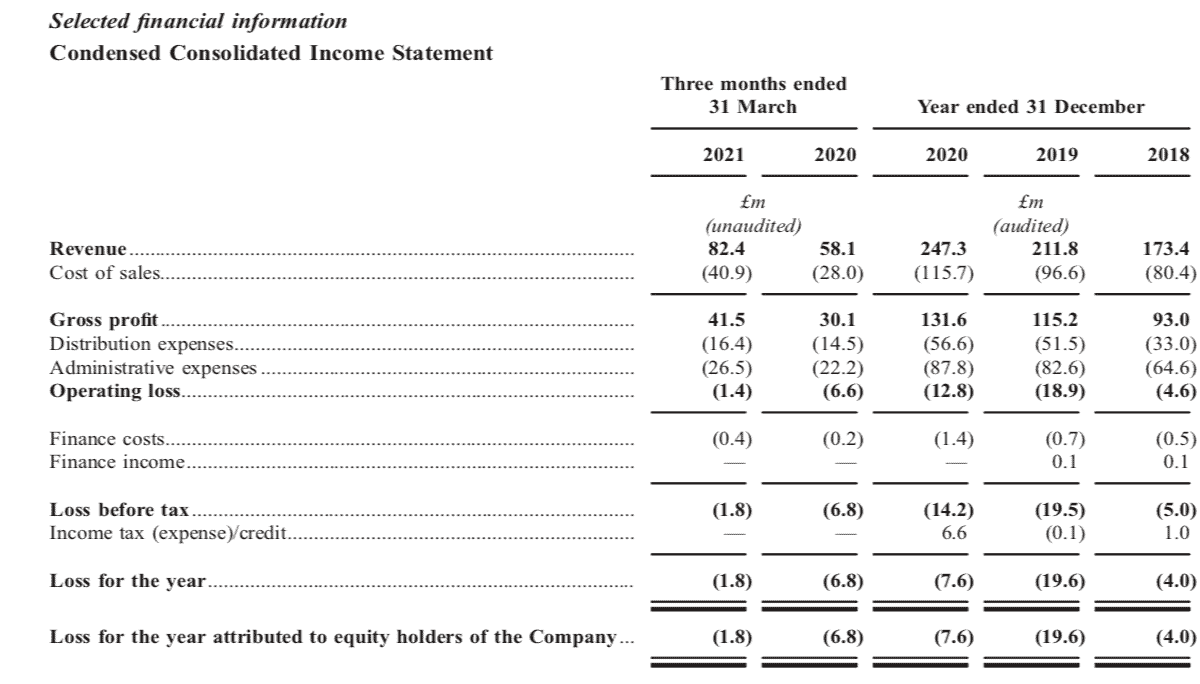
Secondly, the company’s growth in recent years has been impressive. Made’s IPO prospectus reveals that last year it generated revenue of £247.3m, up from £211.8m in 2019 and £173.4m in 2018. So annualised growth over this period was 19.4%. That’s pretty good, given UK economic conditions last year.
Made.com shares

Source: Made.com

Risks

However, I do have some concerns about Made.com shares. One is that the company still isn’t profitable. Last year, its net loss was £7.6m. This adds risk to the investment case. We’ve seen recently that the share prices of companies with no profits can fall sharply in a market sell-off.

Another issue is the competition the company faces. Not only does it face competition from established rivals such as Ikea, DFS, and John Lewis, but it also faces competition from newer companies such as Loaf. In this industry, barriers to entry are minimal.

Finally, there’s the valuation. At Made.com’s current valuation, it has a trailing price-to-sales (P/S) ratio of about 4.85. I see that as quite high. By contrast, online retailer ASOS has a P/S ratio of 1.5.

Made.com shares: my move

Looking at the risks to the investment case, I’m going to keep Made.com shares on my watchlist for now. All things considered, I think there are better stocks I could buy at present.


Edward Sheldon owns shares of ASOS and London Stock Exchange Group. The Motley Fool UK has recommended ASOS. Views expressed on the companies mentioned in this article are those of the writer and therefore may differ from the official recommendations we make in our subscription services such as Share Advisor, Hidden Winners and Pro. Here at The Motley Fool we believe that considering a diverse range of insights makes us better investors.

More on Investing Articles

British pound data
Investing Articles

2 UK shares to consider avoiding as the FTSE 100 extends losses

As the FTSE 100 dips for the second time this year, Mark Hartley weighs up market sentiment and considers two…

Read more »

Young brown woman delighted with what she sees on her screen
Investing Articles

How to invest £125 a month in UK shares to target a £39,039 annual passive income

Muhammad Cheema explains how an investor could earn the current median salary in the UK as passive income by making…

Read more »

Investor looking at stock graph on a tablet with their finger hovering over the Buy button
Investing Articles

These white-hot FTSE 250 growth shares are on sale today!

Royston Wild loves a good bargain. Here he reveals two FTSE 250 shares that all savvy UK stock investors should…

Read more »

A senior man and his wife holding hands walking up a hill on a footpath looking away from the camera at the view. The fishing village of Polperro is behind them.
Investing Articles

How much do you need an ISA for a £31,352 second income?

Investing regularly in a Stocks and Shares ISA can generate a significant second income in retirement. Royston Wild explains how.

Read more »

Aston Martin DBX - rear pic of trunk
Investing Articles

With the Aston Martin share price in pennies, is it in bargain territory?

With the Aston Martin share price at a fraction of what it once was, is it a bargain? Our writer…

Read more »

A hiker and their dog walking towards the mountain summit of High Spy from Maiden Moor at sunrise
Investing Articles

How I plan to lock in sustainable growth on the FTSE 100 in the coming years

Mark Hartley takes a sobering look at the future, and outlines a plan to target FTSE 100 sectors with lower…

Read more »

Close-up image depicting a woman in her 70s taking British bank notes from her colourful leather wallet.
Investing Articles

What are the FTSE’s most lucrative high-yield shares?

Our writer zooms in one one of a handful of high-yield FTSE 100 shares to explain why he thinks it…

Read more »

Businessman with tablet, waiting at the train station platform
Investing Articles

Why bother with a SIPP now rather than wait 10 years?

Interested in a SIPP but putting it off to give yourself time to think? Christopher Ruane explains why that could…

Read more »