FTSE 100 Santa Rally: Is it fact or fiction?

The Santa Claus Rally is said to drive markets like the FTSE 100 higher in December. Looking at the data suggests there is, in fact, some truth to this, but what does that mean for investors?

The content of this article was relevant at the time of publishing. Circumstances change continuously and caution should therefore be exercised when relying upon any content contained within this article.

You’re reading a free article with opinions that may differ from The Motley Fool’s Premium Investing Services. Become a Motley Fool member today to get instant access to our top analyst recommendations, in-depth research, investing resources, and more. Learn More.

‘Tis the season of goodwill. But, does the magic of the Christmas season extend all the way to the FTSE 100? The UK’s main stock market index is up 4.2% already, and we are not even halfway through December. That might cause investors to believe that the so-called Santa Claus Rally is more fact than fiction. However, the general cheer about coronavirus vaccines being rolled out in the UK and the pandemic looking to be coming to an end is probably a better explanation of why the FTSE 100 is performing strongly.

Looking at the average monthly returns for the FTSE 100 in December, and the other 11 months, going all the way back to 1996 should provide a clearer picture. After looking at the data, there might be some truth around the idea of a Santa Rally lifting the FTSE 100 in December.

Has the FTSE 100 been naughty or nice?

The Santa Claus Rally was identified in 1972, by a stock market analyst and author called Yale Hirsch. Specifically, it refers to a tendency of stock markets to rise in the last week or so in December. Market commentators have, however, extended the original observation to December as a whole. So, how does the FTSE 100 tend to perform in December? 

Well, the average monthly return on the FTSE 100 index in December is 2.02%. That is higher than any other month’s average return, save one, going all the way back to 1996. The average return in April was, in fact, the highest at 2.34%. However, my efforts to get the Easter Bunny Hop recognised have failed. That’s probably because Easter sometimes falls in March.
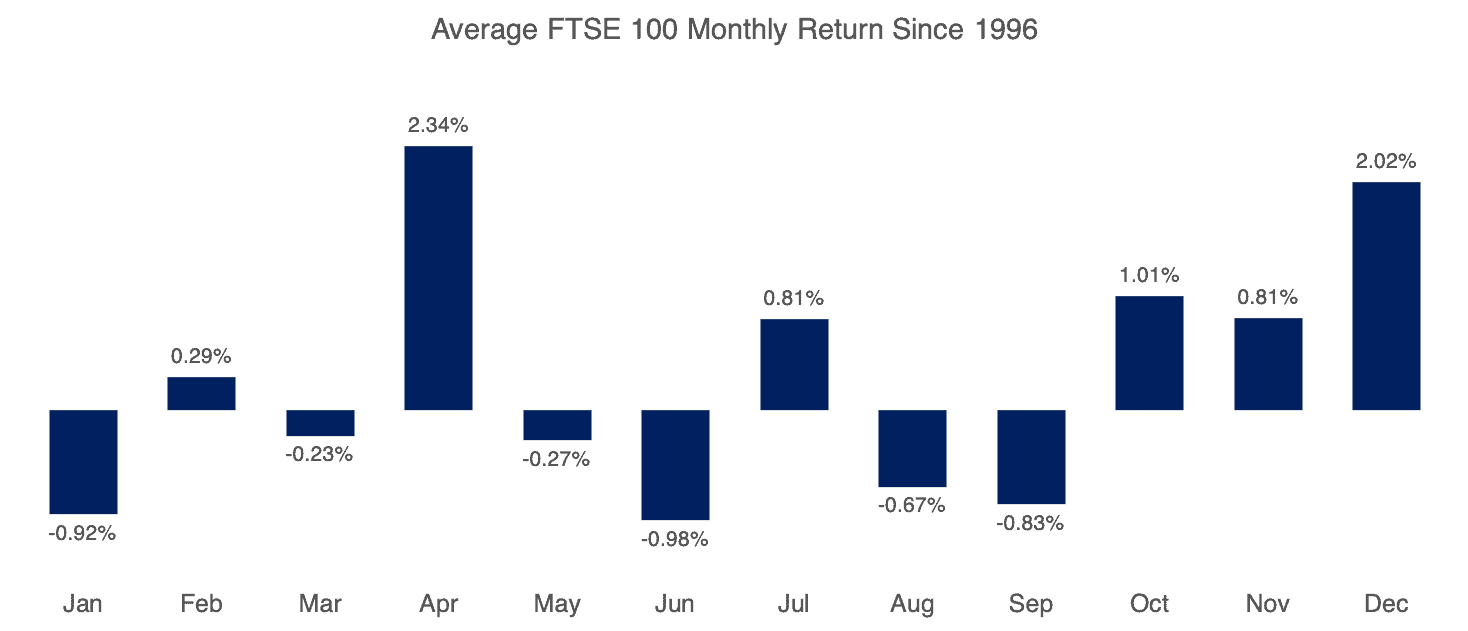
Chart showing the average monthly calendar returns of the FTSE 100 since 1996

Source: Yahoo Finance and author’s own calculations

So let’s get back to the FTSE 100 and December. On average the market rises more in December than any month other than April. December also has the lowest standard deviation of returns at 2.98%, meaning they are less spread around the average compared to other months.

That does not mean that losses do not occur in December. The worst December performance for the FTSE 100 was -5.49%.  In comparison, the worst returns in April and November were -3.25% and -4.6% respectively.

What does this mean for investors?

It’s an interesting observation that the FTSE 100 does tend to perform better in December compared to other months, except for April. The Santa Rally might indeed be real rather than fiction. Will this change how I invest? No, it won’t.

Although there are numerous theories around why markets tend to do better in December, none of them has proved conclusive. Returns are not always positive in December, and there is no reliable way to predict if a Santa Rally will occur. I can’t tell which years will see the Easter Bunny Hop either, unfortunately.

In an earlier article, I demonstrated that time in the market beats trying to time the market over the long-term. Trying to catch a Santa Rally or even an Easter Bunny Hop, is trying to time the market. Over 25 years or so I might get that average 2.02% or even 2.34% return. However, The FTSE 100 has returned 8.33% per year on average over the last 25 years, including dividend reinvestment. I would rather be in the market for the long term, rather than trying to time it.


James J. McCombie has no position in any of the shares mentioned. The Motley Fool UK has no position in any of the shares mentioned. Views expressed on the companies mentioned in this article are those of the writer and therefore may differ from the official recommendations we make in our subscription services such as Share Advisor, Hidden Winners and Pro. Here at The Motley Fool we believe that considering a diverse range of insights makes us better investors.

More on Investing Articles

Close-up of British bank notes
Investing Articles

Want a second income? Here’s how a spare £3k today could earn £3k annually in years to come!

How big can a second income built around a portfolio of dividend shares potentially be? Christopher Ruane explains some of…

Read more »

Close-up of British bank notes
Investing Articles

£20,000 for a Stocks and Shares ISA? Here’s how to try and turn it into a monthly passive income of £493

Hundreds of pounds in passive income a month from a £20k Stocks and Shares ISA? Here's how that might work…

Read more »

Snowing on Jubilee Gardens in London at dusk
Investing Articles

£5,000 put into Nvidia stock last Christmas is already worth this much!

A year ago, Nvidia stock was already riding high -- but it's gained value since. Our writer explores why and…

Read more »

Investing Articles

Are Tesco shares easy money heading into 2026?

The supermarket industry is known for low margins and intense competition. But analysts are bullish on Tesco shares – and…

Read more »

Smiling black woman showing e-ticket on smartphone to white male attendant at airport
Investing Articles

Can this airline stock beat the FTSE 100 again in 2026?

After outperforming the FTSE 100 in 2025, International Consolidated Airlines Group has a promising plan to make its business more…

Read more »

Investing Articles

1 Stocks and Shares ISA mistake that will make me a better investor in 2026

All investors make mistakes. The best ones learn from them. That’s Stephen Wright’s plan to maximise returns from his Stocks…

Read more »

Portrait Of Senior Couple Climbing Hill On Hike Through Countryside In Lake District UK Together
Investing Articles

I asked ChatGPT if £20,000 would work harder in an ISA or SIPP in 2026 and it said…

Investors have two tax-efficient ways to build wealth, either in a Stocks and Shares ISA or SIPP. Harvey Jones asked…

Read more »

Investing Articles

How much would I need invested in an ISA to earn £2,417 a month in passive income?

This writer runs the numbers to see what it takes in an ISA to reach £2,417 a month in passive…

Read more »