Prime Minister Theresa May said we needed a General Election to give her the best possible hand in the imminent Brexit negotiations. Strength and stability were her watchwords.
But as the votes were counted and the Conservative seats rolled over, the only continuity I sensed on election night was a feeling of déjà vu.
We’d seen this movie before, and not that long ago either.
Sure, the characters and the plot had been tweaked. But as with Hitchcock films or the latest murderous episodes of Game of Thrones, we knew we were in for a familiar romp.
Soon enough all the elements of the voguish political dramas of recent times were on display: shock, upset, and an aftermath of uncertainty.
After the pizza crusts and the empty bottles of bubbly have been tidied away, it’s the uncertainty that will linger.
May asked the country to strengthen her hand for Brexit. In the process her party has lost its majority in Parliament.
So, what happens next?
Exit hard Brexit?
That was surely the top question in executive suites and boardrooms this morning, just like it was in kitchens, on buses and trains, and everywhere on social media. The little we did know about how the next couple of years would play out, we can no longer be sure of.
Businesses did not know exactly how or when the UK would withdraw from the European Union. But the one thing we all knew was that Theresa May was set to lead the Brexit process, and that she favoured what’s become known as a ‘hard Brexit’.
A hard Brexit seemed to imply that UK companies must start thinking about a life outside the EU. That they should prepare to trade outside of the European single market, and very likely without access to the steady flow of immigrant workers that many have enjoyed thanks to free movement within the EU, too.
But with the UK Parliament in limbo, a soft Brexit – and with it the potential to remain inside the single market – could be back on the table. That could have significant consequences for UK businesses, and for our investments in them.
Similarly, away from Europe, which manifesto pledges will now be implemented?
Tax rises, tax cuts, re-nationalisations, and semi-privatisation… will any of the ideas the parties put before us (such as the cut in the dividend allowance to £2,000 next year) get into legislation before the ruling regime falls over and another election is called?
Or will the Government cobble together every day as it comes, insecure as a limpet clinging not to a rock but to driftwood tossed around by the tide? How should businesses plan in such an environment?
A vote for the FTSE 100
In the UK, it’s the giant multinationals that seem best placed to ride out this uncertainty. They have operations all over the globe, and their sales often dwarf the contribution from their UK divisions.
In fact, roughly three-quarters of FTSE 100 revenues are generated in foreign markets.
Overseas trading doesn’t just offer protection from turbulence in the UK economy. As we saw after the EU Referendum, the pound will likely take the strain of reflecting the angst of international capital.
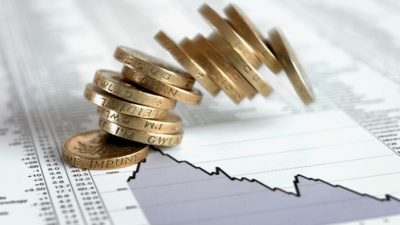
The value of the pound against other major currencies fell sharply the moment the exit polls were announced. It could keep falling. The pound’s had been rallying ever since Theresa May kicked off her stability-seeking election. Why won’t that now be unwound?
A weak pound is bad if you need euros, dollars, or other currencies, whether for a holiday or a second home in Spain. It’s bad for UK consumers, too, if it means higher prices and more imported inflation as retailers seek to recover the higher costs of imported goods.
But for FTSE 100 companies, a weaker pound can be a boon. It boosts reported sales and profits, as the foreign currency earned overseas is worth more when converted back into pounds. Generally, I expect the FTSE 100 to rise when our currency falls.
Closer to home, domestically focused companies like homebuilders and high street banks should do okay assuming the UK economy holds up. However, companies who earn all their money in sterling obviously won’t see any boost from a weaker currency, and some may face higher costs from higher import costs. Their share prices could suffer if investors decide to sell them to get back into those behemoth blue chips.
Not great if you’re investor in many UK small caps, but there’s a positive spin. A weaker pound makes British companies cheaper to foreign predators. Perhaps predators in Europe or the US could choose this moment to pounce. That could see select share prices pop.
Still that’s hardly something long-term Foolish investors should bet on (and maybe not something to welcome, either, if we want a wide range of great UK firms to invest in).
Make your own portfolio strong and stable
There’s a silver lining to the repeated political shocks of recent times, which is that I suspect investors are toughening up.
Boxing legend Mike Tyson famously said everyone has a plan until they get punched in the face. That’s how markets typically react to big surprises, too. But investors have been repeatedly smacked in the chops over the past few years, and I suspect this has made it easier for us to stick to our investing plans.
I definitely don’t think most readers should be out there dumping shares today on the back of this political uncertainty.
That’s not because I think whatever eventually happens will be good or bad for the UK economy, or for the UK markets on a 6-12 month view. On the contrary, it’s because I don’t know – and I strongly suspect few other do right now, either.
Never mind. A proper investing plan stretches over multiple Parliaments, hung or otherwise. It should even be robust enough to get through the odd national tumult.
A sensible diversified portfolio should contain a mix of cash, bonds, property, and perhaps even gold and other alternative assets alongside a substantial backbone of shares, and of the latter you should have plenty of money invested in funds giving you exposure to those overseas markets and currencies.
And this mix should be appropriate from a risk perspective for your age and stage of life. Ideally, you should add new capital to your portfolio every month, right up until you retire.
Do that, and while you may still watch developments at Westminster through your fingers, at least when it comes to your portfolio you’ll feel a little calmer.