
We have some exciting news to share! The Motley Fool UK has now become an independent, UK-owned company, led by our long-serving UK management team — Mark Rogers, Chris Nials and Heather Adlington. In practical terms, it’s the same team you know, now fully focused on serving our UK readers and members.

Just as importantly, our approach remains unchanged: long-term, jargon-free, and on your side. We’ll be introducing a new name and brand over the coming weeks — we're very excited to share it with you and embark on this new chapter together!

Forget buy-to-let! Consider buying this cheap REIT instead

James Beard explains why he thinks this bargain FTSE 250 real estate investment trust (REIT) could do better than a buy-to-let.

| More on:

The content of this article was relevant at the time of publishing. Circumstances change continuously and caution should therefore be exercised when relying upon any content contained within this article.

You’re reading a free article with opinions that may differ from The Motley Fool’s Premium Investing Services. Become a Motley Fool member today to get instant access to our top analyst recommendations, in-depth research, investing resources, and more. Learn More.

Female Tesco employee holding produce crate

Image source: Tesco plc

Lots of people have invested in property as means of increasing their long-term wealth. But I reckon real estate investment trusts (REITs) are a great alternative. And in some cases, they are currently (30 January) offering a yield greater than a typical buy-to-let (BTL).

According to Eddisons, a BTL rental yield in excess of 6% is “very good”, although it says this varies by region. For example, in the north of England and parts of Scotland, it might be possible to get something closer to 8%. However, this is a gross figure. It doesn’t take into account letting fees, repairs, and mortgage interest.

And then there’s tax to consider. Remember, holding a REIT in a Stocks and Shares ISA means any dividends and capital gains can be earned tax free.

I know from personal experience that being a landlord isn’t easy. That’s why I now prefer stocks and shares to bricks and mortar.

Please note that tax treatment depends on the individual circumstances of each client and may be subject to change in future. The content in this article is provided for information purposes only. It is not intended to be, neither does it constitute, any form of tax advice.

Shopping around

In fact, one of my shareholdings is Supermarket Income REIT (LSE:SUPR). Based on amounts paid over the past 12 months, it’s yielding 7.1%. This is far superior to anything that I’ve ever earned on my BTL.

The REIT invests in omnichannel supermarkets in the UK and France, which are used for in-store shopping, click and collect services, and home deliveries.
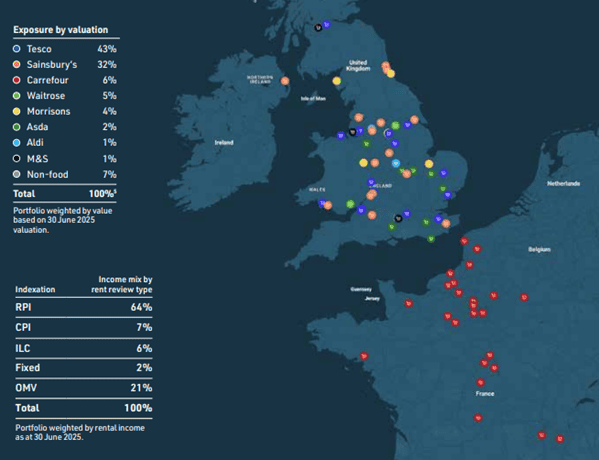
Source: company presentation

One of the things that I like about REITs is that, generally speaking, they have very simple business models. For example, Supermarket Income employs just 15 people to look after its portfolio worth close to £2bn.

Towards the end of 2025, the trust went on a bit of a shopping spree buying more stores for its own portfolio as well as some for a joint venture with Blue Owl Capital. Latest figures show that this partnership now owns 23 assets with a value of £833m.

Impressively, for the 12 months to 30 June 2025, the trust had 100% occupancy and a perfect record of rent collection. Given that it claims it has a 75% exposure to “investment grade clients”, this is probably not surprising.

Looking ahead, 77% of its tenancy agreements provide for inflation-linked rent increases. And its weighted average unexpired lease term (WAULT) is 12 years. Both these factors give it a relatively high degree of certainty over its future revenue.

Buyer beware

Of course, there are risks. Dividends can never be guaranteed, especially in the commercial property sector, which can be volatile.

Larger properties are also facing significant increases in their rates bills. And in common with most REITs, Supermarket Income usually borrows to buy more properties. This means its earnings are vulnerable to a higher interest rate environment.

Also, due to the nature of its business, I’m not expecting its share price to take off any time soon. Slow and steady capital growth is probably the best that can be hoped for.

Supermarket Income is my favourite REIT. I like the sector that it operates in as well as its blue-chip tenants. And, of course, there’s the attractive dividend. For these reasons, I think it’s worth considering. And with each share costing approximately 84p, a lot less cash is needed to get a foothold in the real estate market than with a BTL property.


James Beard has positions in Supermarket Income REIT Plc. The Motley Fool UK has no position in any of the shares mentioned. Views expressed on the companies mentioned in this article are those of the writer and therefore may differ from the official recommendations we make in our subscription services such as Share Advisor, Hidden Winners and Pro. Here at The Motley Fool we believe that considering a diverse range of insights makes us better investors.

More on Dividend Shares

A senior group of friends enjoying rowing on the River Derwent
Investing Articles

How much do investors need in an ISA to target a £31,353 yearly passive income

Harvey Jones shows how building a portfolio of FTSE 100 shares can generate enough passive income to enjoy a truly…

Read more »

Man smiling and working on laptop
Investing Articles

These 3 ‘secret’ dividend shares could be top stocks to buy in May!

Forget FTSE 100 dividend shares. And look past the FTSE 250 for passive income. Here are three lesser-known dividend stocks…

Read more »

Woman riding her old fashioned bicycle along the Beach Esplanade at Aberdeen, Scotland.
Investing Articles

Here’s how a £20k ISA could generate £2,413 every week from passive income shares

Investing in a Stocks and Shares ISA can deliver transformational wealth in retirement. Royston Wild explains the benefit of passive…

Read more »

Businessman with tablet, waiting at the train station platform
Investing Articles

161 years of dividend growth! 3 investment trusts for passive income

Searching for ways to make a growing passive income over time? Royston Wild reveals three investment trusts that deserve serious…

Read more »

Red lorry on M1 motorway in motion near London
Investing Articles

Here’s how 44,248 shares of this UK dividend stock generate a £10,000 annual passive income

Zaven Boyrazian takes a closer look at one of the highest yielding dividend stocks in the FTSE 250 and explains…

Read more »

DIVIDEND YIELD text written on a notebook with chart
Investing Articles

Hunting passive income? Consider these high-yielding FTSE 250 dividend stocks to buy in May

While looking for dividend stocks to buy, two lesser-known FTSE 250 stocks with high yields caught my attention. But is…

Read more »

Hand is turning a dice and changes the direction of an arrow symbolizing that the value of an ETF (Exchange Traded Fund) is going up (or vice versa)
Investing Articles

3 ETFs to consider in a Stocks and Shares ISA for passive income!

Many top exchange-traded funds (ETFs) in the UK offer sky-high dividend yields right now. Royston Wild selects three that deserve…

Read more »

UK coloured flags waving above large crowd on a stadium sport match.
Investing Articles

With high yields and low P/Es, are these UK dividend shares screaming buys?

Royston Wild runs the rule over two big-paying dividend shares, including one from the FTSE 100. Are they too cheap…

Read more »