
£250K ISA: how much second income could you get monthly?

A £250K ISA can deliver a steady second income – see how contributions and reinvested dividends today can help support your lifestyle.

| More on:

The content of this article was relevant at the time of publishing. Circumstances change continuously and caution should therefore be exercised when relying upon any content contained within this article.

You’re reading a free article with opinions that may differ from The Motley Fool’s Premium Investing Services. Become a Motley Fool member today to get instant access to our top analyst recommendations, in-depth research, investing resources, and more. Learn More.

Rear view image depicting a senior man in his 70s sitting on a bench leading down to the iconic Seven Sisters cliffs on the coastline of East Sussex, UK. The man is wearing casual clothing - blue denim jeans, a red checked shirt, navy blue gilet. The man is having a rest from hiking and his hiking pole is leaning up against the bench.

Image source: Getty Images

If you’re looking to use an ISA to generate a second income, understanding how your savings grow over time is key.

Tiered contributions

To reach a £250,000 ISA, the first step is knowing how much you need to contribute each year. Contributions typically increase gradually over time, reflecting realistic savings behaviour. The table below illustrates how you could reach your target under different return assumptions over a 20-year period.

Annual ReturnTotal ContributionsAverage Annual
Contributions
6%£143,750£7,188
7%£130,000£6,500
8%£117,500£5,875

What that £250,000 could mean for your income

Hitting a £250,000 ISA total is an important milestone, but it’s only the starting point. What really matters is how much dependable second income that pot can generate in retirement.

Assuming the ISA moves into drawdown and is invested more cautiously, I’ve modelled long-term returns at 4% a year. The chart below shows what happens when the portfolio is deliberately run down to zero at age 85.
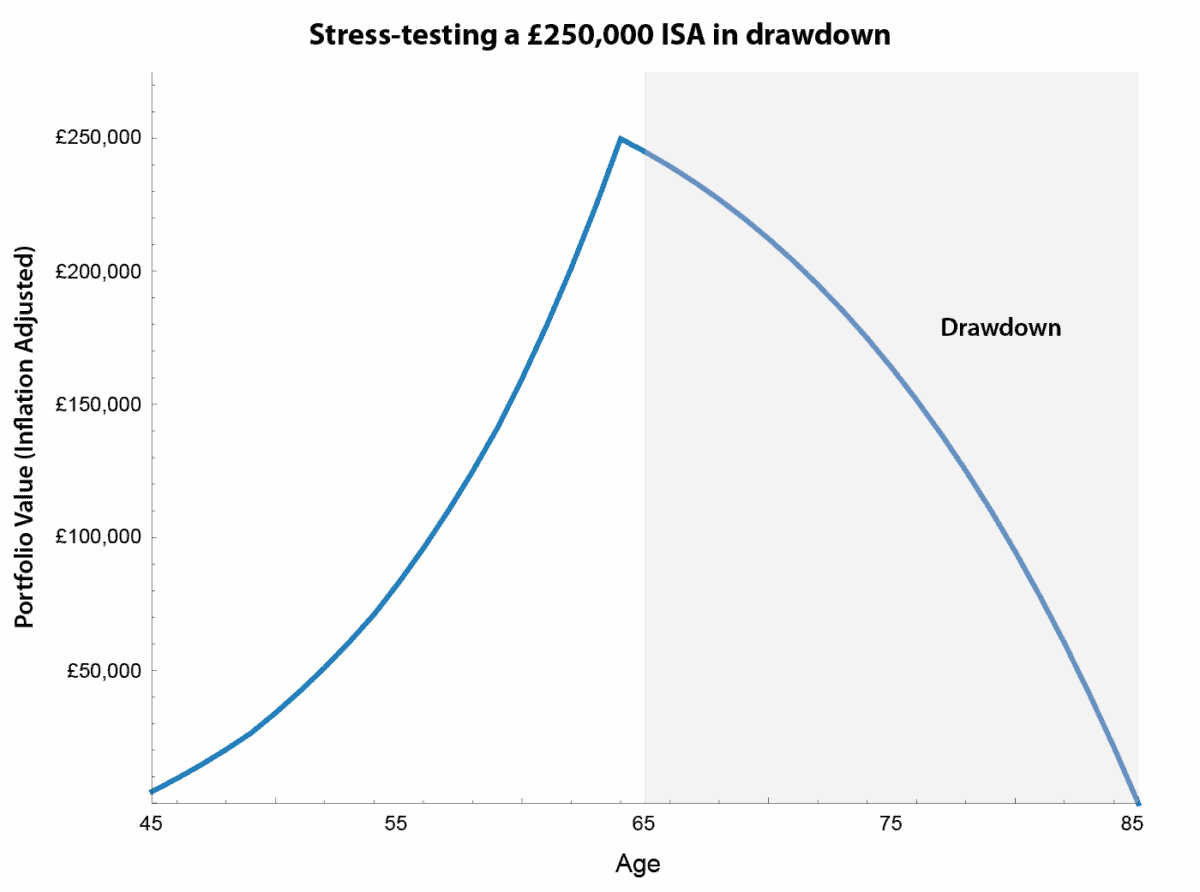
Chart showing how a £250k ISA portfolio supports a second income

Chart generated by author

Under these assumptions, the ISA can deliver an annual income of just over £10,000 – or around £833 a month. All figures are inflation-adjusted, so that income keeps its real spending power throughout retirement.

Most investors, however, won’t want to spend their final pound. Building in a sensible safety margin of 10% to protect against market shocks, longer life expectancy or to leave an inheritance still supports a £750 monthly income – with around £57,000 left in the ISA pot at age 85.

Growth catalyst

To achieve the higher return assumptions used in the contribution phase, long-term investors need exposure to businesses with recovery and re-rating potential. One FTSE 250 stock I think fits that bill is asset management giant Aberdeen (LSE: ABDN).

Despite a strong rebound over the past year, the shares remain around two-thirds below their 2015 highs. That reflects well-documented challenges facing traditional active asset managers, particularly sustained outflows from the group’s Adviser division.

However, the market may be overlooking how much has already changed beneath the surface – and why the risk-reward balance now looks more attractive for patient investors.

Diversified business

The group’s interactive investor — or ii — platform has become a genuine growth engine. Customer numbers, trading activity and assets under administration continue to rise, driven by demand for self-directed investing and SIPPs.

With its flat-fee pricing model and growing brand recognition, ii is steadily emerging as a credible challenger in the direct-to-consumer market. Crucially, this business benefits from operating leverage – incremental growth should increasingly feed through to profits.

The long-running drag from the Adviser division is also easing. Net outflows have fallen sharply year on year, helped by more competitive pricing and sustained investment in service quality. While this business may not return to strong growth in the short term, stabilisation alone could materially improve group cash generation.

Even so, risks remain. A renewed market sell-off could prompt independent financial advisers to move clients out of Aberdeen’s funds, and further outflows could delay any re-rating. Shares are best held as part of a diversified ISA during the growth phase, rather than relied on for income alone.

Bottom line

From an accumulation perspective, Aberdeen illustrates how a recovery story with built-in yield can work in practice. The shares currently yield around 7%, which could be reinvested to enhance long-term growth – showing how considering an ISA holding like this could contribute to a steady second income over time.


Andrew Mackie owns shares in Aberdeen. The Motley Fool UK has no position in any of the shares mentioned. Views expressed on the companies mentioned in this article are those of the writer and therefore may differ from the official recommendations we make in our subscription services such as Share Advisor, Hidden Winners and Pro. Here at The Motley Fool we believe that considering a diverse range of insights makes us better investors.

More on Investing Articles

Young mixed-race woman looking out of the window with a look of consternation on her face
Investing Articles

With stock market risks emerging, is now the time to consider the 60/40 portfolio?

The stock market could be in for a period of turbulence. Here’s a simple strategy that can help long-term investors…

Read more »

Bus waiting in front of the London Stock Exchange on a sunny day.
Investing Articles

Is a stock market crash coming? It’s not too late to get ready!

Christopher Ruane sees reasons to fear a coming stock market crash. Rather than tying to time it, he's hoping to…

Read more »

Investing Articles

Down 4% in 2026, is now the time to consider buying Nvidia shares

Has Nvidia become too big to keep growing? Or is the stock’s decline this year a chance to think about…

Read more »

Investing Articles

Is the party finally over for Rolls-Royce shares?

Rolls-Royce shares have made investors rich but momentum is slowing and the Iran conflict isn't helping. How worried should we…

Read more »

Asian man looking concerned while studying paperwork at his desk in an office
Investing Articles

7.8% dividend yield! A dirt-cheap UK income share to buy today?

I’m on the hunt for lucrative passive income opportunities, and this under-the-radar FTSE stock currently offers a whopping 7.8% dividend…

Read more »

Close-up image depicting a woman in her 70s taking British bank notes from her colourful leather wallet.
Investing Articles

3 passive income stocks tipped to soar 41% (or more) by 2027

One of these shares offering passive income is trading at a massive 79% discount to where City analysts think it…

Read more »

Mature Caucasian woman sat at a table with coffee and laptop while making notes on paper
Investing Articles

171,885 shares of this FTSE dividend star pays an income equal to the State Pension

Zaven Boyrazian calculates how many shares investors would have to buy to generate enough income to match the UK State…

Read more »

Finger clicking a button marked 'Buy' on a keyboard
Investing Articles

This stock’s the opposite of red-hot at the moment. But I reckon it could still be one to buy

The recent dramatic fall in the value of this FTSE 100 stock makes James Beard think it’s a stock to…

Read more »