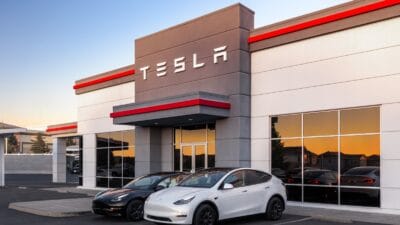
Tesla (NASDAQ:TSLA) stock has confounded many analysts. It trades at phenomenally high multiples regardless of the sector. But for now, its core business remains the sale of cars, and that’s not a business where you’d typically find ‘expensive’ companies.
What do I mean by expensive? Well, one share will set someone back just shy of $500 at the time of writing. That might mean it’s out of some investors’ price bracket.
But what I actually mean is it’s expensive versus its earnings. The company earns less than $2 per share meaning that it trades at 297 times forward earnings.
Returning to the basic premises of investing, this also means it would take 297 years for Tesla to earn back its current share price, assuming profits stand still and all earnings were hypothetically returned to shareholders.
That is an extraordinary assumption to make for any business, let alone one operating in a fiercely competitive, capital-intensive industry.
Despite this high valuation, the stock has actually continued to rise. Over the last month, it has gained 18%. Coupled with a 2% appreciation in the dollar versus the pound, a £10,000 investment a month ago would be worth around £12,000 today.
Missing the point
Of course, Tesla bulls would argue that this framing misses the point.
The investment case rests on rapid growth, margin expansion, and the monetisation of software, autonomy, energy storage, and AI. In that sense, the market is not valuing Tesla as a car manufacturer at all, but as a future technology platform.
The difficulty is that today, the overwhelming majority of revenues and profits still come from selling vehicles. Automotive margins are under pressure, pricing power has weakened, and competitors — both legacy manufacturers and Chinese EV specialists — are closing the gap.
As such, investors are being asked to pay a technology-company multiple for what is, in cash-flow terms, still largely a manufacturing business.
That does not mean the valuation is wrong. But it does mean expectations are exceptionally high. After all, analysts see medium-term earnings growth at 31% annually. This is strong growth but isn’t enough to satisfy a 297 times earnings ratio.
For context, this gives us a price-to-earnings-to-growth (PEG) ratio of 9.1. That’s a 406% premium to the consumer discretionary sector average. And there’s no dividend to distort those metrics.
The valuation also leaves little room for disappointment. Setbacks in driverless regulation or even the concerns about the technology could severely hampered the company’s prospects.
Where do I stand?
If you’ve ever read my work or watched my videos, you’ll know that I screen for stocks using valuation criteria. Unsurprisingly, Tesla doesn’t appear in any of those screens because its so expensive, and doesn’t satisfy any of my requirements.
This way of looking for stocks takes the speculation out of investments. However, it does mean missing the meteoric rise of Tesla and other companies like Palantir. But I’m happy with that.
But is Tesla worth considering? Well, probably. But it’s not for me, as much as I’d love it to succeed.