
Dividend shares can be great for passive income. But be careful to avoid these 3 mistakes…

Avoid these common mistakes when picking dividend shares. Mark Hartley points out risks and how DCC stands up as a thoughtful example.

| More on:

The content of this article was relevant at the time of publishing. Circumstances change continuously and caution should therefore be exercised when relying upon any content contained within this article.

You’re reading a free article with opinions that may differ from The Motley Fool’s Premium Investing Services. Become a Motley Fool member today to get instant access to our top analyst recommendations, in-depth research, investing resources, and more. Learn More.

Photo of a man going through financial problems

Image source: Getty Images

Dividend shares are stocks that pay out part of their profits regularly to shareholders to signal financial strength and attract investment. For many income-focused investors, these shares are the backbone of passive income streams — but they aren’t all reliable.

Here are three mistakes to avoid when picking dividend shares for passive income.

1. Chasing the highest yields

It’s tempting to pick the shares with the highest dividend yields, but ultra-high numbers often signal hidden trouble. A yield above ~10% frequently reflects a share price that’s fallen sharply because business is weak or risk is high. Struggling companies often can’t sustain such payouts, which may lead to cut dividends and poor total returns.

A better approach tends to emphasise sustainable yields, ones in the 5%-8% range, backed by solid cash flow and reliable dividend coverage.

Consider DCC (LSE: DCC), a FTSE 100 company specialising in energy sales, marketing and support services. Its yield’s around 4.3%, well below those risky high-yield names. But its income looks durable: free cash flow remains strong and dividend coverage has been consistent.

These qualities make it less flashy but perhaps more dependable than chasing big yields alone.

2. Ignoring payout ratios and cash flow

A company’s payout ratio measures how much of its earnings are paid out as dividends – but an investor should also check how much cash the firm has and how much free cash flow it generates. If dividends exceed what the business can generate in cash, risk increases.

Looking again at DCC, revenue dropped 4.5% in its full year ended March due to lower energy commodity prices. But its operating profit in the Energy division rose 8.5% on a constant currency basis.

Free cash flow conversion is very high at 84% and the company proposed a 5% dividend increase. This suggests DCC’s dividends are well supported. That said, its Technology division saw a drop in profit, which could drag on group cash generation if not addressed.

3. Overlooking long-term stability and growth

Stable dividend growth over many years compounds nicely. Companies that raise payouts steadily tend to reward patient investors more than those at risk of erratic payments. When choosing dividend shares, look for firms with long records of increasing dividends, manageable debt and predictable sectors.

DCC has a strong record: 31 consecutive years of dividend growth, with a compound annual growth rate of 12.9%. That’s rare and demonstrates a commitment to shareholder returns.
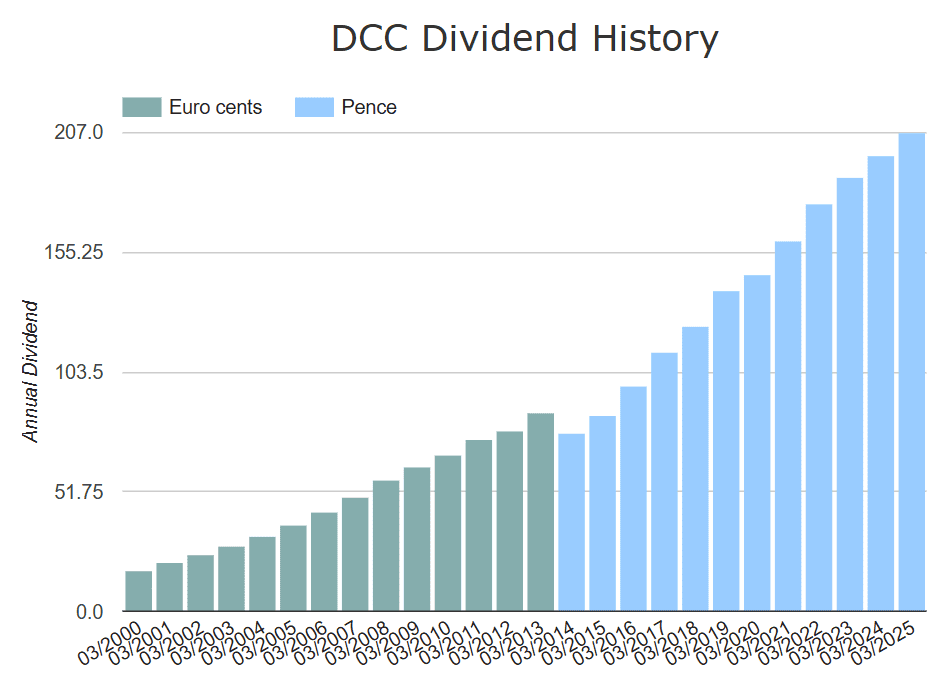
dividend shares DCC
Screenshot from dividenddata.co.uk

However, even with DCC there are risks. Revenue declined in some segments, there’s pressure in Technology, and there’s exposure to energy commodity price swings. If it fails to offset these negatives, growth in dividends or profit may stall.

Think sustainable and consistent

Dividend shares can deliver reliable income but not all are created equal. The best income stocks are those that combine sustainable payout ratios, strong cash flow and consistent growth.

DCC stands out among FTSE 100 income names. It has strong financials in its Energy division, good cash flow, and a long history of dividend increases. It’s a stock investors may consider for income, provided they keep an eye on profit trends, cost pressures and how well the weaker divisions recover.

In the end, building a strong passive income portfolio’s about avoiding traps as much as it is about finding winners – and DCC illustrates both sides of that coin.


Mark Hartley has no position in any of the shares mentioned. The Motley Fool UK has no position in any of the shares mentioned. Views expressed on the companies mentioned in this article are those of the writer and therefore may differ from the official recommendations we make in our subscription services such as Share Advisor, Hidden Winners and Pro. Here at The Motley Fool we believe that considering a diverse range of insights makes us better investors.

More on Investing Articles

Modern apartments on both side of river Irwell passing through Manchester city centre, UK.
Investing Articles

With an empty ISA today, how long would it take to aim for a million?

Is it realistic to aim for a million with an empty ISA? Our writer turns from fantasy to facts to…

Read more »

Burst your bubble thumbtack and balloon background
Investing Articles

What on earth’s going on with the Helium One share price?

The Helium One share price rally has stalled. Our writer reflects on the reasons and asks whether now could be…

Read more »

Female student sitting at the steps and using laptop
Investing Articles

Getting started with investing? Here are 3 UK stocks to take a look at

The next time the stock market opens, it will be the new financial year. And Stephen Wright has three UK…

Read more »

Diverse children studying outdoors
Growth Shares

2 growth shares beating Rolls-Royce stock so far this year

Jon Smith points out some growth shares that have come out of the blocks strongly in 2026, with momentum right…

Read more »

Calendar showing the date of 5th April on desk in a house
Investing Articles

How much would someone need in an ISA to double the state pension and target a £24,436 annual income?

A full state pension is £230.25 per week. But James Beard reckons it’s possible to aim to double this by…

Read more »

Smartly dressed middle-aged black gentleman working at his desk
Investing Articles

New to investing? Here’s how to use the stock market to try and generate a second income

Is investing in the stock market a better way of earning a second income than starting a business? Stephen Wright…

Read more »

UK supporters with flag
Investing Articles

How much would someone need in a Stocks and Shares ISA to target a £1,667 monthly second income?

Our writer reckons a Stocks and Shares ISA is a great way of targeting a healthy second income. And it…

Read more »

Hand of person putting wood cube block with word VALUE on wooden table
Investing Articles

April stocks: 2 value shares I’m taking a closer look at

Value investors looking for shares to buy in April have a lot of eye-catching opportunities. Here are two that I…

Read more »