
Here’s how UK shares could boost savers’ wealth by £37k!

Buying UK and international shares in an ISA or other investment product can help investors effectively balance risk and reward.

| More on:

The content of this article was relevant at the time of publishing. Circumstances change continuously and caution should therefore be exercised when relying upon any content contained within this article.

BUY AND HOLD spelled in letters on top of a pile of books. Alongside is a piggy bank in glasses. Buy and hold is a popular long term stock and shares strategy.

Image source: Getty Images

You’re reading a free article with opinions that may differ from The Motley Fool’s Premium Investing Services. Become a Motley Fool member today to get instant access to our top analyst recommendations, in-depth research, investing resources, and more. Learn More.

Savings and investment accounts both serve important roles in building long-term wealth. I myself hold products like the Cash ISA to keep my emergency cash and manage risk. I also have a Stocks and Shares ISA and Self-Invested Personal Pensions (SIPPs) to buy UK and overseas shares to target greater returns.

The lion’s share of my surplus cash each month is used to purchase stocks, investment trusts and exchange-traded funds (ETFs) on the stock market. History shows that holding too much money in a low-risk, low-return cash accounts can leave a hole in an individual’s pension pot.

A £37k shortfall

Fresh research from Moneybox underlines the size of this potential shortfall. It highlights “a £37,000 difference in average investment holdings between financially confident individuals and those who lack confidence, regardless of income.

It says that “investments have historically outperformed cash over time,” but that a lack of confidence and financial education is impacting demand for riskier assets.

Moneybox says that investment confidence among Britons has risen to 39% in 2025 from 33% last year. However, confidence in saving remains far higher, at 84% today versus 79% in 2025.

The financial services provider notes that “this contrast is highlighted by the fact that since the start of 2025, only 11% of individuals have transitioned money from savings into investments.”

Better returns

The added risk that accompanies share investing is why — understandably — many people are drawn to savings accounts. Unlike cash savings, the value of stock investments can fall as well as rise over time.

Yet while past performance isn’t always a reliable guide, share investing has over time proved a powerful way to control risk while still delivering strong returns. According to Moneyfacts, the average Stocks and Shares ISA investor has enjoyed a 9.64% average annual return since 2015.

That figure sits way back at 1.21% for Cash ISA users.

Harnessing shares with investment trusts

Furthermore, modern investors can choose from a wide range of assets to mitigate risk. They can purchase lower-risk shares like utilities, defence contractors, and manufacturers of consumer staples to limit volatility.

They can also build a diversified portfolio spanning different sectors and regions to spread risk. Investment trusts like Personal Assets Trust (LSE:PNL) offer a simple (and low-cost) way to achieve this kind of resilience.

Since 2015, it’s delivered an average yearly return of 5.5%. That’s far ahead of what a Cash ISA saver would have made over the period.

The trust has achieved this thanks to a strong rating of equities of equities. Just under 40% of it is tied up in global shares, but its holdings are well diversified. What’s more, less than 5% of it is tied up in one single company, which reduces concentration risk.
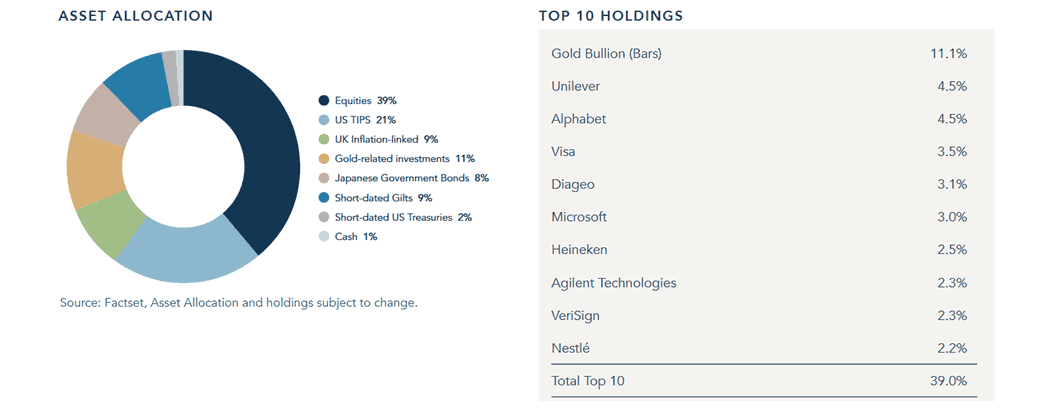
The investment trust offers exposure to UK and overseas shares
Source: Personal Assets Trust

The remainder of the fund is locked up in safe-haven assets like gold, government bonds and cash, which balances investor risk and helps provide a smooth return across the economic cycle.

Personal Assets Trust remains vulnerable to broader movements on stock markets. But I think it’s still a great investment trust to consider to manage risk and target super returns.


Royston Wild has no position in any of the shares mentioned. The Motley Fool UK has no position in any of the shares mentioned. Views expressed on the companies mentioned in this article are those of the writer and therefore may differ from the official recommendations we make in our subscription services such as Share Advisor, Hidden Winners and Pro. Here at The Motley Fool we believe that considering a diverse range of insights makes us better investors.

More on Investing Articles

Investing Articles

Want to start buying shares next week with £200 or £300? Here’s how!

Ever thought of becoming a stock market investor? Christopher Ruane explains how someone could start buying shares even on a…

Read more »

Rear view image depicting a senior man in his 70s sitting on a bench leading down to the iconic Seven Sisters cliffs on the coastline of East Sussex, UK. The man is wearing casual clothing - blue denim jeans, a red checked shirt, navy blue gilet. The man is having a rest from hiking and his hiking pole is leaning up against the bench.
Investing Articles

2 ideas for a SIPP or ISA in 2026

Looking for stocks for an ISA or SIPP portfolio? Our writer thinks a FTSE 100 defence giant and fallen pharma…

Read more »

Midnight is celebrated along the River Thames in London with a spectacular and colourful firework display.
Investing Articles

Could buying this stock at $13 be like investing in Tesla in 2011?

Tesla stock went on to make early investors a literal fortune. Our writer sees some interesting similarities with this eVTOL…

Read more »

Close-up of British bank notes
Investing Articles

3 reasons the Lloyds share price could keep climbing in 2026

Out of 18 analysts, 11 rate Lloyds a Buy, even after the share price has had its best year for…

Read more »

Chalkboard representation of risk versus reward on a pair of scales
Growth Shares

Considering these UK shares could help an investor on the road to a million-pound portfolio

Jon Smith points out several sectors where he believes long-term gains could be found, and filters them down to specific…

Read more »

Close-up image depicting a woman in her 70s taking British bank notes from her colourful leather wallet.
Investing For Beginners

Martin Lewis is embracing stock investing, but I think he missed a key point

It's great that Martin Lewis is talking about stocks, writes Jon Smith, but he feels he's missed a trick by…

Read more »

House models and one with REIT - standing for real estate investment trust - written on it.
Investing Articles

This 8% yield could be a great addition to a portfolio of dividend shares

Penny stocks don't usually make for great passive income investments. But dividend investors should consider shares in this under-the-radar UK…

Read more »

Queen Street, one of Cardiff's main shopping streets, busy with Saturday shoppers.
Investing Articles

Why this 9.71% dividend yield might be a rare passive income opportunity

This REIT offers a 9.71% dividend yield from a portfolio with high occupancy, long leases, and strong rent collection from…

Read more »