£5k invested in FTSE banks before interest rates started to rise is now worth…

Jon Smith looks at the performance of a basket of FTSE banks over the past few years and is very impressed with his findings.

| More on:

The content of this article was relevant at the time of publishing. Circumstances change continuously and caution should therefore be exercised when relying upon any content contained within this article.

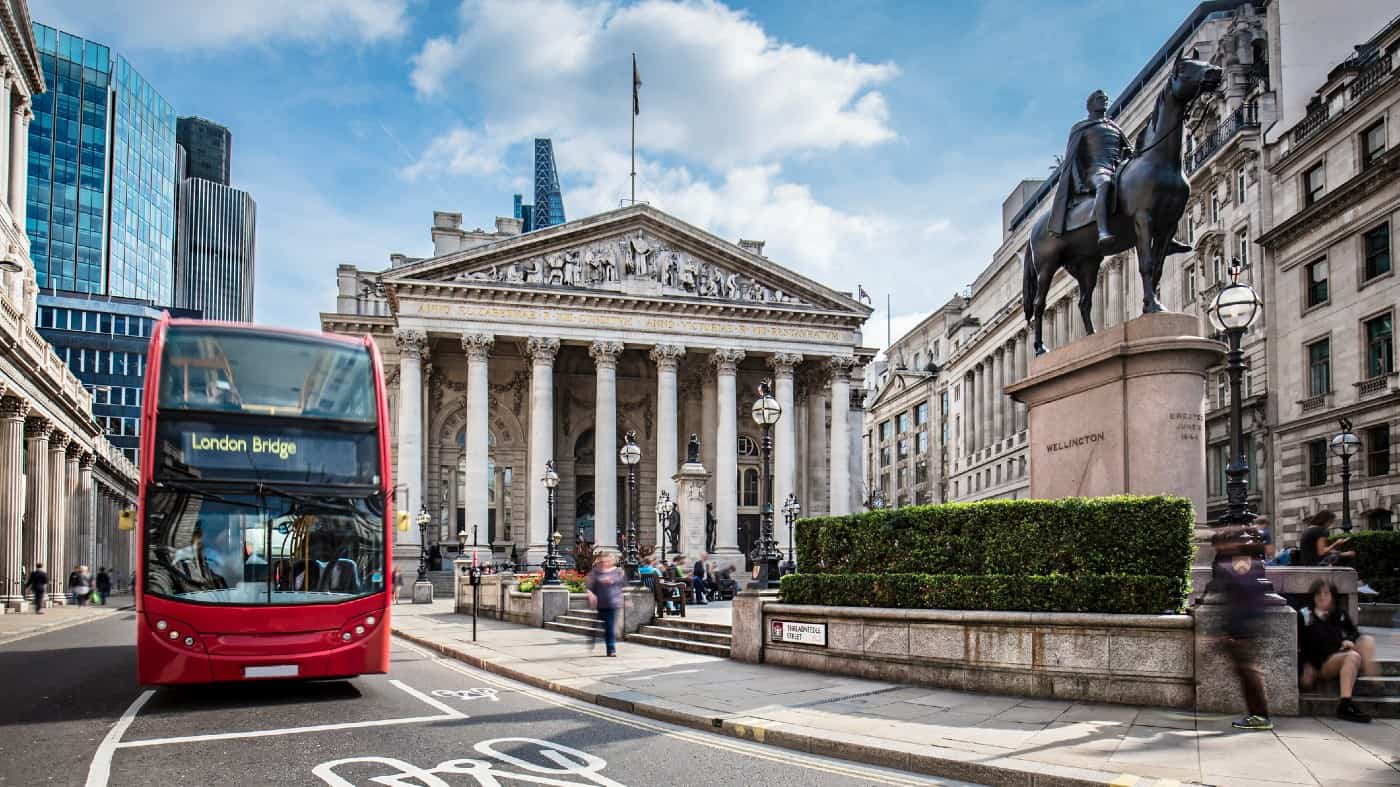
Bus waiting in front of the London Stock Exchange on a sunny day.

Image source: Getty Images

You’re reading a free article with opinions that may differ from The Motley Fool’s Premium Investing Services. Become a Motley Fool member today to get instant access to our top analyst recommendations, in-depth research, investing resources, and more. Learn More.

At the December 2021 meeting of the Bank of England, the committee decided to raise interest rates by 0.15% to 0.25%. This was the first move that signalled the intent to raise rates to start fighting rising inflation. Over the next couple of years, the base rate rocketed higher to 5.25%. FTSE banking stocks benefited from this, with any investment made in late 2021 looking very attractive now.

Leading the charge

I’m going to assume that instead of putting all eggs in one basket, an investor might have split £5,000 between five different banks. This would enable the overall risk to be lowered in case one underperformed. For example, they could have picked Barclays, HSBC, Lloyds, NatWest, and Metro Bank (LSE:MTRO).

If £1,000 was put in at the start of December 2021 in each bank, the blended percentage return from all five would give the total current value. Interestingly, the best performer was NatWest Group, gaining 123% over this period. The worst performer was Metro Bank, up just 15%. Overall, the return for the banking portfolio was 74.7%. So the £5,000 would currently be worth £8,735.

That’s impressive, especially when I consider that the FTSE 100 overall is up 21% over the same period.

The benefit of high interest rates

To some extent, the belief that interest rates would rise sharply would mean that buying banking stocks was a smart move. All the banks in the portfolio make money primarily via the net interest margin. This refers to the difference between the rate charged on loans and the rate paid out on deposits. When the base rate is near zero, there isn’t much margin to be made (unless you have negative deposit rates!). When the base rate rises, so does net interest income.

Metro Bank benefited from this. According to its 2022 full-year results, the net interest margin rose from 1.23% in 2021 to 1.91% in 2022. Net interest income increased to £475.6m in 2022 (up from £353.2m in 2021). Metro Bank had a sticky deposit base due to its branch-heavy model, allowing it to benefit more than fintech firms. In 2022, total deposits were £16bn, helping support its loan growth and interest earnings.

The share price is up 221% in the last year, although this is slightly misleading as the share price was falling in late 2023 and early 2024 due to it having to implement a £925m refinancing package. This was related to issues in meeting regulatory capital requirements and wasn’t a good look for the bank.

Looking ahead

Even though the banks have done very well, I’m not massively optimistic looking forward. Interest rates are now falling, and should continue to do so. Even though the banks can still remain profitable through other income streams, I don’t see the same kind of gains as likely for the next few years. Therefore, I’ll be looking to other sectors (such as AI) as growth areas for the future.


HSBC Holdings is an advertising partner of Motley Fool Money. Jon Smith has no position in any of the shares mentioned. The Motley Fool UK has recommended Barclays Plc, HSBC Holdings, and Lloyds Banking Group Plc. Views expressed on the companies mentioned in this article are those of the writer and therefore may differ from the official recommendations we make in our subscription services such as Share Advisor, Hidden Winners and Pro. Here at The Motley Fool we believe that considering a diverse range of insights makes us better investors.

More on Growth Shares

Investing Articles

Down 34% in 2025 — but could this be one of the UK’s top growth stocks for 2026?

With clarity over research funding on the horizon, could Judges Scientific be one of the UK’s best growth stocks to…

Read more »

piggy bank, searching with binoculars
Investing Articles

Can the rampant Barclays share price beat Lloyds in 2026?

Harvey Jones says the Barclays share price was neck and neck with Lloyds over the last year, and checks out…

Read more »

Investing Articles

Here’s how Rolls-Royce shares could hit £25 in 2026

If Rolls-Royce shares continue their recent performance, then £25 might be on the cards for 2026. Let's take a look…

Read more »

Departure & Arrival sign, representing selling and buying in a portfolio
Investing Articles

Prediction: in 2026 the red-hot Rolls-Royce share price could turn £10,000 into…

Harvey Jones can't believe how rapidlly the Rolls-Royce share price has climbed. Now he looks at the FTSE 100 growth…

Read more »

UK coloured flags waving above large crowd on a stadium sport match.
Investing Articles

Prediction: the Vodafone share price could soar 40% in 2026

Despite a great 2025, the Vodafone share price is still down 20% over five years. The latest predictions suggest more…

Read more »

Investing Articles

I asked ChatGPT to name 3 epic growth stocks to buy in 2026 and it said…

Harvey Jones is looking to inject some excitement into his portfolio this year and wondered if ChatGPT could suggest some…

Read more »

Businessman using pen drawing line for increasing arrow from 2024 to 2025
Investing Articles

What £10,000 invested in Babcock’s and BAE Systems’ shares 1 year ago is worth today…

Harvey Jones says BAE Systems' shares have been going great guns while fellow FTSE 100 defence stock Babcock has shot…

Read more »

One English pound placed on a graph to represent an economic down turn
Investing Articles

Lloyds’ share price near £1: has the easy money already been made?

With the Lloyds share price struggling to break above £1, Mark Hartley questions whether its years-long rally has come to…

Read more »