
With no savings at 30, here’s how an investor can work towards a huge passive income portfolio

Consistency is key, and it can certainly pay to start contributing to an ISA sooner rather than later in the pursuit of passive income.

| More on:

The content of this article was relevant at the time of publishing. Circumstances change continuously and caution should therefore be exercised when relying upon any content contained within this article.

Young black colleagues high-fiving each other at work

Image source: Getty Images

You’re reading a free article with opinions that may differ from The Motley Fool’s Premium Investing Services. Become a Motley Fool member today to get instant access to our top analyst recommendations, in-depth research, investing resources, and more. Learn More.

Millions of us invest for passive income. However, most don’t know where to start. That’s especially the case for those of us without anything saved.

So where does an investor begin, especially with no nest egg at age 30? The answer, as ever, is deceptively simple. Start putting aside a portion of salary each month.

Even if the amount feels modest at first — perhaps £100 or £200, whatever is manageable — the key is consistency. By treating savings as a non-negotiable expense, akin to rent or council tax, a foundation’s created for a future portfolio that works independently.

Compounding magic

But here’s the real magic: compounding. This is the quiet force that transforms small, regular investments into substantial wealth over time. And that’s important. Because we need substantial wealth in order to earn a passive income.

For example, if £200 is invested each month from age 30, and an average annual return of 5% is achieved, by age 65 the resulting pot could be well into six figures. However, more successful investors may be able to average double-digit returns over the period.

As we can see from the below chart, £200 a month could compound into nearly £800,000 with 10% annualised growth (which not everyone will be able to achieve).
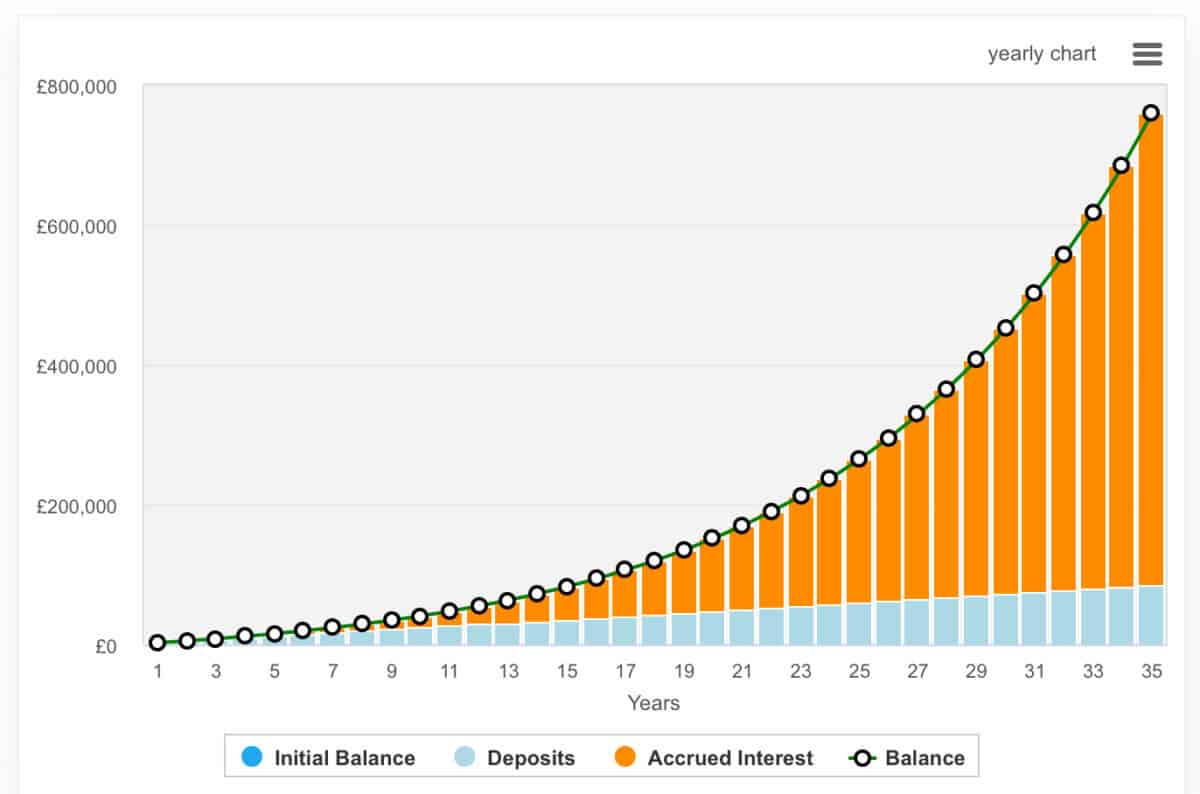
Souce: thecalculatorsite.com

The earlier the start, the more powerful compounding becomes. Consider two hypothetical investors: one begins at 30, the other waits until 40 but doubles the monthly contribution. Despite putting in more money, the late starter’s unlikely to catch up, simply because the early bird’s money has had more time to snowball.

Reinvesting dividends is another crucial lever. Rather than taking payouts as cash, dividends need to be ploughed back into holdings. This creates a virtuous cycle that accelerates growth.

Above all, patience is the greatest ally. The urge to tinker or chase fads can be ignored. Time and compounding do the heavy lifting.

Where to invest?

Let’s be practical and not assume a 10% return. One option that could be considered as part of a diverse portfolio over the next 35 years is Lloyds (LSE:LLOY). The British lender offers a blend of income and value for investors seeking exposure to the banking sector. Despite recent volatility, including the motor finance mis-selling probe, Lloyds is resilient with strong capital buffers and a progressive dividend policy.

Looking ahead, Lloyds’ forward earnings are forecast to improve. Earnings per share (EPS) are projected at 6.5p in 2025, rising to 8.85p in 2026 and 10.68p in 2027.

As such, the forward price-to-earnings (P/E) ratio’s expected to decline from 10.9 times in 2025 to 8 times in 2026 and 6.6 times in 2027. Dividends are also set to grow, with forecasts of 3.44p per share in 2025, 4.07p in 2026, and 4.64p in 2027, translating to yields between 4.9% and 6.6%.
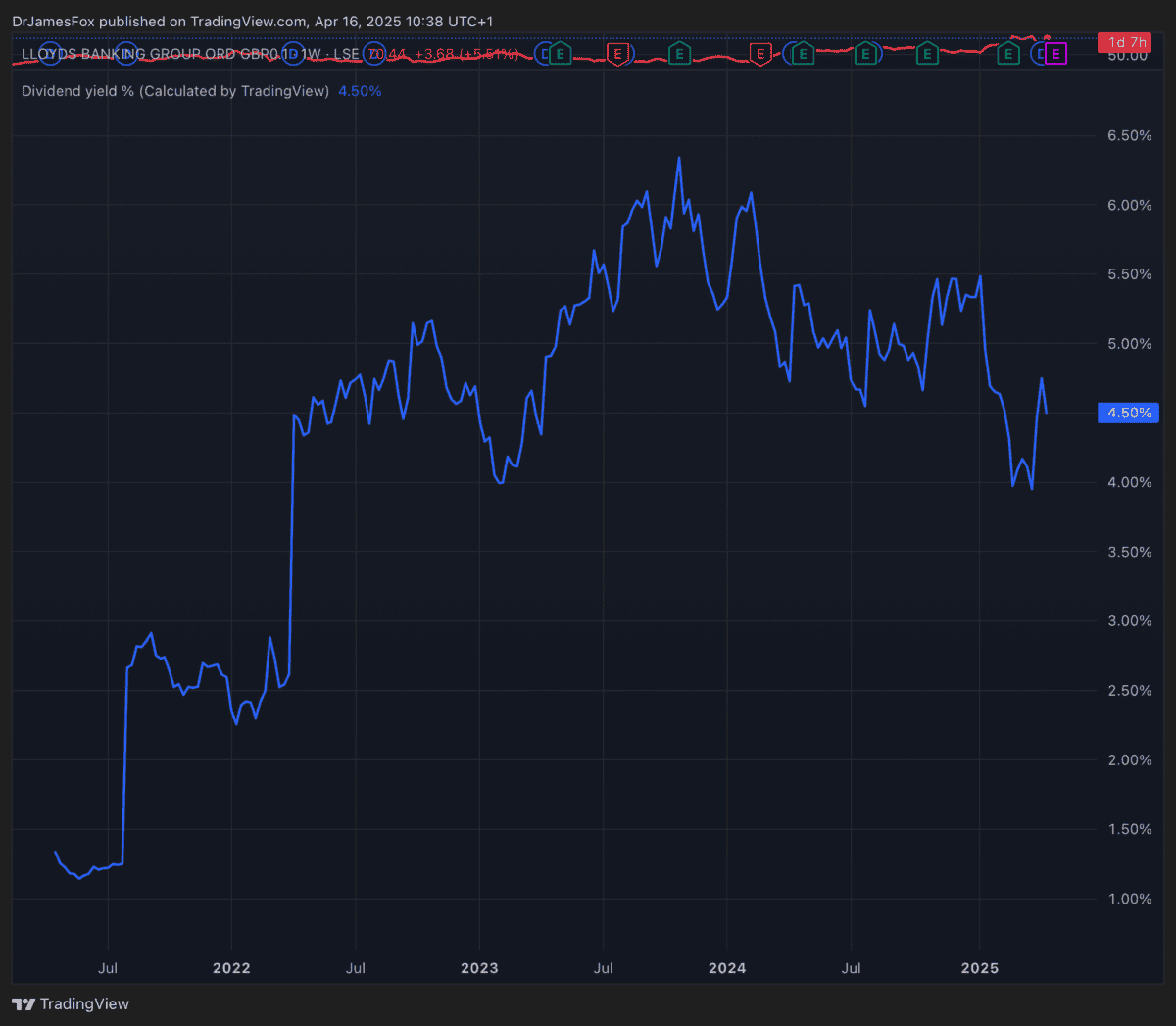
Source: TradingView — Trailing Dividend Yield

What’s more, the payout ratio remain sustainable.
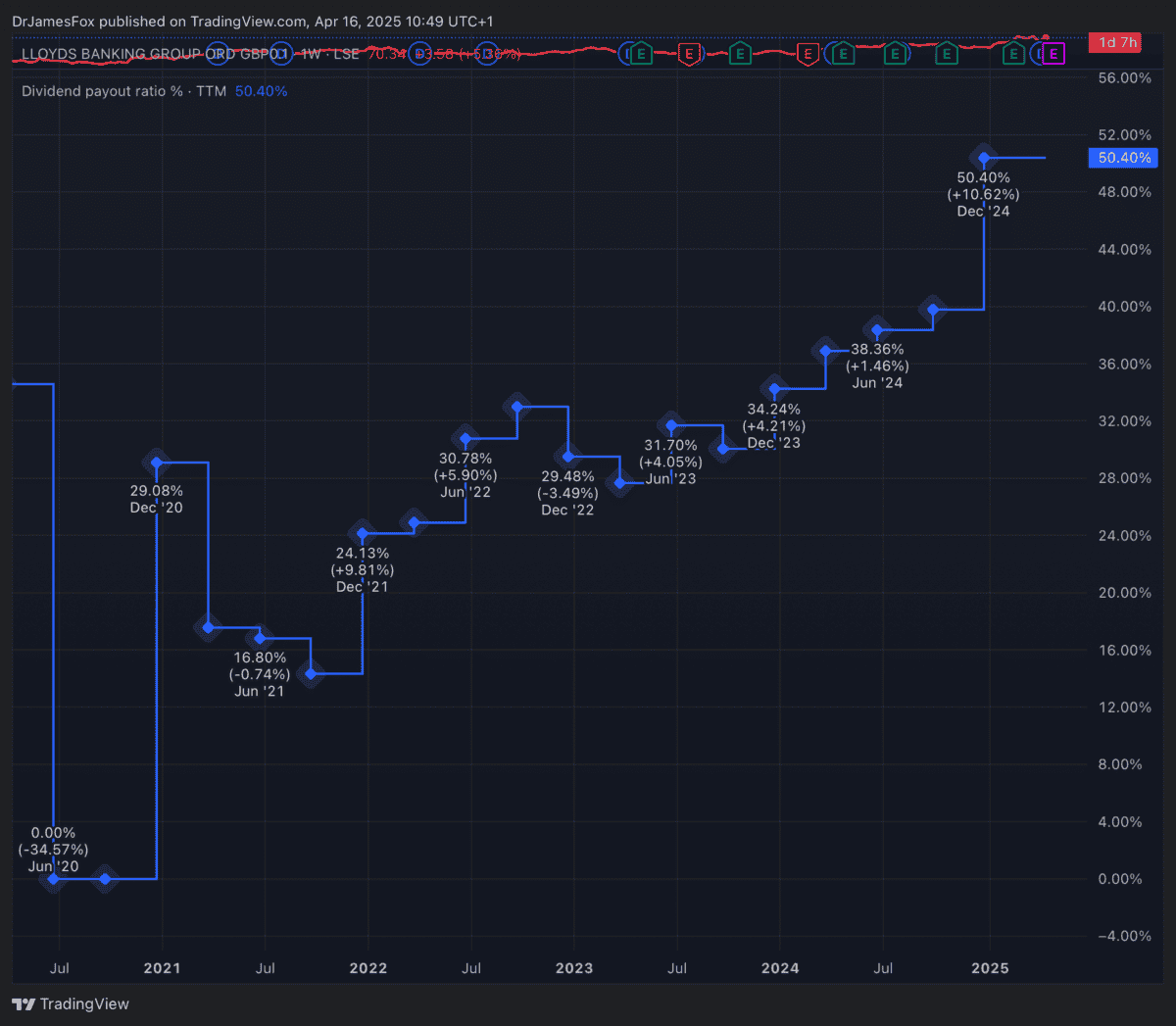
Source: TradingView

Risks persist, of course. The UK economy could face a slowdown because of US tariffs, and this really isn’t good for banks, which typically reflect the health of the economy. However, it’s still an interesting proposition. Personally, I’m just holding on to my Lloyds shares, rather than buying more, due to concentration risk.


James Fox has positions in Lloyds Banking Group Plc. The Motley Fool UK has recommended Lloyds Banking Group Plc. Views expressed on the companies mentioned in this article are those of the writer and therefore may differ from the official recommendations we make in our subscription services such as Share Advisor, Hidden Winners and Pro. Here at The Motley Fool we believe that considering a diverse range of insights makes us better investors.

More on Investing Articles

Illustration of flames over a black background
Investing Articles

Recently released: December’s higher-risk, high-reward stock recommendation [PREMIUM PICKS]

Fire ideas will tend to be more adventurous and are designed for investors who can stomach a bit more volatility.

Read more »

Abstract 3d arrows with rocket
Growth Shares

Will the SpaceX IPO send this FTSE 100 stock into orbit?

How can British investors get exposure to SpaceX? Here is one FTSE 100 stock that might be perfect for those…

Read more »

Array of piggy banks in saturated colours on high colour contrast background
Investing Articles

Could drip-feeding £500 into the FTSE 250 help you retire comfortably?

Returns from FTSE 250 shares have rocketed to 10.6% over the last year. Is now the time to plough money…

Read more »

Passive and Active: text from letters of the wooden alphabet on a green chalk board
Investing Articles

How much does one need in an ISA for £2,056 monthly passive income?

The passive income potential of the Stocks and Shares ISA is higher than perhaps all other investments. Here's how the…

Read more »

Finger clicking a button marked 'Buy' on a keyboard
Investing Articles

The best time to buy stocks is when they’re cheap. Here’s 1 from my list

Buying discounted stocks can be a great way to build wealth and earn passive income. But investors need to be…

Read more »

Bus waiting in front of the London Stock Exchange on a sunny day.
Investing Articles

Martin Lewis just explained the stock market’s golden rule

Unlike cash, the stock market can quietly turn lump sums into serious wealth. So, what’s the secret sauce that makes…

Read more »

Close-up of British bank notes
Investing Articles

£5,000 invested in Greggs shares at the start of 2025 is now worth…

This year's been extremely grim for FTSE 250-listed Greggs -- but having slumped more than 40%, could its shares be…

Read more »

Investing Articles

Looking for shares to buy as precious metals surge? 3 things to remember!

Gold prices have been on a tear. So has silver. So why isn't this writer hunting for shares to buy…

Read more »