
How much passive income could an investor earn if they put £200 a month in an ISA?

Millions of Britons use the Stocks and Shares ISA as a vehicle to build a large pot of money and eventually earn a tax-free second income.

| More on:

The content of this article was relevant at the time of publishing. Circumstances change continuously and caution should therefore be exercised when relying upon any content contained within this article.

Mother At Home Getting Son Wearing Uniform Ready For First Day Of School

Image source: Getty Images

You’re reading a free article with opinions that may differ from The Motley Fool’s Premium Investing Services. Become a Motley Fool member today to get instant access to our top analyst recommendations, in-depth research, investing resources, and more. Learn More.

Investing £200 a month in a Stocks and Shares ISA can be a transformative strategy for building wealth over the long term. With a 20-year horizon and assuming a 10% annualised return, the power of compounding can turn modest monthly contributions into a substantial portfolio capable of generating significant passive income. Let’s examine how this works.

Starting with the maths

Over 20 years, monthly contributions of £200 would total £48,000. However, with a 10% annualised return, the portfolio could grow to around £151,874 by the end of the period. This includes £103,874 in interest earned through compounding. The formula for compound growth demonstrates how reinvesting returns amplify portfolio growth over time.

At this point, assuming a 5% dividend yield, the portfolio could generate an annual passive income of £7,594 a year — or £633 a month — providing a steady stream of cash flow that far exceeds the initial monthly investment.
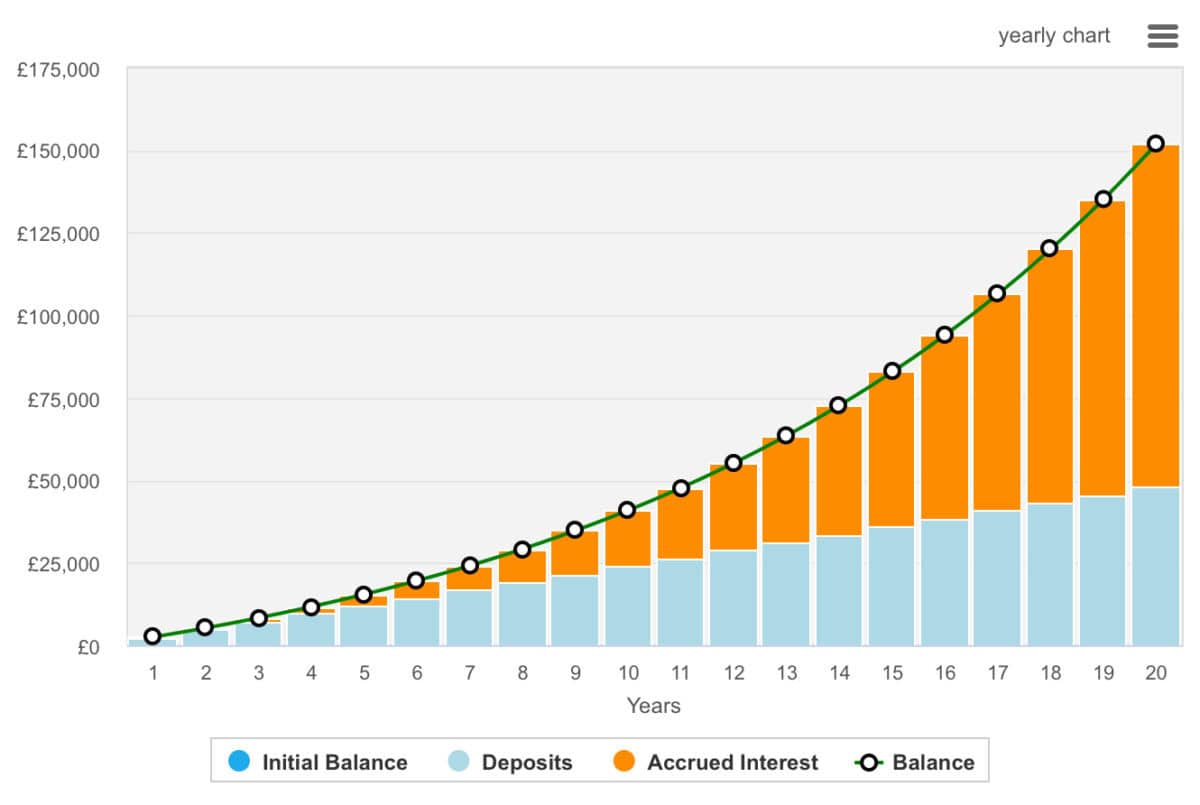
Created at thecalculatorsite.com

Of course, there are several things to note here. Firstly, the investor might not achieve a 10% return. Some get more, but many others get less. Then, £633 won’t go as far in 20 years as it does today. In fact, in two decades tat would feel like around £386.34 in today’s money, assuming a steady annual inflation rate of 2.5%.

And this is why investors typically take a very long-term approach. And that’s because the portfolio will start earning interest on interest. This is something of a snowball effect. After a further 10 years of investing, that £200 a month would be worth more than £450,000.

Please note that tax treatment depends on the individual circumstances of each client and may be subject to change in future. The content in this article is provided for information purposes only. It is not intended to be, neither does it constitute, any form of tax advice. Readers are responsible for carrying out their own due diligence and for obtaining professional advice before making any investment decisions.
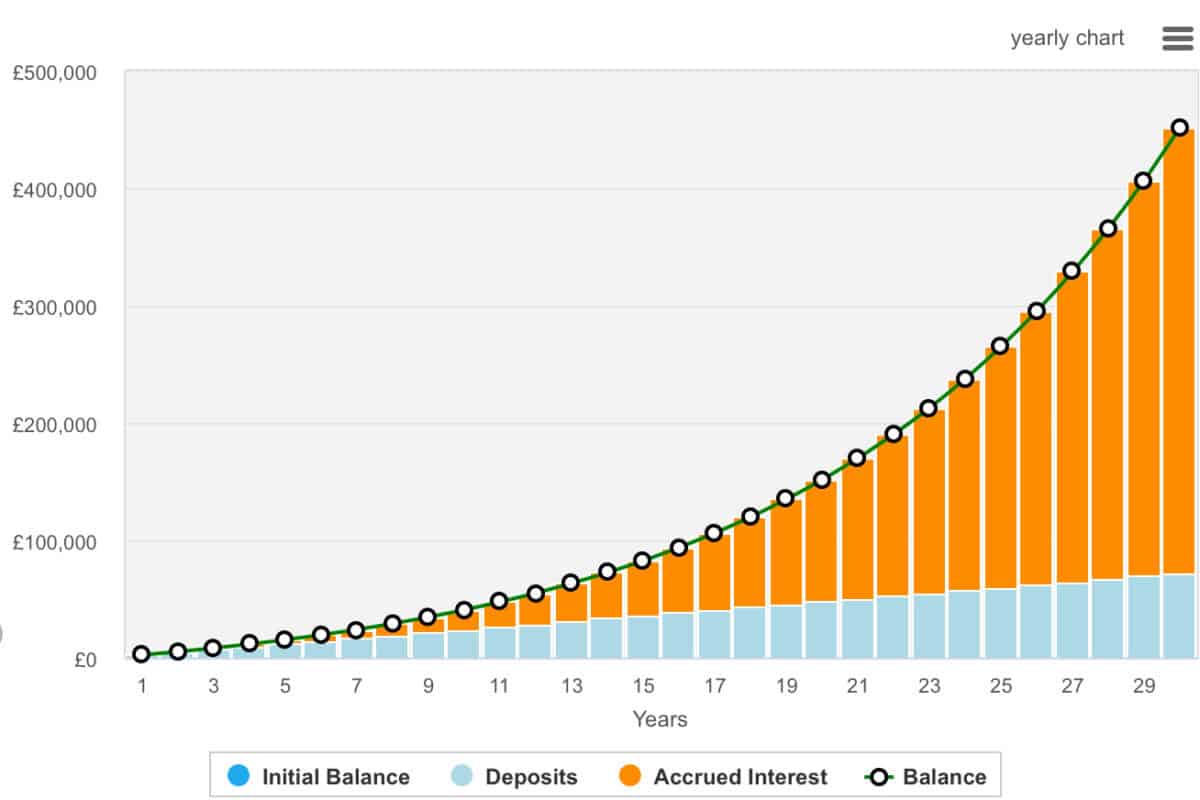
Created at thecalculatorsite.com

One for consideration

One standout option for consideration is Scottish Mortgage Investment Trust (LSE:SMT). Managed by Baillie Gifford, this trust offers exposure to some of the world’s most innovative and disruptive companies. Its portfolio spans both public and private firms, providing access to opportunities that are often unavailable to retail investors.

Current holdings include high-growth businesses like Amazon, Nvidia, and SpaceX, alongside emerging market leaders such as MercadoLibre and Meituan. This global diversification makes Scottish Mortgage an attractive choice for long-term investors seeking exposure to technological change and future market leaders.

Scottish Mortgage’s high-conviction approach is central to its appeal. Managers Tom Slater and Lawrence Burns focus on identifying companies capable of creating new markets or disrupting existing ones. This thematic strategy has delivered outsized returns in the past, with notable successes like Nvidia and Moderna.

However, it’s not without risks. The trust’s significant allocation to private companies introduces liquidity risks. These assets can be harder to sell during market downturns. Another key risk is gearing, or borrowing to invest. This is a strategy employed by Scottish Mortgage to enhance long-term returns.

While gearing can amplify gains in rising markets, it also exacerbates losses during downturns. The trust’s net gearing currently stands at 11%. This means its exposure to equities exceeds its shareholders’ funds by this proportion.

Despite these risks, Scottish Mortgage remains an appealing option for adventurous investors with a long-term perspective to consider. It’s a stock I’ll top up on with the market pulling back.


John Mackey, former CEO of Whole Foods Market, an Amazon subsidiary, is a member of The Motley Fool’s board of directors. James Fox has positions in Nvidia and Scottish Mortgage Investment Trust Plc. The Motley Fool UK has recommended Amazon, MercadoLibre, Moderna, and Nvidia. Views expressed on the companies mentioned in this article are those of the writer and therefore may differ from the official recommendations we make in our subscription services such as Share Advisor, Hidden Winners and Pro. Here at The Motley Fool we believe that considering a diverse range of insights makes us better investors.

More on Investing Articles

Two employees sat at desk welcoming customer to a Tesla car showroom
Investing Articles

Could 2026 be the year when Tesla stock implodes?

Tesla's 2025 business performance has been uneven. But Tesla stock has performed well overall and more than doubled since April.…

Read more »

Portrait of elderly man wearing white denim shirt and glasses looking up with hand on chin. Thoughtful senior entrepreneur, studio shot against grey background.
Investing Articles

Could these FTSE 100 losers be among the best stocks to buy in 2026?

In the absence of any disasters, Paul Summers wonders if some of the worst-performing shares in FTSE 100 this year…

Read more »

Midnight is celebrated along the River Thames in London with a spectacular and colourful firework display.
Investing Articles

Up 184% this year, what might this FTSE 100 share do in 2026?

This FTSE 100 share has almost tripled in value since the start of the year. Our writer explains why --…

Read more »

Close-up as a woman counts out modern British banknotes.
Investing Articles

You can save £100 a month for 30 years to target a £2,000 a year second income, or…

It’s never too early – or too late – to start working on building a second income. But there’s a…

Read more »

Hydrogen testing at DLR Cologne
Investing Articles

Forget Rolls-Royce shares! 2 FTSE 100 stocks tipped to soar in 2026

Rolls-Royce's share price is expected to slow rapidly after 2025's stunning gains. Here are two top FTSE 100 shares now…

Read more »

Road 2025 to 2032 new year direction concept
Investing Articles

Brokers think this 83p FTSE 100 stock could soar 40% next year!

Mark Hartley takes a look at the factors driving high expectations for one major FTSE 100 retail stock – is…

Read more »

Investing Articles

I asked ChatGPT for the best FTSE 100 shares to consider for 2026, and it said…

Whatever an individual investor's favourite strategy, I reckon there's something for everyone among the shares in the FTSE 100.

Read more »

Investing Articles

3 FTSE 100 powerhouses to consider buying for passive income in 2026

Looking to start earning passive income in 2026? Paul Summers picks out three dividend heroes to consider from the UK's…

Read more »