
How much should investors put in an ISA to achieve the average UK wage in passive income?

Millions of Britons use the Stocks and Shares ISA as a vehicle to build wealth, but a successful investor can generate a considerable income.

| More on:

The content of this article was relevant at the time of publishing. Circumstances change continuously and caution should therefore be exercised when relying upon any content contained within this article.

Businessman hand stacking money coins with virtual percentage icons

Image source: Getty Images

You’re reading a free article with opinions that may differ from The Motley Fool’s Premium Investing Services. Become a Motley Fool member today to get instant access to our top analyst recommendations, in-depth research, investing resources, and more. Learn More.

Achieving financial independence through passive income is a top priority for many UK investors. And with the average UK salary projected to hit £37,000 in 2025, I’m wondering how much someone needs to invest in an ISA to generate this amount.

The numbers behind the dream

To earn an annualised £37,000 annually, an investor would need around £740,000 in an ISA. That’s based on the assumption that an investor could achieve an average dividend yield of 5%. This would mean earning a passive income without drawing down the balance of the portfolio. While £740,000 might sound like a lot of money to reach, it’s achievable. The only thing is, it takes time.

Stocks and Shares ISAs have outperformed their cash counterparts, offering an average return of 11.9% in the year leading up to February 2025, compared to just 3.8% for Cash ISAs. This significant difference underscores the potential of equity-based investments for long-term wealth generation.

However, it’s important to note that investing in stocks carries risks, and past performance is no guarantee of future returns. Diversification and a long-term strategy are key to mitigating these risks and maximising returns.

The road to £740,000

For most investors, accumulating £740,000 is no mean feat. It requires consistent saving, disciplined investing, and a clear financial plan. That’s just the start. It also requires investors to invest wisely, and as Warren Buffett states, to avoid losses. In the example below, I’ve assumed £500 of monthly contributions and a 10% annualised return. Under these circumstances it would take 26 years to compound to £740,000.
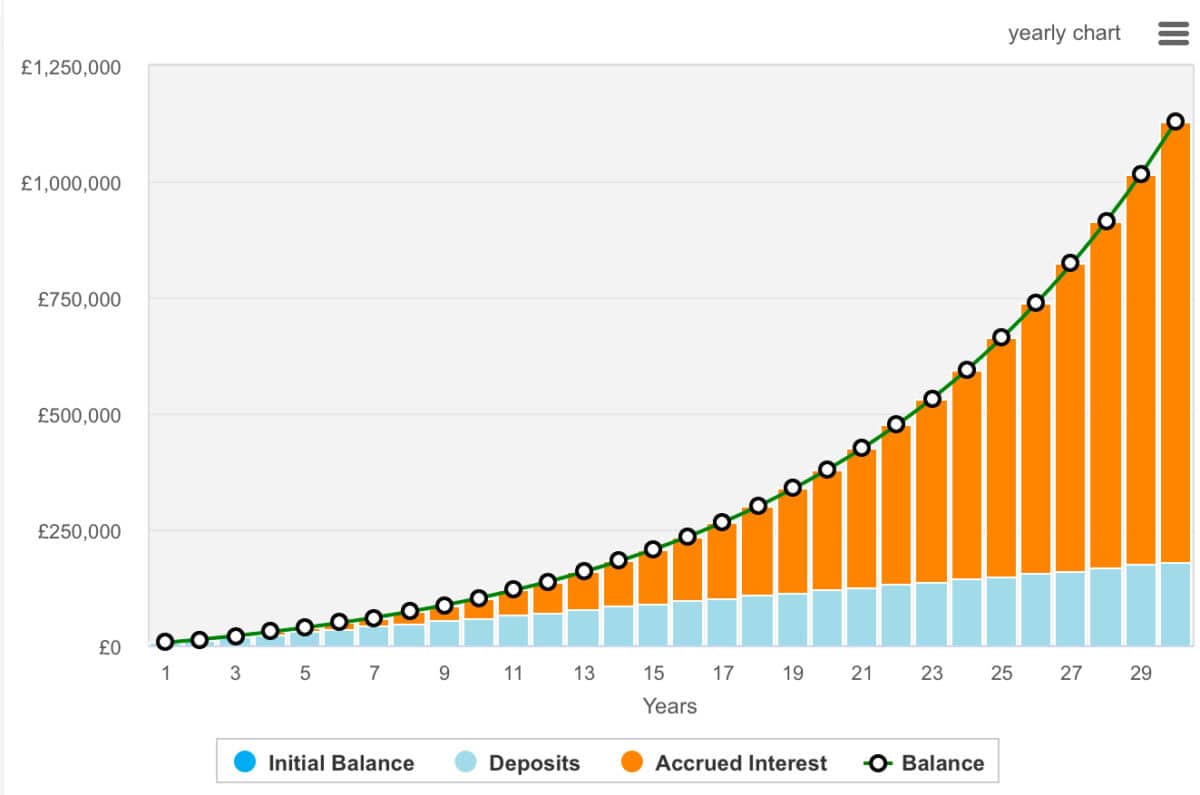
Created at thecalculatorsite.com

However, not everyone can achieve 10% annually. With 8% growth, it would take 30 years and lower percentage returns would take even longer.

A reality check

While the idea of earning the average UK wage passively is enticing, it’s crucial to approach this goal with realistic expectations. Market volatility, inflation, and unforeseen expenses can impact investment returns. It’s also the case that, assuming a constant inflation rate of 2.5% per year, £37,000 today will feel like approximately £19,558.47 in today’s money after 26 years.

An investment to consider

Here’s one from my daughter’s SIPP that investors may want to consider.

The Monks Investment Trust (LSE:MNKS) is a globally-focused investment trust managed by Baillie Gifford, aiming to deliver long-term capital growth through a diversified portfolio of growth-oriented equities. Its strategy emphasises adaptability, investing in companies positioned to thrive amid structural and cyclical changes.

The trust’s approach includes identifying businesses that innovate to reduce costs or improve service quality, ensuring resilience across market cycles. Over the long term, Monks has performed well, with a net asset value (NAV) total return of 173.2% over 10 years as of March 2025. 

However, the trust employs gearing (borrowing to invest), which can amplify returns but also increases risk. If investments underperform, the cost of borrowing can lead to significant losses, particularly during market downturns.

Despite this, the trust’s disciplined risk management and focus on long-term fundamentals make it an attractive option. It’s something I may buy more of, for my daughter’s SIPP at least.


James Fox has positions in The Monks Investment Trust Plc. The Motley Fool UK has no position in any of the shares mentioned. Views expressed on the companies mentioned in this article are those of the writer and therefore may differ from the official recommendations we make in our subscription services such as Share Advisor, Hidden Winners and Pro. Here at The Motley Fool we believe that considering a diverse range of insights makes us better investors.

More on Investing Articles

Warren Buffett at a Berkshire Hathaway AGM
Investing Articles

Can someone invest like Warren Buffett with a spare £500?

Christopher Ruane explains why an investor without the resources of billionaire Warren Buffett could still learn from his stock market…

Read more »

Investing Articles

Can these 2 incredible FTSE 250 dividend stocks fly even higher in 2026?

Mark Hartley examines the potential in two FTSE 250 shares that have had an excellent year and considers what 2026…

Read more »

Thoughtful man using his phone while riding on a train and looking through the window
Investing Articles

Is 45 too late to start investing?

Investing at different life stages can come with its own challenges -- and rewards. Our writer considers why a 45-year-old…

Read more »

Hand of person putting wood cube block with word VALUE on wooden table
Investing Articles

UK shares look cheap — but the market might be about to take notice

UK shares have traded at a persistent discount to their US counterparts. This can create huge opportunities, but investors need…

Read more »

Investing Articles

This FTSE 100 growth machine is showing positive signs for a 2026 recovery

FTSE 100 distributor Bunzl is already the second-largest holding in Stephen Wright’s Stocks and Shares ISA. What should his next…

Read more »

Investing Articles

I asked ChatGPT for the best FTSE 100 stocks to buy for passive income in 2026 and it said…

Paul Summers wanted to learn which dividend stocks an AI bot thinks might be worth buying for 2026. Its response…

Read more »

ISA Individual Savings Account
Investing Articles

Stop missing out! A Stocks and Shares ISA could help you retire early

Investors who don't use a Stocks and Shares ISA get all the risks that come with investing but with less…

Read more »

Investing Articles

Will Greggs shares crash again in 2026?

After a horrible 2025, Paul Summers takes a look at whether Greggs shares could sink even further in price next…

Read more »