How much money would investors need to target a £10,000 monthly passive income?

Millions of us invest for passive income, but many simply don’t know what we can achieve. Dr James Fox lays out a tried-and-tested formula for income.

| More on:

The content of this article was relevant at the time of publishing. Circumstances change continuously and caution should therefore be exercised when relying upon any content contained within this article.

Little girl helping her Grandad plant tomatoes in a greenhouse in his garden.

Image source: Getty Images

You’re reading a free article with opinions that may differ from The Motley Fool’s Premium Investing Services. Become a Motley Fool member today to get instant access to our top analyst recommendations, in-depth research, investing resources, and more. Learn More.

Different analysts will have their own opinions, but I’d suggest that £2.4m is just enough money to generate £10,000 a month. or £120,000 a year.

That’s based on having £2.4m invested in stocks, debt, bonds or active savings that collectively pay an average of 5% annually. What’s more, when this money is invested within a Stocks and Shares ISA, that income would be entirely tax free. That’s the equivalent of earnings £205,000 annually in a salaried job, given the current tax bands.

Please note that tax treatment depends on the individual circumstances of each client and may be subject to change in future. The content in this article is provided for information purposes only. It is not intended to be, neither does it constitute, any form of tax advice. Readers are responsible for carrying out their own due diligence and for obtaining professional advice before making any investment decisions.

Wait! It may be easier than you think

Now, I’m sure many Britons will have zoned out when they saw the figure £2.4m. However, it’s much more achievable than many people think. The answer lies in the economics of a pension, which admittedly many people won’t be familiar with as they don’t actively manage it throughout their working career.

Nonetheless, there’s a critical component and it’s called ‘compounding’. When we invest over a long period of time, our gains compound as each year builds on the next. It may not sound like a winning strategy, but it really is.

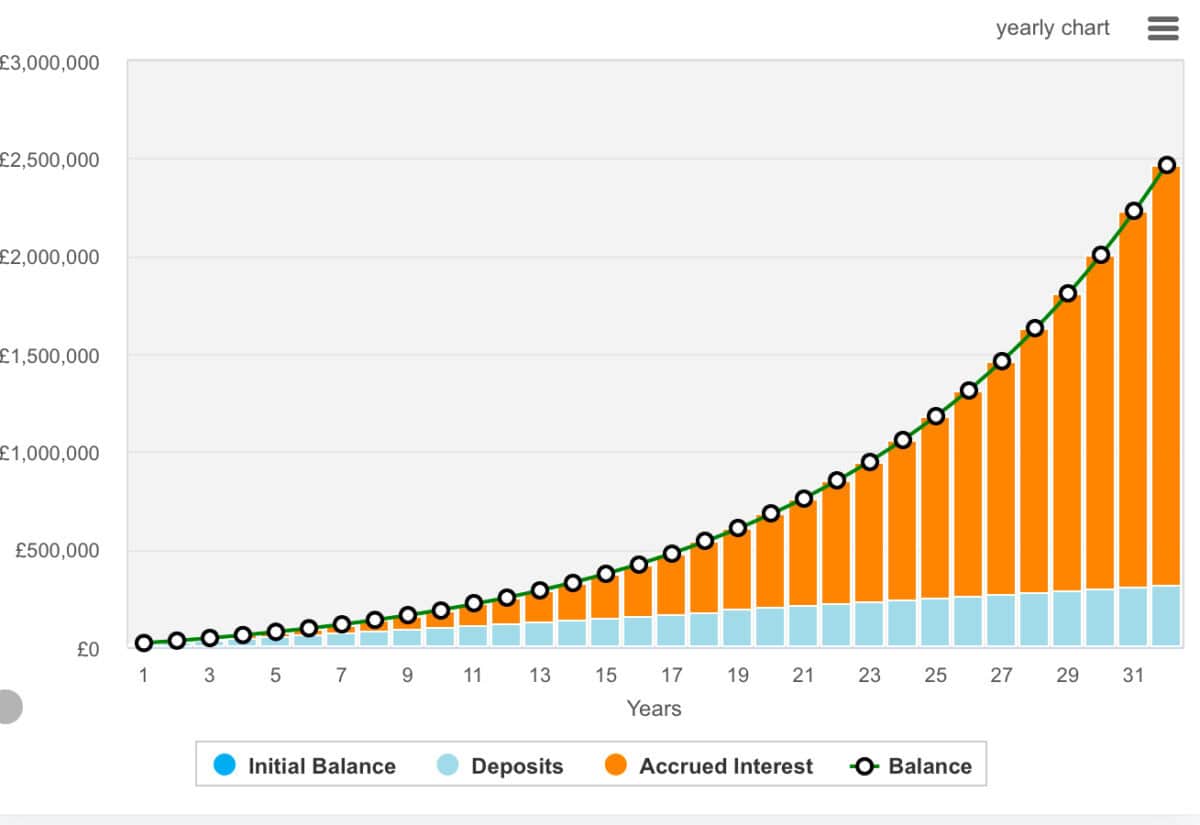
Here’s just one example of how an investor might be able to build a £2.4m portfolio:

  • Initial investment of £10,000
  • Monthly contributions of £800
  • 32 years of consistent contributions and reinvestment
  • An average annualised return of 10%
Created at thecalculatorsite.com

Investing well is key

The above formula is great. However, it doesn’t tell us how to invest. And if we invest poorly, we can lose money. Sadly, this is what happens to lots of novice investors looking to replicate get-rich-quick stories.

Many financial planners or analysts will start by recommending index funds — these attempt to track the performance of an index like the FTSE 100. This is a great approach to achieve diversification quickly.

However, the more adventurous may want to consider investing in individual stocks, more focused funds, or trusts. The Monks Investment Trust (LSE:MNKS) is one with interesting prospects, aiming for long-term capital growth — instead of income. This is because the fund’s managers are attracted to “businesses addressing a particular ‘crisis’ in a novel manner which can help to reduce costs and/or produce a radically improved quality of service”.

Over the past 10 years, the shares have seen 246% growth, driven by investments in companies such as Meta, Amazon, Microsoft, TSMC, and Nvidia, which also represent the five largest holdings.

However, it’s very diversified with the largest holdings all representing less than 5%. The trust’s portfolio consists of about 100 holdings across various growth profiles. As of February, it has total assets of £3,056m and a low ongoing charge of 0.44%. The trust’s dividend yield is just 0.16%. 

Risks? Well, its top holdings are big tech names and some of those valuations are getting a little frothy, and some analysts will suggest that a downturn’s coming. However, over the long run, these big tech names look set to dominate.

Another risk of investing in Monks is the use of gearing (borrowing to invest). The trust can borrow money to make further investments, which can amplify both gains and losses.

In short, it’s an investment I like a lot, and it’s one I’ve added to my daughter’s Self-Invested Personal Pension (SIPP) so I feel it’s worth considering.


Randi Zuckerberg, a former director of market development and spokeswoman for Facebook and sister to Meta Platforms CEO Mark Zuckerberg, is a member of The Motley Fool's board of directors. John Mackey, former CEO of Whole Foods Market, an Amazon subsidiary, is a member of The Motley Fool’s board of directors. James Fox has positions in Nvidia and The Monks Investment Trust Plc. The Motley Fool UK has recommended Amazon, Meta Platforms, Microsoft, Nvidia, and Taiwan Semiconductor Manufacturing. Views expressed on the companies mentioned in this article are those of the writer and therefore may differ from the official recommendations we make in our subscription services such as Share Advisor, Hidden Winners and Pro. Here at The Motley Fool we believe that considering a diverse range of insights makes us better investors.

More on Investing Articles

Investing Articles

Down 35% in 2 months! Should I buy NIO stock at $5?

NIO stock has plunged in recent weeks, losing a third of its market value despite surging sales. Is this EV…

Read more »

Two employees sat at desk welcoming customer to a Tesla car showroom
Investing Articles

Could 2026 be the year when Tesla stock implodes?

Tesla's 2025 business performance has been uneven. But Tesla stock has performed well overall and more than doubled since April.…

Read more »

Portrait of elderly man wearing white denim shirt and glasses looking up with hand on chin. Thoughtful senior entrepreneur, studio shot against grey background.
Investing Articles

Could these FTSE 100 losers be among the best stocks to buy in 2026?

In the absence of any disasters, Paul Summers wonders if some of the worst-performing shares in FTSE 100 this year…

Read more »

Midnight is celebrated along the River Thames in London with a spectacular and colourful firework display.
Investing Articles

Up 184% this year, what might this FTSE 100 share do in 2026?

This FTSE 100 share has almost tripled in value since the start of the year. Our writer explains why --…

Read more »

Close-up as a woman counts out modern British banknotes.
Investing Articles

You can save £100 a month for 30 years to target a £2,000 a year second income, or…

It’s never too early – or too late – to start working on building a second income. But there’s a…

Read more »

Hydrogen testing at DLR Cologne
Investing Articles

Forget Rolls-Royce shares! 2 FTSE 100 stocks tipped to soar in 2026

Rolls-Royce's share price is expected to slow rapidly after 2025's stunning gains. Here are two top FTSE 100 shares now…

Read more »

Road 2025 to 2032 new year direction concept
Investing Articles

Brokers think this 83p FTSE 100 stock could soar 40% next year!

Mark Hartley takes a look at the factors driving high expectations for one major FTSE 100 retail stock – is…

Read more »

Investing Articles

I asked ChatGPT for the best FTSE 100 shares to consider for 2026, and it said…

Whatever an individual investor's favourite strategy, I reckon there's something for everyone among the shares in the FTSE 100.

Read more »