
Share your opinion and earn yourself a free Motley Fool premium report!

We are looking for Fools to join a 75 minute online independent market research forum on 15th / 16th December.

To find out more and express your interest please click here

Here’s how much an investor would need in an ISA to earn £3,000 of passive income monthly

Millions of Britons could retire early or secure additional income in later life by considering some simple steps to generate passive income from an ISA.

| More on:

The content of this article was relevant at the time of publishing. Circumstances change continuously and caution should therefore be exercised when relying upon any content contained within this article.

Mature black woman at home texting on her cell phone while sitting on the couch

Image source: Getty Images

You’re reading a free article with opinions that may differ from The Motley Fool’s Premium Investing Services. Become a Motley Fool member today to get instant access to our top analyst recommendations, in-depth research, investing resources, and more. Learn More.

Generating passive income from investments is a worthwhile financial goal, and an Individual Savings Account (ISA) is an excellent vehicle for achieving it. For UK investors seeking to earn £3,000 in monthly passive income determining the required ISA balance, and how to get there, involves some shrewd planning.

Hitting the target

A widely-used benchmark is the 4% rule. This suggests an investor can withdraw 4% of their portfolio annually without significantly depleting their capital long term — this could be achieved by investing in dividend-paying stocks with an average yield of 4%. Based on this, an investor would need £900,000 in their ISA to generate £3,000 a month.

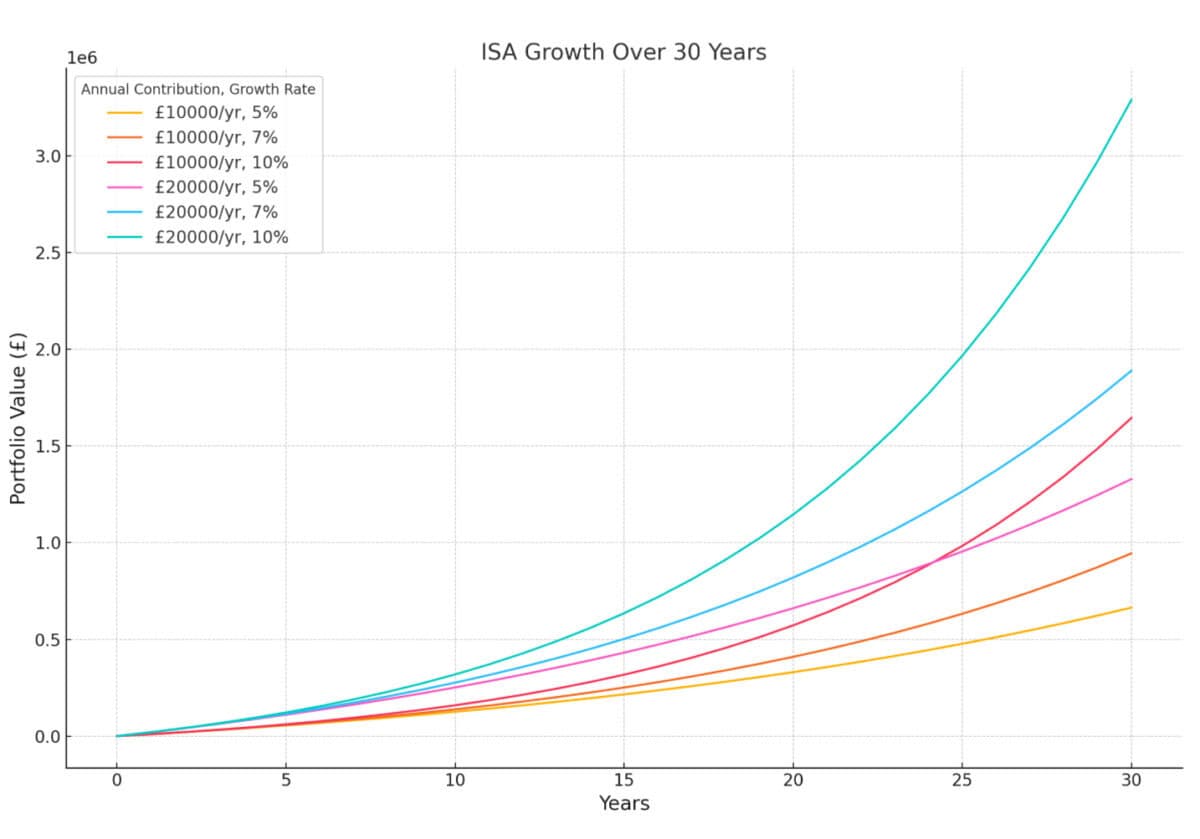
Achieving this balance depends on several factors, including initial contributions, the time horizon, and investment returns. ISA allowances permit up to £20,000 a tax year to be contributed. By doing this and investing in assets with an average annual return of 7% (a typical expectation for shares), an investor starting from £0 could potentially accumulate around £900,000 in 25 years. Of course, that’s not guaranteed and said investor could lose money as well as making it.

There are other ways to aim for the target. One could invest in higher dividend-paying stocks in an effort to generate a larger yield from a smaller balance. The required balance could also be achieved sooner or with less capital if the investor’s shrewd. This is highlighted in the below graph.
The art of the possible

Many novices will buy into index-tracking funds. These aim to track the performance of major indexes. For example, the FTSE 100 averaged 6.3% annually over 20 years, while FTSE 250 outperformed it. America’s S&P 500 returned about 10.5% annually since 1957, averaging 13.3% in the decade to 2024. The Nasdaq achieved 19.8% over the past decade.

But some people, those buying into individual shares and funds, achieve stronger growth. While I’ve averaged strong double-digit returns over the last five years, brain-boxes like analyst J Mintzmyer have averaged over 40%. However, as great as this sounds, investors need to remember that poor investment decisions can result in losing money.

Consider this for the growth phase

I typically invest in individual shares, but in my daughter’s Self-Invested Personal Pension (SIPP), which involves smaller investments, I prefer funds or trusts that offer me diversification while only paying one platform trading fee.

One trust she recently bought and I think is worth considering is Edinburgh Worldwide Investment Trust (LSE:EWI). It’s operated by Baillie Gifford, which also runs the popular Scottish Mortgage Investment Trust.

Like Scottish Mortgage, Edinburgh Worldwide invests in growth-oriented companies but focused on making an initial investment in companies when they are younger — originally companies with a market-cap smaller than $5bn, but this was recently upped to $25bn to broaden the field of play.

Its largest investment is SpaceX which represents a massive 12.3% of the portfolio. This is followed by PsiQuantum at 7.5% and Alnylam Pharmaceuticals. In short, it’s a very interesting portfolio, representing some of the most sought-after growth investments worldwide.

However, SpaceX and quantum computing go some way to highlighting the risky nature of the trust’s holdings. Not only are these early-stage companies — albeit one worth $350bn in the case of SpaceX — but there’s limited available data about their finances — only listed companies need to issue earnings reports.


James Fox has positions in Edinburgh Worldwide Investment Trust and Scottish Mortgage Investment Trust Plc. The Motley Fool UK has no position in any of the shares mentioned. Views expressed on the companies mentioned in this article are those of the writer and therefore may differ from the official recommendations we make in our subscription services such as Share Advisor, Hidden Winners and Pro. Here at The Motley Fool we believe that considering a diverse range of insights makes us better investors.

More on Investing Articles

Three generation family are playing football together in a field. There are two boys, their father and their grandfather.
Investing Articles

How much do you need in a SIPP to target a passive retirement income of £555 a month?

Harvey Jones crunches the numbers to show how a SIPP investor could assemble a portfolio of FTSE 100 shares to…

Read more »

Person holding magnifying glass over important document, reading the small print
Investing Articles

1 FTSE 250 share to consider for the coming decade

With a long-term approach to investing, our writer looks at one FTSE 250 share with a dividend yield north of…

Read more »

Snowing on Jubilee Gardens in London at dusk
Investing Articles

3 UK shares to consider for the long term

What will the world look like years from now? Nobody knows, but our writer reckons this trio of UK shares…

Read more »

BUY AND HOLD spelled in letters on top of a pile of books. Alongside is a piggy bank in glasses. Buy and hold is a popular long term stock and shares strategy.
Investing Articles

Martin Lewis just gave a brilliant presentation on the power of investing in stock market indexes like the FTSE 100

Had an investor stuck £1,000 in the FTSE 100 index a decade ago, they would have done much better than…

Read more »

Surprised Black girl holding teddy bear toy on Christmas
Investing Articles

I asked ChatGPT if we’ll get a stock market crash or rally before Christmas and it said…

Harvey Jones asks artificial intelligence if the run-up to Christmas will be ruined by a stock market crash, and finds…

Read more »

Investing Articles

Up 30% in 2025 and still cheap! Is this former stock market darling the best share to buy today?

Harvey Jones has been hunting for the best shares to buy for his SIPP, and found what he thinks is…

Read more »

Man hanging in the balance over a log at seaside in Scotland
Investing Articles

£5,000 to invest? Consider 5 no-brainer dividend shares with over 20 years of growth

These UK dividend shares have some of the longest track records of consistent growth, making them a dream for passive…

Read more »

Passive income text with pin graph chart on business table
Investing Articles

How to build passive income starting with just £3 a day

Starting with only £3 a day, it's possible to build a pot worth £200,000 over decades. But which investments does…

Read more »