
Why is FTSE 100 stock Unilever tanking?

Since 9 September, FTSE 100 stock Unilever’s fallen more than 10%. Here, Edward Sheldon looks at what’s driving the share price weakness.

| More on:

The content of this article was relevant at the time of publishing. Circumstances change continuously and caution should therefore be exercised when relying upon any content contained within this article.

Middle-aged white man wearing glasses, staring into space over the top of his laptop in a coffee shop

Image source: Getty Images

You’re reading a free article with opinions that may differ from The Motley Fool’s Premium Investing Services. Become a Motley Fool member today to get instant access to our top analyst recommendations, in-depth research, investing resources, and more. Learn More.

Over the last 12 months, Unilever (LSE: ULVR) shares have risen about 16%. However, this figure doesn’t tell the full story. Since 9 September they’ve actually fallen around 12%. So what’s going on with the blue-chip FTSE 100 stock right now? And is this a buying opportunity?

A bond proxy

In my view, the share price weakness can be largely attributed to interest rates. You see, Unilever’s often seen as a ‘bond proxy’. This is a type of stock that’s a bit like a bond in that it’s defensive in nature and it pays regular income.

Now when interest rates are falling, and yields on bonds are dropping, bond proxy stocks often do well. That’s because their dividends become more attractive to investors.

However, when rates are rising, or expected to stay higher for longer, bond proxies often underperform. That’s because many investors opt to invest in bonds instead (bonds are safer than stocks).

Now, if we look at the Unilever chart, it had a brilliant first three quarters of 2024, rising about 27%. Some of this performance was down to strong results, but for most of this period, investors were expecting major central banks such as the US Federal Reserve and the Bank of England to cut rates rapidly.

In the fourth quarter however, it started to become apparent that due to several variables (eg inflation and economic growth), interest rates may stay higher for longer. And government bond yields surged.

The yield on 10-year gilts, for example, jumped from 3.7% in mid-September to 4.6% at the end of the year. It was a similar story with US Treasuries with yields on 10-year Treasuries surging from 3.6% to 4.6%.

All of a sudden, investors could lock in relatively attractive bond yields for the long term. As a result, Unilever shares lost some of their appeal.
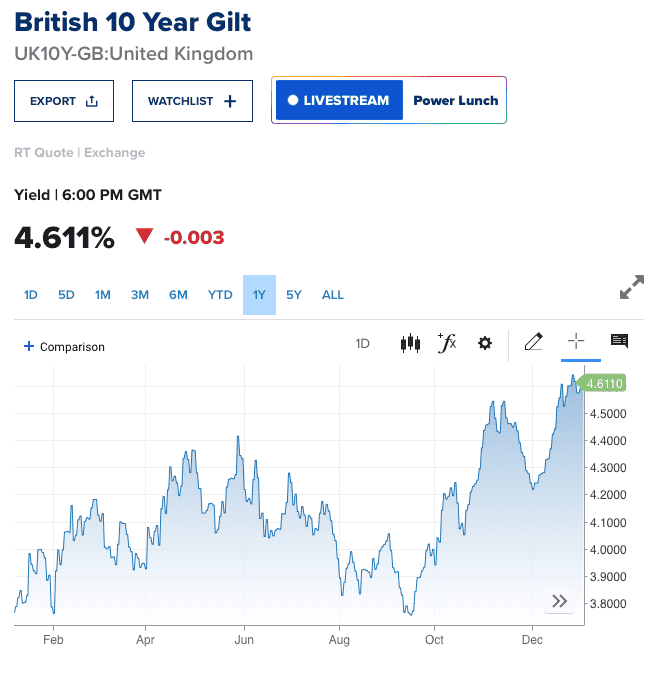
Source: CNBC

Worth buying?

Are the shares worth considering for an investment portfolio today? I think so.

Recently, the company’s been performing pretty well, thanks to a focus on efficiency by the new management team. And this year, the group’s expected to generate solid earnings growth.

Currently, earnings per share (EPS) for 2025 are expected to come in at 309 euro cents. That’s 6.3% higher than the forecast for 2024 (290 euro cents).

Meanwhile, the valuation has come down recently. We’re now looking at a price-to-earnings (P/E) ratio of less than 18, which I think is relatively attractive given this company’s brilliant long-term track record (annual returns of nearly 10% over the last decade).

As for the dividend yield, it’s risen to around 3.5% after the recent share price fall. That’s obviously not the highest out there but it’s decent, especially when you consider that Unilever tends to raise its payout by about 5% a year.

Of course, if interest rates move higher in the near term, I’d expect the stock to continue underperforming. Taking a long-term view however, I think the stock has the potential to generate solid returns when dividends are factored in.


Edward Sheldon has positions in Unilever. The Motley Fool UK has recommended Unilever. Views expressed on the companies mentioned in this article are those of the writer and therefore may differ from the official recommendations we make in our subscription services such as Share Advisor, Hidden Winners and Pro. Here at The Motley Fool we believe that considering a diverse range of insights makes us better investors.

More on Dividend Shares

Passive income text with pin graph chart on business table
Investing Articles

This superb passive income star now has a dividend yield of 10.4%!

This standout passive income gem now generates an annual dividend return higher than the ‘magic’ 10% figure, and consensus forecasts…

Read more »

A pastel colored growing graph with rising rocket.
Investing Articles

Here’s how I’m targeting £12,959 a year in my retirement from £20,000 in this ultra-high yielding FTSE 100 income share…

Analysts forecast this high-yield FTSE 100 income share will deliver rising dividends and capital gains, making it a powerful long-term…

Read more »

Thoughtful man using his phone while riding on a train and looking through the window
Investing Articles

Can the BAE share price do it again in 2026?

The BAE share price has been in good form in 2025. But Paul Summers says a high valuation might be…

Read more »

Investing Articles

7 UK dividend shares yielding over 7% that could thrive if rates fall in 2026

Mark Hartley weighs up the investment benefits of interest rate changes and how they could boost the potential of seven…

Read more »

British coins and bank notes scattered on a surface
Investing Articles

UK dividend stocks could look even more tempting if the Bank of England cuts rates this week!

Harvey Jones says returns on cash are likely to fall in the coming months, making the income paid by FTSE…

Read more »

Investing Articles

Up 115% with a 5.5% yield – are Aviva shares the ultimate FTSE 100 dividend growth machine?

Aviva shares have done brilliantly lately, and the dividend's been tip-top too. Harvey Jones asks if it's one of the…

Read more »

Investing Articles

How much do you need in a SIPP or ISA to target a second income of £36,000 a year in retirement?

Harvey Jones says a portfolio of FTSE 100 shares is a brilliant way to build a sustainable second income, and…

Read more »

Thoughtful man using his phone while riding on a train and looking through the window
Dividend Shares

A 9.2% dividend yield from a FTSE 250 property share? What’s the catch?

This former FTSE 100 stock -- now in the FTSE 250 -- offers a cash yield nearing 10% a year.…

Read more »