
If a 40-year-old put £500 a month in FTSE 100 shares, here’s what they could have by retirement

Looking to buy individual FTSE 100 shares or an exchange-traded fund (ETF)? Here’s an idea of the potential long-term returns one could enjoy.

| More on:

The content of this article was relevant at the time of publishing. Circumstances change continuously and caution should therefore be exercised when relying upon any content contained within this article.

You’re reading a free article with opinions that may differ from The Motley Fool’s Premium Investing Services. Become a Motley Fool member today to get instant access to our top analyst recommendations, in-depth research, investing resources, and more. Learn More.

Shot of an young mixed-race woman using her cellphone while out cycling through the city

Image source: Getty Images

Broadly speaking, investing in FTSE 100 shares has provided a tidy return over the long term. Since 2010, for instance, the UK’s leading index of shares has provided an average annual return of 7%.

It’s easy to see why the Footsie is a popular destination for investors. An index tracker fund provides exposure to:

  • Blue-chip companies with market-leading positions and robust balance sheets.
  • Attractive dividend stocks with large yields and strong records of payout growth.
  • A multitude of different sectors (like banking, energy, and consumer goods).
  • Many global regions, thanks to multinationals including BP, Legal & General, and Unilever.

Past performance isn’t always a reliable guide to future returns. But based on the last 14 years, how much could a 40-year-old investing £500 monthly in the FTSE 100 make by retirement?

Funds vs shares

The outcome depends on whether they purchased an index tracker, or built their portfolio themselves by buying individual shares.

There are advantages to both approaches. A FTSE-tracking exchange-traded fund (ETF) provides exposure to all 100 companies, and it can be cheaper and simpler than buying individual shares.

Purchasing specific stocks, on the other hand, can allow an investor to potentially make index-beating returns. Many businesses — including Ashtead and Games Workshop, which I personally own — have been delivering Footsie-beating, double-digit average annual returns for years.

But focusing on individual shares also creates higher risk and the potential for underwhelming returns. Prudential‘s been a pain in the neck for me personally, its share price sinking steadily since the mid-2010s.

This is why it’s a good idea to consider buying a selection of stocks to balance risk and opportunity.

Solid returns

For the sake of this example, let’s say that our 40-year-old investor spends their £500 a month on a FTSE 100-tracking ETF.

Based on that 7% average annual return since 2010, they would — if they’re targeting retirement at the State Pension age of 68 — have a portfolio worth £519,344.

That’s excluding any trading fees, and any tax they may have to pay if not using a tax-efficient Individual Savings Account (ISA) or Self-Invested Personal Pension (SIPP).

Please note that tax treatment depends on the individual circumstances of each client and may be subject to change in future. The content in this article is provided for information purposes only. It is not intended to be, neither does it constitute, any form of tax advice. Readers are responsible for carrying out their own due diligence and for obtaining professional advice before making any investment decisions.
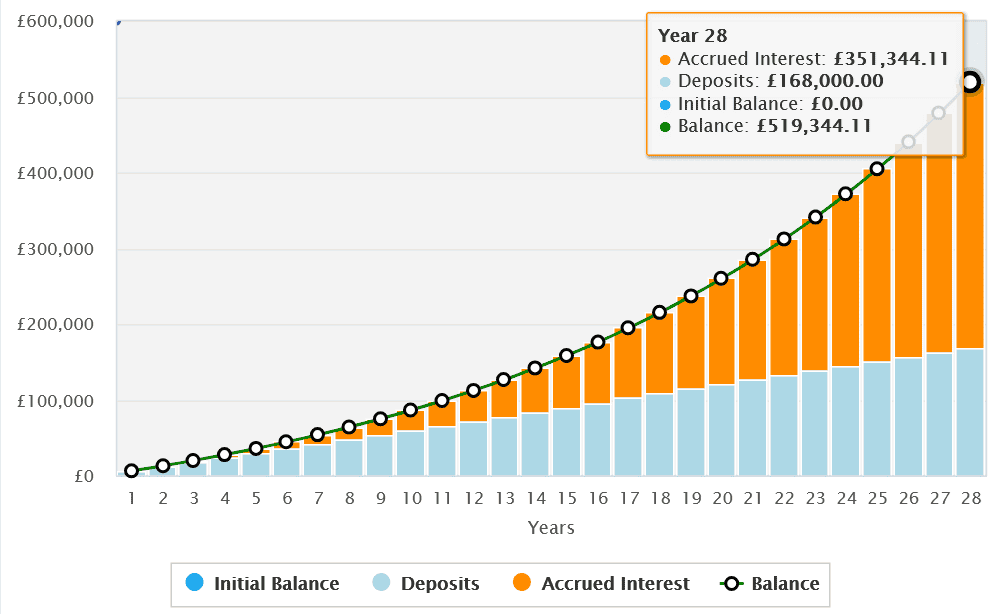
28-year return
Source: thecalculatorsite.com

A better fund?

That’s not a bad return. But it’s not enough to get me excited, given the range of investment opportunities elsewhere.

I’d rather purchase a fund with a better track record of growth. Indeed, it’s why I own an S&P 500-based ETF instead. With an average yearly return of 13.8% since 2010, this US index has provided an average annual return almost double that of the FTSE.

A £500 monthly investment here would turn into almost £2m instead (£1,983,318, to be exact).

The one I chose is the HSBC S&P 500 ETF (LSE:HSPX). With a 0.09% ongoing charge, it’s one of the cheapest in the business.

Its high weighting of tech stocks means the fund could disappoint during economic downturns. But over the long term, I’m expecting further blistering returns thanks to the adoption of new technologies like artificial intelligence (AI).

There is no ‘right’ way to invest in the FTSE 100. But for me, I think investing in individual UK shares and non-Footsie funds is the best approach.


Royston Wild has positions in Ashtead Group Plc, Games Workshop Group Plc, Hsbc ETFs Public - Hsbc S&P 500 Ucits ETF, Legal & General Group Plc, and Prudential Plc. The Motley Fool UK has recommended Ashtead Group Plc, Games Workshop Group Plc, Prudential Plc, and Unilever. Views expressed on the companies mentioned in this article are those of the writer and therefore may differ from the official recommendations we make in our subscription services such as Share Advisor, Hidden Winners and Pro. Here at The Motley Fool we believe that considering a diverse range of insights makes us better investors.

More on Investing Articles

Young mixed-race couple sat on the beach looking out over the sea
Investing Articles

Here’s how a £20k ISA could generate a £1,000 weekly second income

Drip-feeding money into a Stocks and Shares ISA can put you on track to a four-figure second income. Royston Wild…

Read more »

A senior Hispanic couple kayaking
Investing Articles

Here’s how you could create a large ISA passive income and retire early

Fancy retiring years before the State Pension age? Who doesn't? Royston Wild explains how to target passive income in a…

Read more »

A handsome mature bald bearded black man in a sunglasses and a fashionable blue or teal costume with a tie is standing in front of a wall made of striped wooden timbers and fastening a suit button
Investing Articles

Trading at 3.5x net income, I think Jet2 could lead the next stock market recovery

The stock market recovery is on... well, not so much in the UK. Dr James Fox explains why Jet2 could…

Read more »

Aviva logo on glass meeting room door
Investing Articles

£5,000 invested in Aviva shares 6 years ago is now worth…

The last six years have been interesting for Aviva shares, to say the least. How would a few thousands pounds…

Read more »

Businessman hand stacking up arrow on wooden block cubes
Growth Shares

Why I think the HSBC share price could hit 2,000p by December

Jon Smith explains why the HSBC share price could be primed to rally for the rest of the year, despite…

Read more »

Elevated view over city of London skyline
Investing Articles

£15,000 invested in UK shares a decade ago is now worth…

How have UK shares performed in recent years? That depends which ones you have in mind, as our writer explains.…

Read more »

Businessman hand stacking money coins with virtual percentage icons
Investing Articles

3 FTSE shares with many years of consecutive dividend growth

Paul Summers picks out a selection of FTSE shares that have offered passive income seekers consistency for quite a long…

Read more »

piggy bank, searching with binoculars
Investing Articles

Prediction: Diageo shares could soar in the next 5 years if this happens…

Diageo shares have been in the doldrums for some years now. What on earth could waken this FTSE 100 dud…

Read more »