
Will the Next share price be affected by 2 insiders selling?

With two of the retailer’s directors offloading £31.8m of shares, our writer considers what might happen to the Next share price.

| More on:

The content of this article was relevant at the time of publishing. Circumstances change continuously and caution should therefore be exercised when relying upon any content contained within this article.

Man writing 'now' having crossed out 'later', 'tomorrow' and 'next week'

Image source: Getty Images

You’re reading a free article with opinions that may differ from The Motley Fool’s Premium Investing Services. Become a Motley Fool member today to get instant access to our top analyst recommendations, in-depth research, investing resources, and more. Learn More.

Since 11 October 2022, the Next (LSE:NXT) share price has been the fourth-best performer on the FTSE 100. Beaten only by 3i Group, Marks and Spencer and Rolls-Royce Holdings, the retailer has managed to deliver exceptional share price growth by selling mass-market-to-premium clothing and homewares.

Insider transactions

However, over the past three weeks, two of the company’s directors have been reducing the size of their shareholdings.

In late September, Lord Wolfson, the chief executive, sold 290,000 shares for £29.23m (£100.08 a share). On 9 October, Jeremy Stakol (and his wife) disposed of £2.6m of stock. The CEO of its Lipsy unit sold at an average price of £98.79.

As a shareholder, I try to ignore the commentary surrounding such sales.

There are many personal reasons why someone might want to dispose of their shares. And I don’t think it’s unreasonable for an individual who has a large proportion of their wealth tied up in one investment to — periodically — convert some of it into cash. After all, you can’t spend shares.

But as with so many things in life, timing is everything.

These disposals occurred after the company issued its half-year results for its 2025 financial year (FY25). It issued another earnings upgrade and now expects to record a FY25 profit before tax of £995m.

That’s probably why — as I write (11 October) — the company’s share price remains above £100. Investors don’t appear to be too alarmed by these insider transactions.

Inside the boardroom

Like me, I suspect they have confidence in the leadership of Lord Wolfson. When he took over the running of the business in August 2001, he was the FTSE 100’s youngest CEO.

Back then, the company’s share price was around 940p. An investment of £10,000 at the time would now be worth more than £107,000. No wonder his total remuneration package was £4.52m last year.

Of course, nothing is guaranteed when it comes to investing. History doesn’t necessarily repeat itself.

However, all of Next’s directors are participants in the company’s long-term incentive plan. They receive 100% of their bonus if the retailer can deliver total shareholder returns — over three years — greater than 80% of 20 other listed “broadly comparable” businesses.

This seems like a sensible metric for measuring performance. And it means the interests of the directors are closely aligned with mine.

As the table below shows, since August 2020, very few have done better than Next.
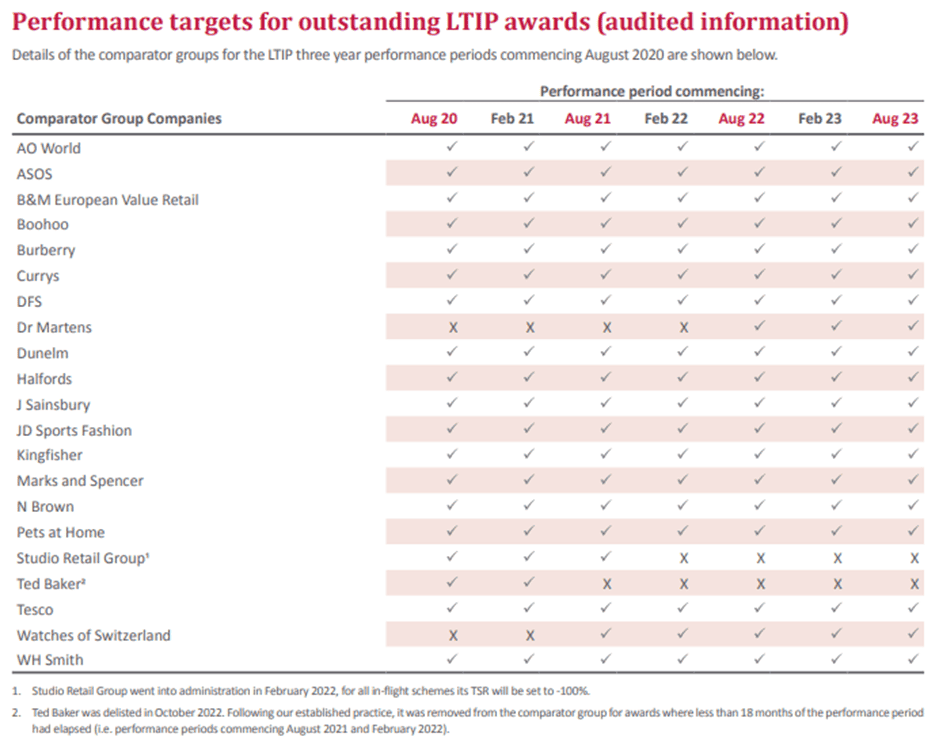
Source: 2024 annual report

Despite the impressive growth in its share price and earnings, the stock trades on a reasonable forward price-to-earnings ratio of 14.2.

Okay, it’s not in bargain territory — it’s broadly in line with its average over the past 20 years — but it suggests to me that the shares aren’t unreasonably priced.

Possible challenges

However, keeping its clothing relevant is a constant challenge. It’s also vulnerable to the rise of ‘fast fashion’ and others producing cheap imitations.

In addition, it’s heavily exposed to the domestic economy — 84% of its revenue came from the UK in FY24. A fall in disposable incomes would affect its sales and earnings.

But over the past two decades, under Lord Wolfson’s stewardship, the company’s overcome many challenges. It’s done better than many of its rivals and I see no obvious reason why this can’t continue.


James Beard has positions in Next Plc and Rolls-Royce Plc. The Motley Fool UK has recommended Rolls-Royce Plc. Views expressed on the companies mentioned in this article are those of the writer and therefore may differ from the official recommendations we make in our subscription services such as Share Advisor, Hidden Winners and Pro. Here at The Motley Fool we believe that considering a diverse range of insights makes us better investors.

More on Investing Articles

Female student sitting at the steps and using laptop
Investing Articles

How much do you need in an ISA to target £8,333 a month of passive income?

Our writer explores a potential route to earning double what is today considered a comfortable retirement and all tax-free inside…

Read more »

Three signposts pointing in different directions, with 'Buy' 'Sell' and 'Hold' on
Investing Articles

Could these 3 FTSE 100 shares soar in 2026?

Our writer identifies a trio of FTSE 100 shares he thinks might potentially have more petrol in the tank as…

Read more »

Pakistani multi generation family sitting around a table in a garden in Middlesbourgh, North East of England.
Dividend Shares

How much do you need in a FTSE 250 dividend portfolio to make £14.2k of annual income?

Jon Smith explains three main factors that go into building a strong FTSE 250 dividend portfolio to help income investors…

Read more »

Tesla building with tesla logo and two teslas in front
Investing Articles

275 times earnings! Am I the only person who thinks Tesla’s stock price is over-inflated?

Using conventional measures, James Beard reckons the Tesla stock price is expensive. Here, he considers why so many people appear…

Read more »

Investing Articles

Here’s what I think investors in Nvidia stock can look forward to in 2026

Nvidia stock has delivered solid returns for investors in 2025. But it could head even higher in 2026, driven by…

Read more »

Investing Articles

Here are my top US stocks to consider buying in 2026

The US remains the most popular market for investors looking for stocks to buy. In a crowded market, where does…

Read more »

Investing Articles

£20,000 in excess savings? Here’s how to try and turn that into a second income in 2026

Stephen Wright outlines an opportunity for investors with £20,000 in excess cash to target a £1,450 a year second income…

Read more »

DIVIDEND YIELD text written on a notebook with chart
Investing Articles

Is a 9% yield from one of the UK’s most reliable dividend shares too good to be true?

Taylor Wimpey’s recent dividend record has been outstanding, but investors thinking of buying shares need to take a careful look…

Read more »