
Starting in June, I’d invest £1,000 a month to aim for a £102,000 second income in retirement

This author highlights a less well-known FTSE 100 stock that could help his portfolio generate a very big second income in future.

| More on:

The content of this article was relevant at the time of publishing. Circumstances change continuously and caution should therefore be exercised when relying upon any content contained within this article.

Aerial shot showing an aircraft shadow flying over an idyllic beach

Image source: Getty Images

You’re reading a free article with opinions that may differ from The Motley Fool’s Premium Investing Services. Become a Motley Fool member today to get instant access to our top analyst recommendations, in-depth research, investing resources, and more. Learn More.

Building a large portfolio doesn’t have to break the bank. Indeed, investing £1,000 a month can result in a portfolio worth £1.16m after 30 years. That could generate a very sizeable second income.

The great news here is that this scenario assumes a 7% average annual return. That’s actually below the long-term total return from the FTSE 100 and significantly less than the average returns of the S&P 500.

Here’s how I’d go about trying to reach a £100k+ passive income portfolio.

Get the ball rolling

A no-brainer starting point would be to set up a Stocks and Shares ISA. This would literally open up a world of investing possibilities because most ISA providers today allow international dealing.

The benefit here is that it would give my portfolio diversification, allowing me to buy US stocks as well as those listed in London. My own portfolio today is split about 50/50 between US and UK shares.

Even better, an ISA allows me to invest £20k a year and pay no tax on any capital returns or dividends. That’s why I use the term no-brainer.

Please note that tax treatment depends on the individual circumstances of each client and may be subject to change in future. The content in this article is provided for information purposes only. It is not intended to be, neither does it constitute, any form of tax advice. Readers are responsible for carrying out their own due diligence and for obtaining professional advice before making any investment decisions.

Which stocks to buy?

Here, I’m going to highlight a FTSE 100 stock I’ve currently got on my buy list. It often flies under the radar despite growing earnings impressively for years. It’s Coca-Cola HBC (LSE: CCH).

This Switzerland-based company has the exclusive rights to bottle and distribute products from The Coca-Cola Company in 29 countries across Europe, Asia, and Africa. The HBC bit at the end stands for Hellenic Bottling Company, hinting at its roots in Greece in the 1960s.

The firm buys core concentrates, syrups and bases from the US soft drinks giant. These are the formulas that give Coca-Cola, Sprite, and Fanta their specific tastes. Meanwhile, Coca-Cola retains a significant ownership stake in the company.
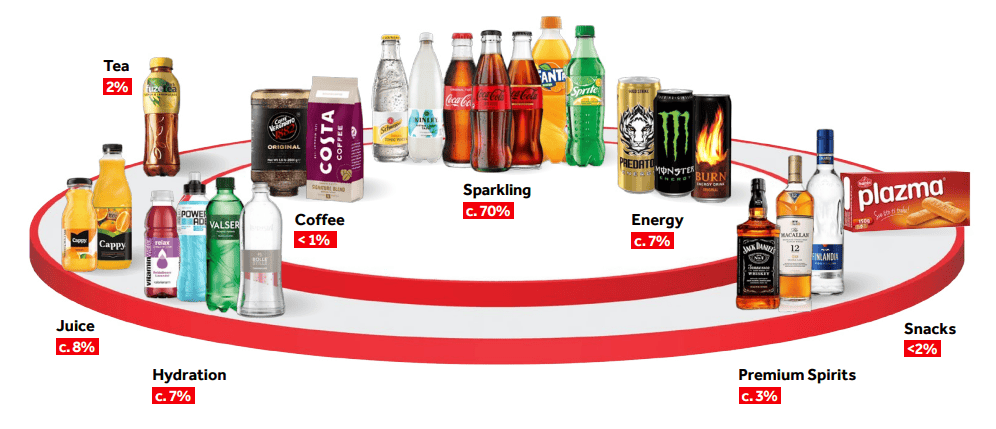
Source: Coca-Cola HBC 2023 annual report

In 2023, net sales revenue increased 10.7% year on year to €10.2bn, representing the third straight year of double-digit growth. Net profit was €637m and brokers see this rising to €864m in 2026.

The dividend was raised by 19% and its five-year compound annual growth rate is 10.3%. The forward-looking dividend yield today is 3.1%, which I find attractive given its long-term growth potential.

Naturally, an economic downturn is a risk here, as this could lead to weaker demand for soft drinks, especially in the tourist hotspots it operates in (Italy, Greece, Switzerland, and so on).

That said, Coke sales tend to hold up pretty well even during downturns. Trading at 14 times forward earnings for 2024, I think the stock offers tremendous value.

Passive income

As mentioned, such stocks achieving a 7% annual return could help me build a £1.16m portfolio in 30 years.

However, I think it’s realistic to aim for an average return of 9%. This isn’t guaranteed and there will be tricky periods along the way, including perhaps the odd major crash. But pound cost averaging (investing regularly so sometimes I buy when prices are high, sometimes when they’re low) would help smooth out these ups and downs.

Assuming this 9% return (which, of course, isn’t guaranteed and could be much lower), my hypothetical £12,000 compounding at this higher rate over three decades would become £1.7m, excluding any brokerage fees. Lovely.

At this point, I could choose to invest in dividend-paying stocks yielding an average 6%, giving me a potential yearly passive income stream of £102,000.


Ben McPoland has no position in any of the shares mentioned. The Motley Fool UK has no position in any of the shares mentioned. Views expressed on the companies mentioned in this article are those of the writer and therefore may differ from the official recommendations we make in our subscription services such as Share Advisor, Hidden Winners and Pro. Here at The Motley Fool we believe that considering a diverse range of insights makes us better investors.

More on Investing Articles

Investing Articles

Want to start buying shares next week with £200 or £300? Here’s how!

Ever thought of becoming a stock market investor? Christopher Ruane explains how someone could start buying shares even on a…

Read more »

Rear view image depicting a senior man in his 70s sitting on a bench leading down to the iconic Seven Sisters cliffs on the coastline of East Sussex, UK. The man is wearing casual clothing - blue denim jeans, a red checked shirt, navy blue gilet. The man is having a rest from hiking and his hiking pole is leaning up against the bench.
Investing Articles

2 ideas for a SIPP or ISA in 2026

Looking for stocks for an ISA or SIPP portfolio? Our writer thinks a FTSE 100 defence giant and fallen pharma…

Read more »

Midnight is celebrated along the River Thames in London with a spectacular and colourful firework display.
Investing Articles

Could buying this stock at $13 be like investing in Tesla in 2011?

Tesla stock went on to make early investors a literal fortune. Our writer sees some interesting similarities with this eVTOL…

Read more »

Close-up of British bank notes
Investing Articles

3 reasons the Lloyds share price could keep climbing in 2026

Out of 18 analysts, 11 rate Lloyds a Buy, even after the share price has had its best year for…

Read more »

Chalkboard representation of risk versus reward on a pair of scales
Growth Shares

Considering these UK shares could help an investor on the road to a million-pound portfolio

Jon Smith points out several sectors where he believes long-term gains could be found, and filters them down to specific…

Read more »

Close-up image depicting a woman in her 70s taking British bank notes from her colourful leather wallet.
Investing For Beginners

Martin Lewis is embracing stock investing, but I think he missed a key point

It's great that Martin Lewis is talking about stocks, writes Jon Smith, but he feels he's missed a trick by…

Read more »

House models and one with REIT - standing for real estate investment trust - written on it.
Investing Articles

This 8% yield could be a great addition to a portfolio of dividend shares

Penny stocks don't usually make for great passive income investments. But dividend investors should consider shares in this under-the-radar UK…

Read more »

Queen Street, one of Cardiff's main shopping streets, busy with Saturday shoppers.
Investing Articles

Why this 9.71% dividend yield might be a rare passive income opportunity

This REIT offers a 9.71% dividend yield from a portfolio with high occupancy, long leases, and strong rent collection from…

Read more »