
Do record revenues and profits mean investors should pay more attention to the Halma share price?

A P/E ratio of 37 might put some investors off the Halma share price without a second look. But impressive growth means this could be a mistake.

| More on:

The content of this article was relevant at the time of publishing. Circumstances change continuously and caution should therefore be exercised when relying upon any content contained within this article.

Person holding magnifying glass over important document, reading the small print

Image source: Getty Images

You’re reading a free article with opinions that may differ from The Motley Fool’s Premium Investing Services. Become a Motley Fool member today to get instant access to our top analyst recommendations, in-depth research, investing resources, and more. Learn More.

The Halma (LSE:HLMA) share price has gone from £6.08 in June 2014 to £23.50 today. That makes it one of the best-performing FTSE 100 stocks of the last decade. 

With any business, it’s important to keep up with its trading updates. But it’s especially important for companies like Halma.

Valuation risk

The share price is up 289% over the last 10 years. Never mind the FTSE 100 – that’s enough to outperform the likes of Berkshire Hathaway

Investors should note where the increase has come from though. Earnings per share have increased by 121%, but the rest is due to an expanding price-to-earnings (P/E) ratio.

Halma shares now trade at a P/E ratio of 37, compared to 22 a decade ago. That’s enough to make a certain kind of value investor feel uncomfortable, and they might have a point. 

The biggest risk with the stock is the possibility of the P/E ratio contracting if earnings growth slows. That’s why it’s important to pay attention to the company’s trading updates.

Full-year results

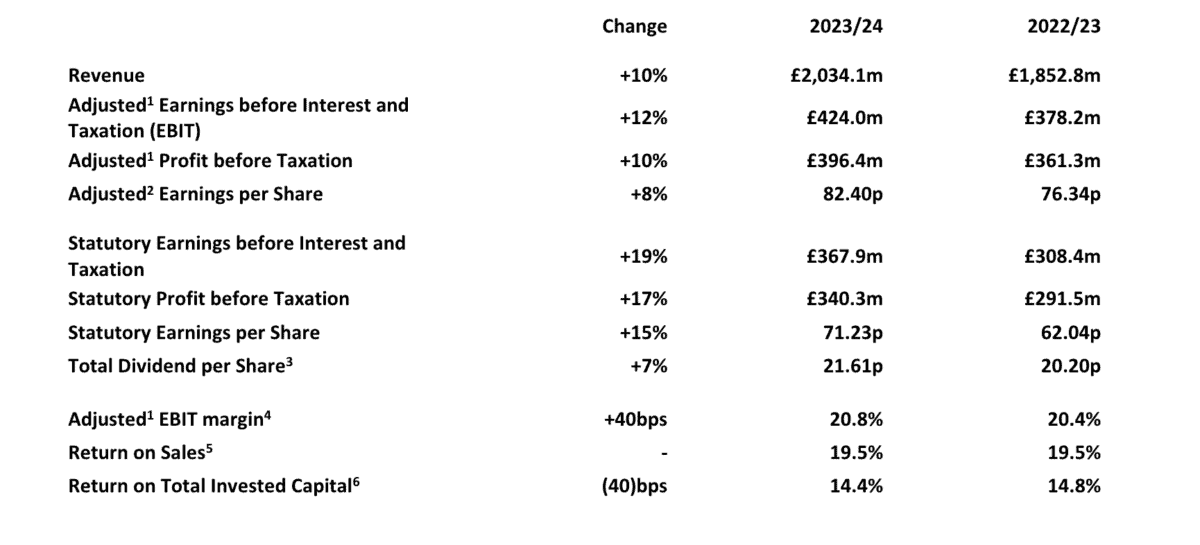
Over the last 12 months, Halma’s revenues reached record levels after growing 10%. This was driven by a mixture of acquisitions and organic growth.

Halma FY 2023-24 Financial Performance
Source: Halma Investor Relations

When businesses grow through acquisitions there can be a risk of overpaying. But there doesn’t seem to be an imminent danger of this with Halma.

The company made eight acquisitions, but returns on invested capital remained steady – at 14.4% compared to 14.8% the year before. That indicates the firm is investing at good rates. 

In addition to record revenues, pre-tax profits (+10%) and earnings per share (+8%) also reached new highs. And management indicated there might be more to come.

Outlook

Acquisitions are the engine that drives Halma’s growth and management stated that there’s more to come here too. That’s important for investors, given the high P/E ratio the stock trades at.

In addition to a healthy pipeline of opportunities, the company has already completed one deal for £44m since the end of the year. That’s quite significant. 

Halma’s eight acquisitions in 2023-24 cost around £292m in total – or £36.5m on average. A £44m deal to start the new financial year is a sign that growth could be set to continue. 

The company is also expecting organic revenue growth and margins to be strong in the year ahead. Overall, things look positive for the business.

Should I buy Halma shares?

I think it’s not controversial to say that Halma is a terrific business with outstanding management. The only question for investors is whether it’s worth buying at a P/E ratio of 37. 

The company boosted its dividend by 7%, but I wouldn’t buy it for short-term passive income. For long-term wealth creation though, I think it could be a terrific investment to consider.


Stephen Wright has positions in Berkshire Hathaway. The Motley Fool UK has recommended Halma Plc. Views expressed on the companies mentioned in this article are those of the writer and therefore may differ from the official recommendations we make in our subscription services such as Share Advisor, Hidden Winners and Pro. Here at The Motley Fool we believe that considering a diverse range of insights makes us better investors.

More on Investing Articles

Investing Articles

Will the S&P 500 crash in 2026?

The S&P 500 delivered impressive gains in 2025, but valuations are now running high. Are US stocks stretched to breaking…

Read more »

Teenage boy is walking back from the shop with his grandparent. He is carrying the shopping bag and they are linking arms.
Investing Articles

How much do you need in a SIPP to generate a brilliant second income of £2,000 a month?

Harvey Jones crunches the numbers to show how investors can generate a high and rising passive income from a portfolio…

Read more »

Investing Articles

Will Lloyds shares rise 76% again in 2026?

What needs to go right for Lloyds shares to post another 76% rise? Our Foolish author dives into what might…

Read more »

Investing Articles

How much passive income will I get from investing £10,000 in an ISA for 10 years?

Harvey Jones shows how he plans to boost the amount of passive income he gets when he retires, from FTSE…

Read more »

Investing Articles

Down 34% in 2025 — but could this be one of the UK’s top growth stocks for 2026?

With clarity over research funding on the horizon, could Judges Scientific be one of the UK’s best growth stocks to…

Read more »

piggy bank, searching with binoculars
Investing Articles

Can the rampant Barclays share price beat Lloyds in 2026?

Harvey Jones says the Barclays share price was neck and neck with Lloyds over the last year, and checks out…

Read more »

Investing Articles

Here’s how Rolls-Royce shares could hit £25 in 2026

If Rolls-Royce shares continue their recent performance, then £25 might be on the cards for 2026. Let's take a look…

Read more »

Departure & Arrival sign, representing selling and buying in a portfolio
Investing Articles

Prediction: in 2026 the red-hot Rolls-Royce share price could turn £10,000 into…

Harvey Jones can't believe how rapidlly the Rolls-Royce share price has climbed. Now he looks at the FTSE 100 growth…

Read more »