
Admiral shares are an underrated passive income opportunity

Stephen Wright thinks shares in the UK’s largest car insurance firm could be a better source of income than a 2.71% dividend yield makes them seem.

| More on:

The content of this article was relevant at the time of publishing. Circumstances change continuously and caution should therefore be exercised when relying upon any content contained within this article.

You’re reading a free article with opinions that may differ from The Motley Fool’s Premium Investing Services. Become a Motley Fool member today to get instant access to our top analyst recommendations, in-depth research, investing resources, and more. Learn More.

Person holding magnifying glass over important document, reading the small print

Image source: Getty Images

It’s easy to underestimate Admiral (LSE:ADM) shares as a source of passive income. According to Google, the stock comes with a dividend yield of 2.71%.
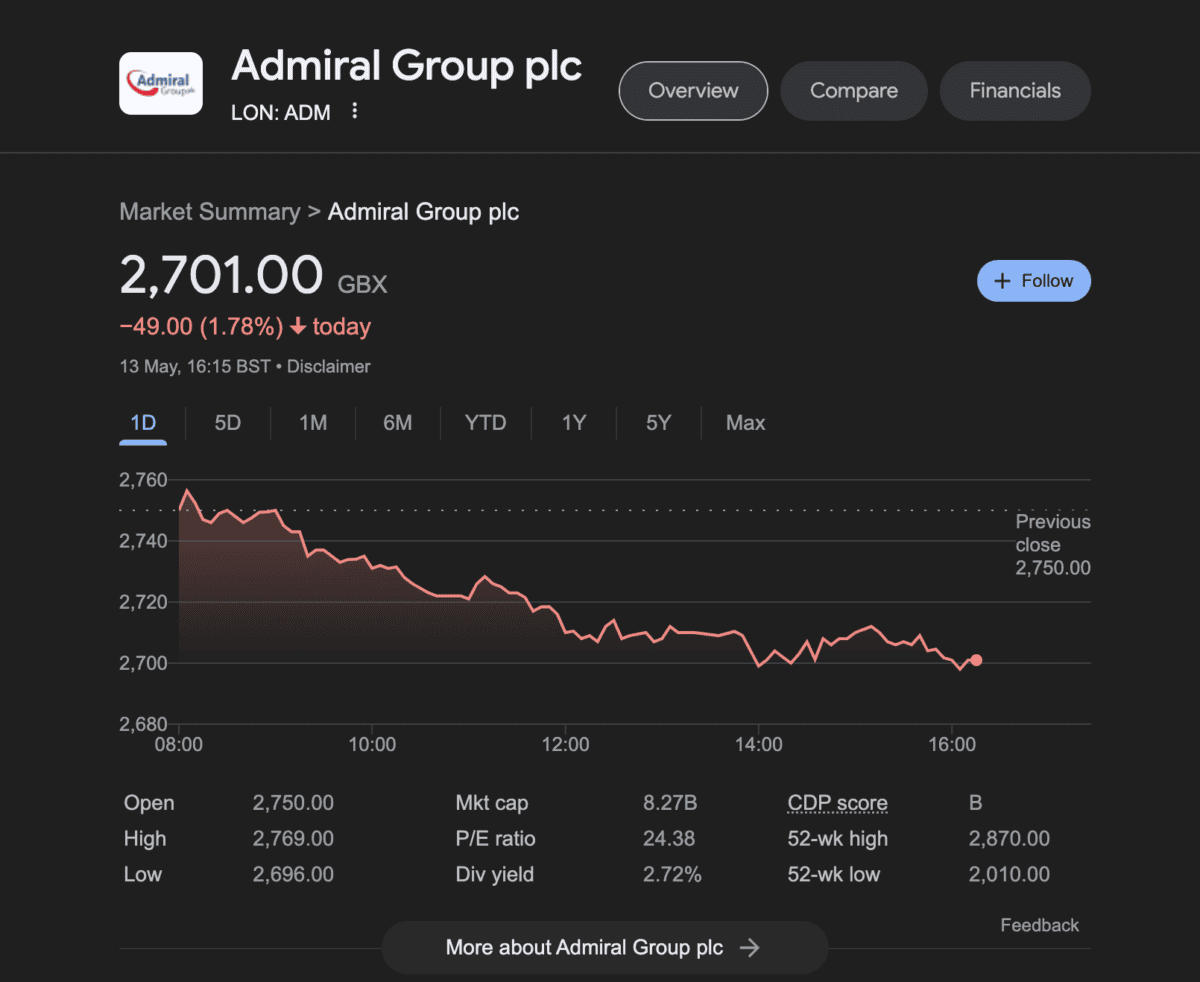
Source: Google

That doesn’t tell the full story though – over the last 12 months the company’s paid out £1.03 per share in dividends. That’s a 3.81% yield, so what’s going on here?

Dividends

During the last year, Admiral’s normal dividend’s amounted to 73.4p per share – a 2.71% yield at today’s prices. But that’s not the only dividend the firm’s paid.

The business has also delivered 29.6p in special dividends, which amounts to an extra 1.1%. Both put cash in the pockets of shareholders, but Google only seems to recognise one.

What’s the difference? According to the company’s website, the firm’s policy is to pay out 65% of its post-tax profits to shareholders as a normal dividend.

On top of this, Admiral distributes any cash not required by the business to meet solvency or insurance reserve requirements as a special dividend.

Special dividends 

Companies sometimes distribute special dividends to investors when they have an unusual cash surplus. CostCo’s a good example of this.

Dividends are never guaranteed, but special dividends are even less predictable than regular ones. With Admiral though, things are somewhat different. 
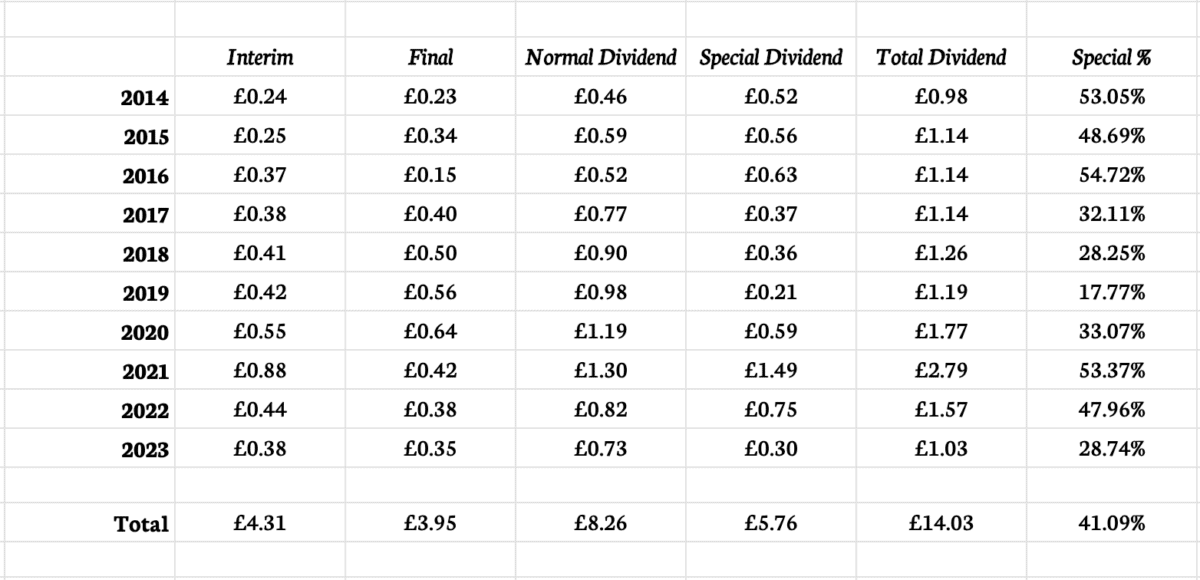
Source: Admiral Investor Relations

The firm’s paid special dividends consistently for the last decade. While these have varied (like the normal dividend) they’ve been an important part of the total dividend each year.

Since 2014, the special dividend has accounted for 41% of Admiral’s total distribution. Leaving that out of the calculation makes the dividend yield seem much lower than it is.

A quality company

Buying shares in Admiral come with some significant risks. The insurance industry is fiercely competitive and customer loyalty is essentially non-existent. 

There’s also the issue of inflation to contend with. As the price of cars increase, repairs become more expensive, increasing costs for the companies that pay for them.

Despite this, Admiral has produced unusually good results. The firm’s data and technology has allowed its underwriting to be consistently more profitable than its rivals.

I think this will prove durable. And a business that has a unique advantage in providing a product people need could be a terrific source of dividend income for a long time.

A stock to buy?

Admiral doesn’t initially look like an obvious target for investors looking for passive income. A 2.7% dividend yield’s below the FTSE 100’s 3.36% average

A closer look though, reveals there’s much more going on beneath the surface. As I see it, it’s a quality business with an above-average yield.

That’s a winning combination for me, which is why I’ve been buying the stock for my portfolio. And I plan on continuing to do this.


Stephen Wright has positions in Admiral Group Plc. The Motley Fool UK has recommended Admiral Group Plc. Views expressed on the companies mentioned in this article are those of the writer and therefore may differ from the official recommendations we make in our subscription services such as Share Advisor, Hidden Winners and Pro. Here at The Motley Fool we believe that considering a diverse range of insights makes us better investors.

More on Investing Articles

Man writing 'now' having crossed out 'later', 'tomorrow' and 'next week'
Investing Articles

The best time to buy stocks? It might be right now

Short-term issues that delay long-term trends create opportunities to buy stocks. And that could be happening right now with a…

Read more »

Queen Street, one of Cardiff's main shopping streets, busy with Saturday shoppers.
Investing Articles

Here’s why Next stock rose 5% and topped the FTSE 100 today

Next was the leading FTSE 100 stock today, rising 5%. Our writer takes a look at why and asks if…

Read more »

Renewable energies concept collage
Investing Articles

Up 458% in a year, could the Ceres Power share price go even higher?

Christopher Ruane reviews some highs and lows of the Ceres Power share price over the years and wonders whether the…

Read more »

Rolls-Royce's Pearl 10X engine series
Investing Articles

Are the glory days over for Rolls-Royce shares?

Rolls-Royce shares have soared in recent years. Lately, though, they have taken a tumble. Could there be worse still to…

Read more »

Group of friends meet up in a pub
Investing Articles

Are ‘66% off’ Diageo shares a once-in-a-decade opportunity?

Diageo shares have taken another hit in the early weeks of 2026. Are we looking at a massive bargain or…

Read more »

Investing Articles

Meet the UK stock under £1.50 smashing Rolls-Royce shares over the past year

While Rolls-Royce shares get all the attention, this under-the-radar trust has quietly made investors a fortune. But is it still…

Read more »

UK financial background: share prices and stock graph overlaid on an image of the Union Jack
Investing Articles

Down 19%, the red lights are flashing for Barclays shares!

Barclays shares have fallen almost a fifth in value as the Middle East war has intensified. Royston Wild argues that…

Read more »

Aviva logo on glass meeting room door
Investing Articles

After falling another 5%, are Aviva shares too cheap to ignore?

£10,000 invested in Aviva shares five years ago would have grown 50% by now. But what might the future hold,…

Read more »