Share your opinion and earn yourself a free Motley Fool premium report!

We are looking for Fools to join a 75 minute online independent market research forum on 15th / 16th December.

To find out more and express your interest please click here

Warren Buffett believes this one investing rule is key to his success

In this article, I’ll use my position in a UK-listed ETF to help illustrate a well-known ‘investing trick’ that’s favoured by the likes of Warren Buffett!

| More on:

The content of this article was relevant at the time of publishing. Circumstances change continuously and caution should therefore be exercised when relying upon any content contained within this article.

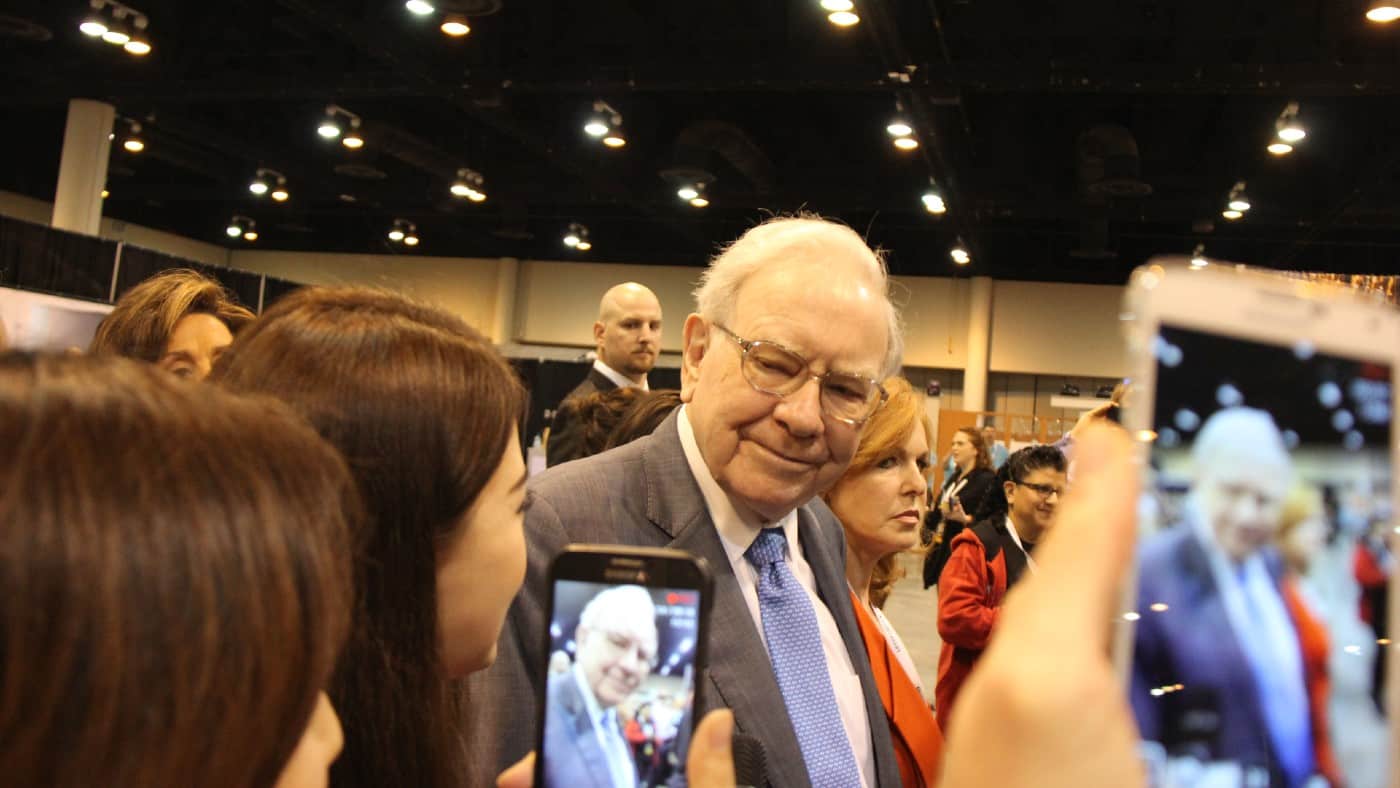
Fans of Warren Buffett taking his photo

Image source: The Motley Fool

You’re reading a free article with opinions that may differ from The Motley Fool’s Premium Investing Services. Become a Motley Fool member today to get instant access to our top analyst recommendations, in-depth research, investing resources, and more. Learn More.

Warren Buffett has earned the nickname ‘the Oracle of Omaha’ due to his place of birth (Omaha) and his apparent ability to foresee the future. His amazing propensity to know which stocks to invest in seems prophetic to many people. 

Of course, there is no real magic involved. 

As Buffett admits himself, his success is largely due to something we all have the ability to harness: compound returns.

The snowball effect

Buffett describes the power of compound returns as similar to that of a snowball: as it rolls downhill, it grows exponentially larger and larger.

In investing, this is exhibited by an increasing degree of growth over time.

The exponential growth of compounding returns
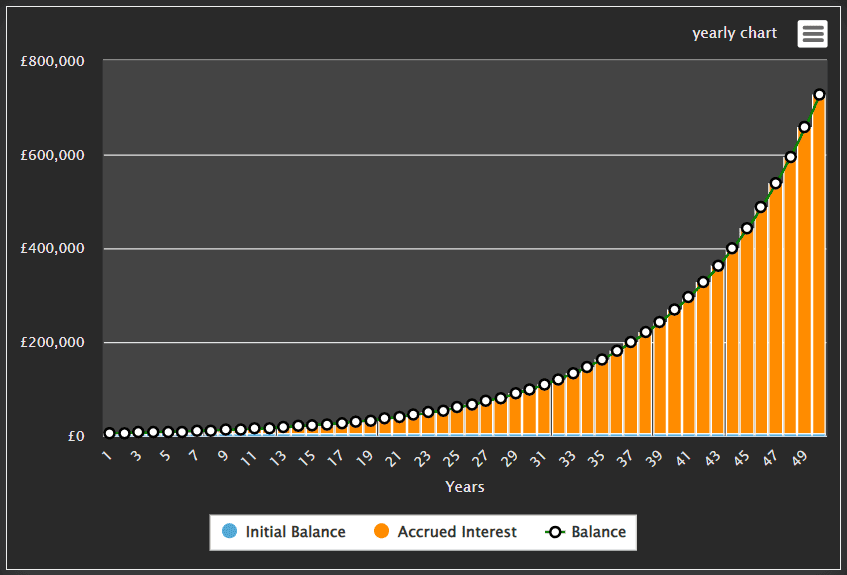
Created on thecalculatorsite.com

Let’s use the iShares Core S&P 500 ETF (LSE:IUSA) as an example. This UK-listed exchange-traded fund (ETF) provides exposure to major US companies listed on the S&P 500, such as Microsoft, Apple, Amazon, and Buffett’s own Berkshire Hathaway.

The ETF is weighted towards tech stocks (30%) but also includes exposure to sectors such as financials, health care, industrials, and energy.

Over the past 10 years, the ETF provided annualised returns of approximately 12% per year. It’s worth noting that it made losses in 2018 and 2022, by -4.7% and -18.4%. It has an average price-to-earnings (P/E) ratio of 25.5 but the price-to-book (P/B) ratio of 4.44 is quite high, suggesting the shares could be overvalued.

So, based on an average 12% rate of return, if I invested £100 in the iShares Core S&P 500 ETF, I could have £112 after the first year. Does that mean after the second year I’ll have £124? And after the third, £136? 

No.

The magic of compounding returns means my total return grow even more because the initial investment now includes the accumulated returns. So after year one, I would have £112, but in year two, with £112, the returns would be £13.44, bringing my total to £125.44. In year three, the returns would be £15.05, bringing my total to £140.49.
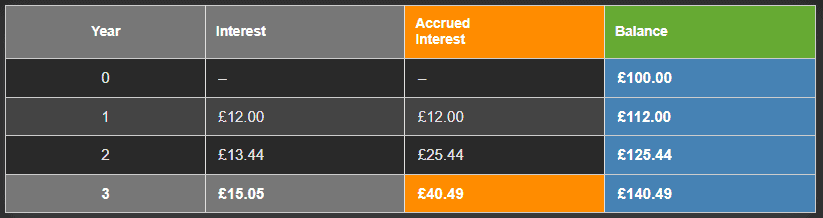
Created on thecalculatorsite.com

Of course, this is just a simple example — in reality, these numbers would differ slightly due to price fluctuations throughout the year.

Time in the market

The magic of compounding returns is echoed in the popular saying ‘It’s not about timing the market, but about time in the market’.

Timing the market refers to the act of trying to buy and sell at opportune moments. This is opposed to ‘time in the market’, meaning being invested for a long period. Buying and selling frequently can be profitable for some but statistics show that usually it’s less profitable than simply staying invested for long periods.

Of course, it’s not all down to compounding returns. Experienced investors like Warren Buffett have a deep understanding of global markets and spend hours researching potential stock options.

For us lesser experienced investors, investments like the iShares Core S&P 500 ETF provide exposure to a well managed and diverse portfolio of stocks. I see it as a low-risk option that I hope will provide me with consistent and reliable returns for years to come.


John Mackey, former CEO of Whole Foods Market, an Amazon subsidiary, is a member of The Motley Fool’s board of directors. Mark Hartley has positions in Apple, Microsoft, and iShares Public - iShares S&P 500 Ucits ETF. The Motley Fool UK has recommended Amazon, Apple, and Microsoft. Views expressed on the companies mentioned in this article are those of the writer and therefore may differ from the official recommendations we make in our subscription services such as Share Advisor, Hidden Winners and Pro. Here at The Motley Fool we believe that considering a diverse range of insights makes us better investors.

More on Investing Articles

Night Takeoff Of The American Space Shuttle
Investing Articles

Will the Rolls-Royce share price double in 2026?

The Rolls-Royce share price remains one of the FTSE 100's best performers. Royston Wild asks if the engineer can do…

Read more »

Group of young friends toasting each other with beers in a pub
Investing Articles

Could ‘Drastic Dave’ save the Diageo share price in 2026?

Diageo will get a new boss on 1 January. But will the appointment of Sir Dave Lewis help reverse the…

Read more »

Investing Articles

The biggest ‘no-brainer’ stock in my ISA and SIPP as we approach 2026 is…

Edward Sheldon owns a lot of high-quality stocks within his ISA and pension. But this one – a household name…

Read more »

DIVIDEND YIELD text written on a notebook with chart
Investing Articles

Forget high yields? Here’s the smart way to build passive income with dividend shares

Stephen Wright outlines how investors looking for passive income can put themselves in the fast lane with dividend shares.

Read more »

Businessman hand stacking up arrow on wooden block cubes
Investing Articles

15,446 Diageo shares gets me a £1,000 monthly second income. Should I?

Diageo has been a second-rate income stock for investors over the last few years. But the new CEO sees potential…

Read more »

Investing Articles

2 FTSE 100 stocks to target epic share price gains in 2026!

Looking for blue-chip shares to buy? Discover which two FTSE 100 stocks our writer Royston Wild thinks could explode in…

Read more »

A row of satellite radars at night
Investing Articles

If the stock market crashes in 2026, I’ll buy these 2 shares like there’s no tomorrow

These two shares have already fallen 25%+ in recent weeks. So why is this writer wating for a stock market…

Read more »

British Pennies on a Pound Note
Investing Articles

How much money does someone really need to start buying shares?

Could it really be possible to start buying shares with hundreds of pounds -- or even less? Christopher Ruane weighs…

Read more »