
No savings at 40? Here’s how I would aim to retire with £27,000 a year in passive income

If I had no savings at 40, this is how I would aim to retire with an adequate amount of passive income to keep myself comfortable.

| More on:

The content of this article was relevant at the time of publishing. Circumstances change continuously and caution should therefore be exercised when relying upon any content contained within this article.

A senior group of friends enjoying rowing on the River Derwent

Image source: Getty Images

You’re reading a free article with opinions that may differ from The Motley Fool’s Premium Investing Services. Become a Motley Fool member today to get instant access to our top analyst recommendations, in-depth research, investing resources, and more. Learn More.

Recent FCA data reveals up to a third of UK adults over 40 have less than £1,000 in savings. With little or no savings, an aggressive savings plan is required to build a passive income stream for retirement. Here’s how.

The average 40-year-old UK citizen earns £40k a year – around £2,700 a month after tax. By saving £500 a month, I could turn that into a decent passive income stream of £27,000 a year.

But £500 a month only saves me £6,000 a year, so how can I reach that goal? 

Less tax, more returns

Aiming to retire at 65 would give me 25 years to build my passive income stream. A typical bank savings account won’t provide anywhere near enough interest for me to reach my goal. Neither will bonds or real estate, which typically offer average annual returns of around 4%. So I’m looking at shares.

Using a Stocks and Shares ISA, I can invest up to £20,000 a year tax-free into the UK stock market. I would start by building a portfolio of shares in companies with long-term reliable growth. By reinvesting my gains, I would maximise my savings through the miracle of compounding returns.

Please note that tax treatment depends on the individual circumstances of each client and may be subject to change in future. The content in this article is provided for information purposes only. It is not intended to be, neither does it constitute, any form of tax advice. Readers are responsible for carrying out their own due diligence and for obtaining professional advice before making any investment decisions.

Building a portfolio that delivers reliable returns of around 7% annually is what I would aim for. By investing £500 a month for 25 years, my investment could grow to £410,261. At this point, I would be earning £27,470 a year in passive income – assuming I maintain an average 7% annual return.

Of course, there’s a risk that some years I may earn less than 7% or possibly even lose money.
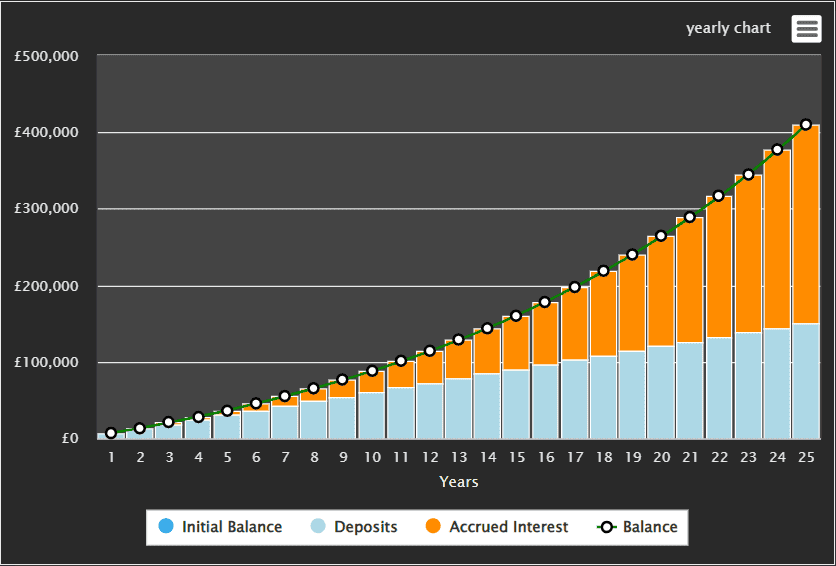
Passive income
Created on thecalculatorsite.com

An example of a UK share I would consider for my ISA

To secure reliable returns for 25 years, I must choose my shares wisely. This means selecting well-established companies with a long history of stable growth. 

Unilever (LSE:ULVR) is one such stock. As a multinational goods producer of everything from food to cosmetics, Unilever’s services are typically in high demand. With shares that are less volatile than 75% of UK stocks, I think it’s a safe, reliable option.

In its 2022 earnings report last March, Unilever’s earnings per share (EPS) exceeded analyst’s expectations. More recent Q3 results revealed sales growth of 5.2% per year, putting Unilever’s future return on equity (ROE) at 33.1%. ROE is a good measure of long-term potential, indicating how effectively management is expected to allocate shareholder resources.

However, in 2023 Unilever shares fell 9%, leaving the company with a negative forward-looking EPS growth rate of -1.1%. Its dividend yield has also decreased recently, from 4% to 3%. This is an example of how some shares have bad years but it’s important to focus on the long term.

To diversify my portfolio, I would include some high-yield dividend shares that may be less stable but promise better returns. Examples include insurance firm Phoenix Group, with a dividend yield of 8.9%, and Vodafone, currently paying an impressive 11.2% dividend yield. I would also consider adding a few index-tracking exchange-traded funds (ETFs) like the iShares Core S&P 500.


Mark Hartley has positions in Vodafone Group Public. The Motley Fool UK has recommended Unilever Plc and Vodafone Group Public. Views expressed on the companies mentioned in this article are those of the writer and therefore may differ from the official recommendations we make in our subscription services such as Share Advisor, Hidden Winners and Pro. Here at The Motley Fool we believe that considering a diverse range of insights makes us better investors.

More on Investing Articles

Young Caucasian man making doubtful face at camera
Dividend Shares

Will the Diageo share price crash again in 2026?

The Diageo share price has crashed 35.6% over one year, making it one of the FTSE 100's worst performers in…

Read more »

Investing Articles

Is Alphabet still one of the best shares to buy heading into 2026?

The best time to buy shares is when other investors are seeing risks. Is that the case with Google’s parent…

Read more »

Investing Articles

Could the Barclays share price be the FTSE 100’s big winner in 2026?

With OpenAI and SpaceX considering listing on the stock market, could investment banking revenues push the Barclays share price higher…

Read more »

Investing Articles

Will the Nvidia share price crash in 2026? Here are the risks investors can’t ignore

Is Nvidia’s share price in danger in 2026? Stephen Wright outlines the risks – and why some might not be…

Read more »

Middle-aged white man pulling an aggrieved face while looking at a screen
Growth Shares

I asked ChatGPT how much £10,000 invested in Lloyds shares 5 years ago is worth today? But it wasn’t very helpful…

Although often impressive, artificial intelligence has its flaws. James Beard found this out when he used it to try and…

Read more »

Portrait of pensive bearded senior looking on screen of laptop sitting at table with coffee cup.
Investing Articles

Did ChatGPT give me the best FTSE stocks to buy 1 year ago?

ChatGPT can do lots of great stuff, but is it actually any good at identifying winning stocks from the FTSE…

Read more »

Surprised Black girl holding teddy bear toy on Christmas
Investing Articles

Who will be next year’s FTSE 100 Christmas cracker?

As we approach Christmas 2025, our writer identifies the FTSE 100’s star performer this year. But who will be number…

Read more »

Businessman with tablet, waiting at the train station platform
Investing Articles

I asked ChatGPT for an 8%-yielding passive income portfolio of dividend shares and it said…

Mark Hartley tested artificial intelligence to see if it understood how to build an income portfolio from dividend shares. He…

Read more »