
Putting aside £50 a week? Here’s how I’d aim for £71,849 in passive income

Passive income is the holy grail for many investors. But just how can we turn our weekly surplus into a life-changing income?

The content of this article was relevant at the time of publishing. Circumstances change continuously and caution should therefore be exercised when relying upon any content contained within this article.

Front view photo of a woman using digital tablet in London

Image source: Getty Images

You’re reading a free article with opinions that may differ from The Motley Fool’s Premium Investing Services. Become a Motley Fool member today to get instant access to our top analyst recommendations, in-depth research, investing resources, and more. Learn More.

We’d all love a passive income, regardless where that comes from. Some people in the UK invest in buy-to-let properties, other try their hand at trading.

However, for me, investing provides a pathway to financial growth and security. Stocks and shares offer the promise of substantial financial gains — much more so than buy-to-let — without the risks associated with trading.

How do we invest?

If I were new to investing, I’d start by opening an investment account with a reputable brokerage. This involves researching and selecting a platform that aligns with my needs, offering a user-friendly interface and access to a variety of investment options.

Personally, I use the Hargreaves Lansdown platform, but appreciate there are alternatives with lower trading fees.

After this, I would have to define my financial goals. I need to establish what and when I’m investing for. For example, when will I want to start taking a passive income?

Understanding my risk tolerance is crucial in determining the mix of assets in my portfolio. I’d have to educate myself on different investment vehicles, considering stocks, bonds, and even cash.

And finally, when I’m ready, I can start purchasing stocks, bonds, or other investment vehicles.

Compounding is key

If I’m investing £50 a week or £200 a month, I need to appreciate that I’m not going to build a huge portfolio over night.

In fact, the longer I leave my money invested, the faster it grows. And that’s all down to the magical power of compounding. While the initial growth may seem gradual, the power of compounding can significantly amplify returns over time.

As such, it’s essential to stay disciplined and resist the urge to react hastily to short-term market fluctuations.

As the portfolio grows, so does the potential for compounding to work its magic. That’s because I can start earning interest on my interest as well as my contributions.

Compounding takes place when I reinvest my returns year after year. This may involve me reinvesting the dividends I receive.

Or if I invest in a stock like Nvidia, which doesn’t offer a dividend, the company essentially reinvests on my behalf. That’s because it’s focused on growth.

Bringing it all together

A novice investor may look to achieve between 6-10% annually in the way of returns. While an experienced investor might aim for higher returns — perhaps around 10-15% annually.

Of course, it’s not guaranteed that my returns will be positive. If I invest poorly, I could, and probably will, lose money. And that’s important to recognise because if I lose 50% of my investments, I’ve got to gain 100% to get back to where I was.

So if I were starting with nothing, and investing £50 a week, here’s how my investment could grow over 35 years, assuming a 10% annualised return. At the end of the period I’d have £759,327, and it would have generated £71,849 in the final year. Even in 35 years, that’s a strong figure.
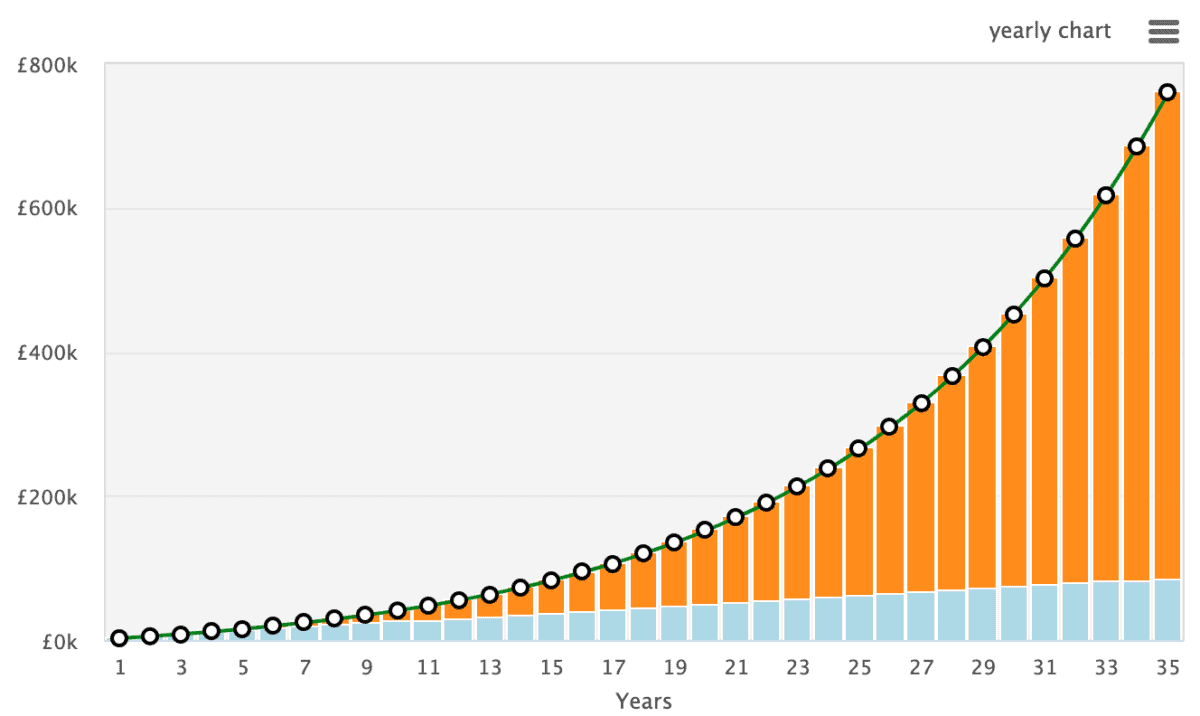

Created at thecalculatorsite.com

James Fox has positions in Hargreaves Lansdown Plc and Nvidia. The Motley Fool UK has recommended Hargreaves Lansdown Plc and Nvidia. Views expressed on the companies mentioned in this article are those of the writer and therefore may differ from the official recommendations we make in our subscription services such as Share Advisor, Hidden Winners and Pro. Here at The Motley Fool we believe that considering a diverse range of insights makes us better investors.

More on Investing Articles

Investing Articles

My top 10 ISA and SIPP stocks in 2026

Find out why a FTSE 100 investment trust is now this writer's top holding across his Stocks and Shares ISA…

Read more »

Rolls-Royce's Pearl 10X engine series
Investing Articles

£10,000 invested in Rolls-Royce shares 5 Christmases ago is now worth…

James Beard reflects on the post-pandemic Rolls-Royce share price rally and whether the group could become the UK’s most valuable…

Read more »

Investing Articles

Will Nvidia shares continue their epic run into 2026 and beyond?

Nvidia shares have an aura of invincibility as an AI boom continues to benefit the chipmaker. Can anything stop the…

Read more »

Investing Articles

Can Babcock’s and BAE Systems’ shares blast off again in 2026?

The defence sector has been going great guns in 2025, so Harvey Jones looks at whether BAE systems’ and Babcock’s…

Read more »

Woman riding her old fashioned bicycle along the Beach Esplanade at Aberdeen, Scotland.
Investing Articles

£10,000 invested in Lloyds shares at the beginning of 2025 is now worth…

It's been a banner year for Lloyds shares! Here is what a £10,000 stake would have returned over the course…

Read more »

Frustrated young white male looking disconsolate while sat on his sofa holding a beer
Investing Articles

I asked ChatGPT if I was an idiot for buying Aston Martin shares and it said…

Investors so caught up with the Christmas spirit might think it's a good idea to buy Aston Martin shares. But…

Read more »

Growth Shares

How high could the Vodafone share price go in 2026?

Jon Smith explains why the Vodafone share price is carrying strong momentum into 2026 and why it could continue to…

Read more »

Content white businesswoman being congratulated by colleagues at her retirement party
Investing Articles

I asked ChatGPT to find 3 shares for a brand new SIPP, and it picked…

Many UK investors will have an ISA or SIPP on their planning lists for 2026, while others seek new additions…

Read more »