
If I’d put £10k into Lloyds shares 2 years ago here’s how much I’d have today!

Lloyds shares, once the darlings of the FTSE 100, have traded sideways in recent years. Dr James Fox details his investment case for the stock.

| More on:

The content of this article was relevant at the time of publishing. Circumstances change continuously and caution should therefore be exercised when relying upon any content contained within this article.

Businessman use electronic pen writing rising colorful graph from 2023 to 2024 year of business planning and stock investment growth concept.

Image source: Getty Images

You’re reading a free article with opinions that may differ from The Motley Fool’s Premium Investing Services. Become a Motley Fool member today to get instant access to our top analyst recommendations, in-depth research, investing resources, and more. Learn More.

Lloyds (LSE:LLOY) shares today trade at a fraction of where they were before the 2008 financial crash. The stock is down around 90% from its peaks.

However, over the past two years, shares in the banking giant are pretty much flat. So if I had invested £10,000 in Lloyds shares two years ago, today I’d still have around £10,000, plus dividends.

Thankfully, given the above-average dividend yield, and increases in payments over the two years, I would have received around £800. So we’re looking at an annualised yield of 4%. That’s not great, but the FTSE 100 index has performed poorly too.

Bad debt crisis?

The decline in the Lloyds share price has been driven by concerns regarding the bank’s potential exposure to a significant rise in impairment costs caused by higher interest rates, which could lead to a wave of loan defaults.

Under the bank’s worst-case scenario, Lloyds is projecting expected credit losses (ECL) to reach a substantial £10.1bn. This amount represents around 35% of Lloyds’ current market capitalisation.

As of 30 June, the severe downside scenario appeared to be twice as impactful as the probability-weighted scenario, which was considered the most likely at the time.

During this period, Lloyds emphasised that even a slight change in interest rates could significantly impact ECL. A mere 10 basis point increase was estimated to result in a £226m ECL rise, while a 10 basis point decrease could potentially lead to a £366m increase in ECL.

These factors have added to the market’s concerns and contributed to the decline in the Lloyds share price.

Worst case avoided

However, it appears likely that the worst-case scenario has now been avoided, especially with the Bank of England halting its monetary tightening cycle. For now, this appears to have released some downward pressure on the bank, with the share price pushing up 6% over one month. Nonetheless, with Monetary Policy Committee electing to keep interest rates at 5.25%, some risks remain.

The Goldilocks zone

I’ve been saying this for a while, but I foresee very attractive conditions for banks in the medium term. Taking the bank’s probability-weighted forecast below, we can see that interest rates will likely moderate while economic growth is expected to stabilise.
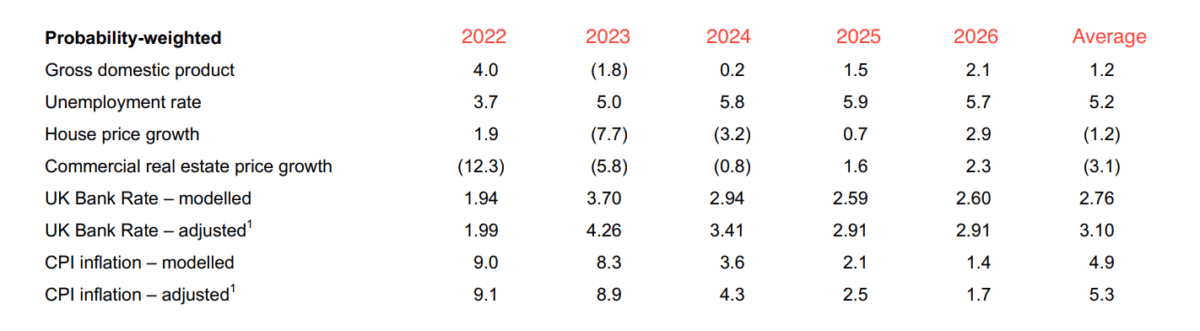
Source: Lloyds Q2

Interest rates ranging from 2-3% are often considered a favourable ‘Goldilocks zone’ for banks. In this range, impairment charges are expected to decline, while net interest income remains robust. Banks, being cyclical stocks, typically thrive in a healthy economic environment.

This environment allows banks to navigate with lower risks of loan defaults, resulting in reduced impairment charges. Simultaneously, they can continue to benefit from elevated net interest income, which contributes to their overall financial strength.

Additionally, banks tend to perform more optimally during periods of economic prosperity, as a thriving economy often leads to increased lending activity and improved financial results for these financial institutions.

Moreover, valuation remains central to my investment thesis. Lloyds trades at just 5.8 times earnings and 0.72 times book value.


James Fox has positions in Lloyds Banking Group Plc. The Motley Fool UK has recommended Lloyds Banking Group Plc. Views expressed on the companies mentioned in this article are those of the writer and therefore may differ from the official recommendations we make in our subscription services such as Share Advisor, Hidden Winners and Pro. Here at The Motley Fool we believe that considering a diverse range of insights makes us better investors.

More on Investing Articles

Sunrise over Earth
Investing Articles

Meet the ex-penny share up 109% that has topped Rolls-Royce and Nvidia in 2025

The share price of this investment trust has gone from pennies to above £1 over the past couple of years.…

Read more »

House models and one with REIT - standing for real estate investment trust - written on it.
Investing Articles

1 of the FTSE 100’s most reliable dividend stocks for me to buy now?

With most dividend stocks with 6.5% yields, there's a problem with the underlying business. But LondonMetric Property is a rare…

Read more »

Investing Articles

Is 2026 the year to consider buying oil stocks?

The time to buy cyclical stocks is when they're out of fashion with investors. And that looks to be the…

Read more »

ISA coins
Investing Articles

3 reasons I’m skipping a Cash ISA in 2026

Putting money into a Cash ISA can feel safe. But in 2026 and beyond, that comfort could come at a…

Read more »

US Stock

I asked ChatGPT if the Tesla share price could outperform Nvidia in 2026, with this result!

Jon Smith considers the performance of the Tesla share price against Nvidia stock and compares his view for next year…

Read more »

Investing Articles

Greggs: is this FTSE 250 stock about to crash again in 2026?

After this FTSE 250 stock crashed in 2025, our writer wonders if it will do the same in 2026. Or…

Read more »

Investing Articles

7%+ yields! Here are 3 major UK dividend share forecasts for 2026 and beyond

Mark Hartley checks forecasts and considers the long-term passive income potential of three of the UK's most popular dividend shares.

Read more »

Hand is turning a dice and changes the direction of an arrow symbolizing that the value of an ETF (Exchange Traded Fund) is going up (or vice versa)
Investing Articles

2 top ETFs to consider for an ISA in 2026

Here are two very different ETFs -- one set to ride the global robotics boom, the other offering a juicy…

Read more »