
We have some exciting news to share! The Motley Fool UK has now become an independent, UK-owned company, led by our long-serving UK management team — Mark Rogers, Chris Nials and Heather Adlington. In practical terms, it’s the same team you know, now fully focused on serving our UK readers and members.

Just as importantly, our approach remains unchanged: long-term, jargon-free, and on your side. We’ll be introducing a new name and brand over the coming weeks — we're very excited to share it with you and embark on this new chapter together!

Warren Buffett’s net worth hits $123bn! Here’s one strategy we can all copy

Warren Buffett is among the most successful investors of all time. Dr James Fox takes a closer look at one of Buffett’s investment strategies we can all copy.

The content of this article was relevant at the time of publishing. Circumstances change continuously and caution should therefore be exercised when relying upon any content contained within this article.

You’re reading a free article with opinions that may differ from The Motley Fool’s Premium Investing Services. Become a Motley Fool member today to get instant access to our top analyst recommendations, in-depth research, investing resources, and more. Learn More.

Buffett at the BRK AGM

Image source: The Motley Fool

Warren Buffett, the legendary investor often dubbed the “Oracle of Omaha”, currently boasts a net worth that has surged to an impressive $123bn.

What sets Buffett apart in the world of finance is not just his staggering wealth but also his unparalleled investment philosophy, which places a heavy emphasis on the power of compound returns.

For decades, Buffett has adhered to a time-tested strategy that harnesses the exponential growth potential of compounding.

As aspiring investors seek to navigate the complex world of financial markets, there’s much to be gained from taking a page out of Buffett’s playbook and recognising the transformative potential of compound returns in building lasting wealth.

“My wealth has come from a combination of living in America, some lucky genes, and compound interest”.

How compounding works

Compound returns is a powerful concept in finance that helps our money grow over time. It’s much like a snowball rolling downhill, getting bigger and bigger. Here’s a simple explanation of how it works with an example using an 8% annualised return:

Imagine I have £1,000 that I decide to invest, and I manage to achieve an 8% annual return on my investment. In the first year, my investment grows by 8%, which means I earn £80 (8% of £1,000). So, at the end of the first year, I’ll have £1,080.

Now, in the second year, my 8% return is not calculated on my initial £1,000, it’s calculated on my new total of £1,080. So, I’ll earn £86.40 (8% of £1,080) in the second year. Now, my total investment is £1,166.40.

This process continues year after year, with my investment earning a percentage of the new, larger amount. Over time, this compounding effect causes my investment to grow exponentially. Here’s how it might look after a few years:

  • Year 1: £1,000 + £80 = £1,080
  • Year 2: £1,080 + £86.40 = £1,166.40
  • Year 3: £1,166.40 + £93.31 = £1,259.71
  • Year 4: £1,259.71 + £100.78 = £1,360.49
  • Year 5: £1,360.49 + £108.84 = £1,469.33

As you can see, my investment grows faster and faster with each passing year because I’m earning interest not just on my initial £1000 but also on the interest I’ve already earned. This is the snowball effect of compound returns, and it can lead to significant wealth accumulation over time.

As we can see below, the long I leave it, the faster it grows. After 30 years, the size of my investment will have increased tenfold.
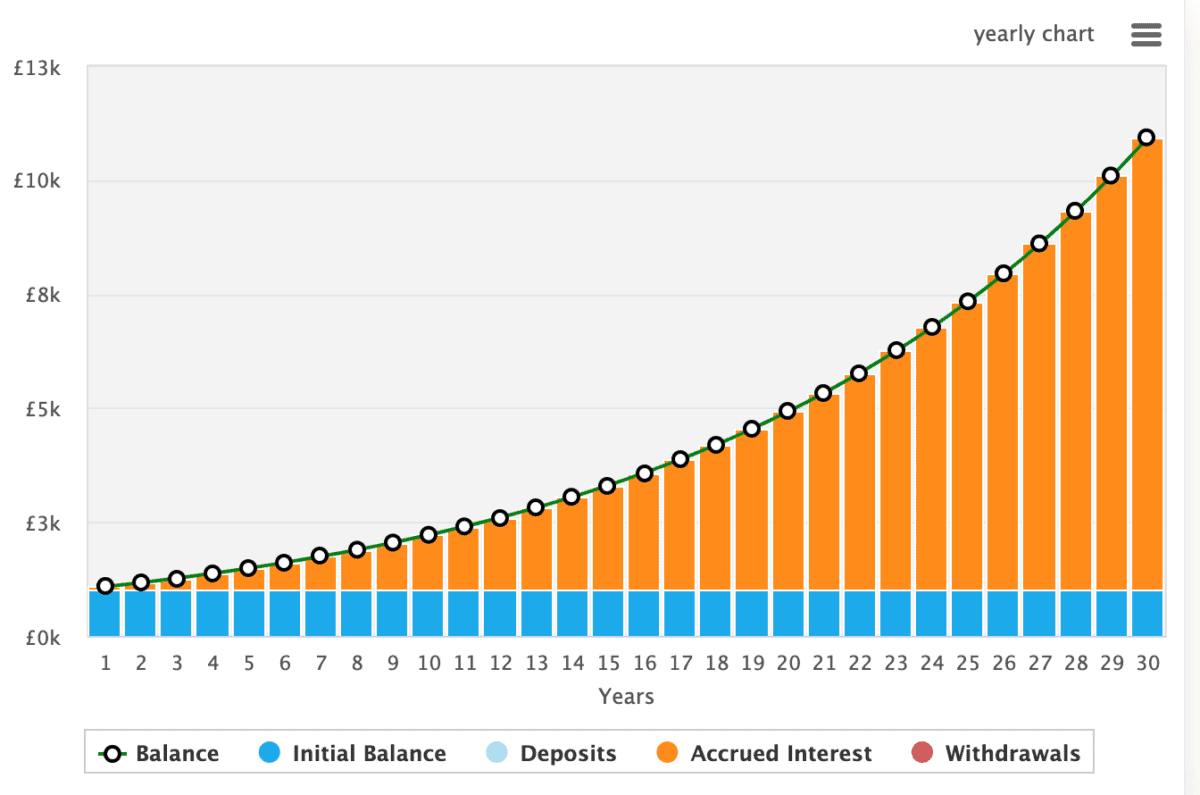
Created at thecalculatorsite.com

Be more Buffett

Of course, there are many ways we can follow Buffett. Thankfully, he regularly shares his thoughts and philosophy of investing. He also reminds us that we can lose money if we invest poorly and if we follow the crowd.

In fact, the current environment in the UK presents us with a unique opportunity a British Buffett would likely relish. And that’s the opportunity to buy top quality stocks at discounted prices.

And when we look at the FTSE 100, discounts are everywhere, from Barclays which trades at 0.42 times book value, to Hagreaves Lansdown, which is trading with a historic low price-to-earnings multiple.

Just look at how the FTSE 100 has compared to its international peers. The index is full of value.
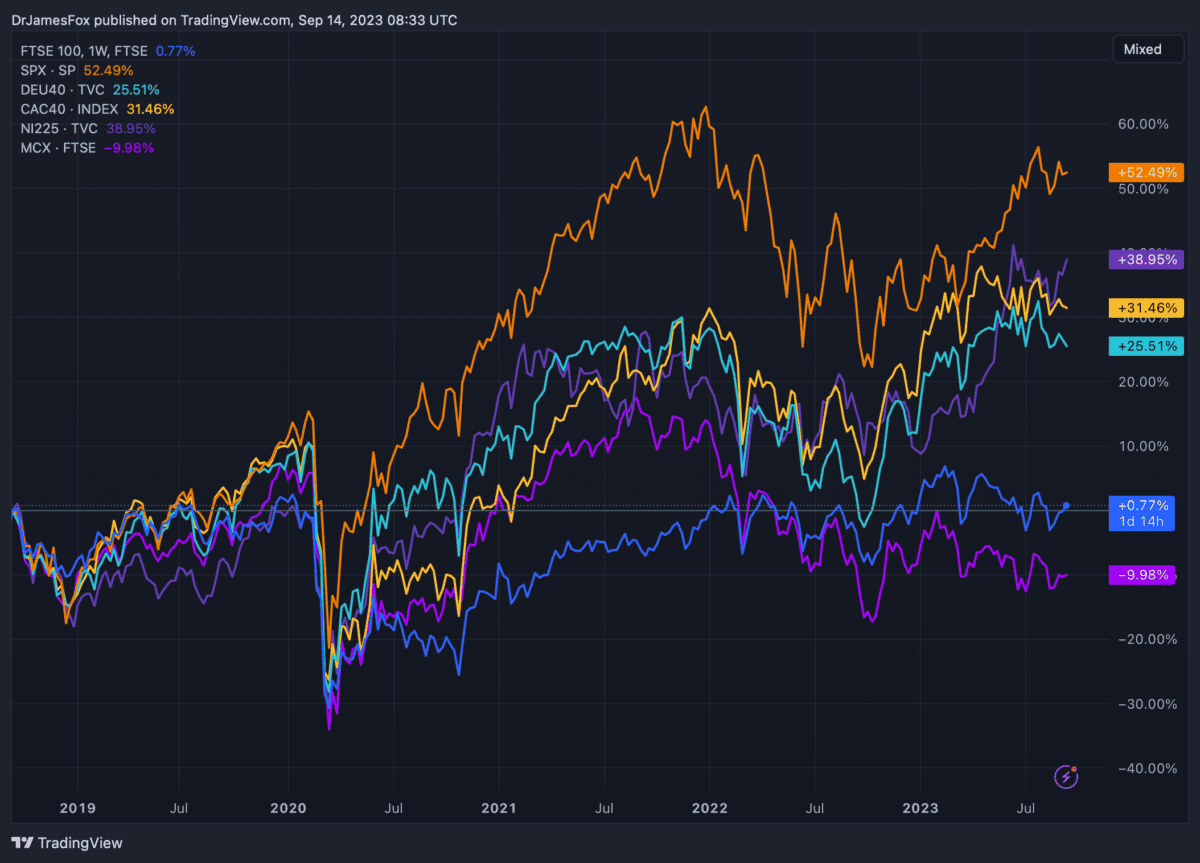

Created at TradingView

James Fox has positions in Barclays Plc and Hargreaves Lansdown Plc. The Motley Fool UK has recommended Barclays Plc and Hargreaves Lansdown Plc. Views expressed on the companies mentioned in this article are those of the writer and therefore may differ from the official recommendations we make in our subscription services such as Share Advisor, Hidden Winners and Pro. Here at The Motley Fool we believe that considering a diverse range of insights makes us better investors.

More on Investing Articles

Businessman with tablet, waiting at the train station platform
Dividend Shares

After years of pain, is the Diageo share price looking up?

For almost five years, the Diageo share price has delivered nothing but pain to long-suffering shareholders. But I see early…

Read more »

Thoughtful man using his phone while riding on a train and looking through the window
Investing Articles

Should I dump Duolingo from my ISA and buy Palantir stock instead?

These two AI-powered software stocks have been heading in very different directions, making me wonder if I should sell one…

Read more »

Warren Buffett at a Berkshire Hathaway AGM
Investing Articles

Warren Buffett just sounded an alarm to the stock market

Last week Warren Buffett used a six-letter word that should give investors pause for thought. But is the Oracle of…

Read more »

Investing Articles

Here are the lazy passive income streams paying me while I sleep

Find out which passive income stocks this writer owns, as well as one from the FTSE 100 index that he's…

Read more »

View of Lake District. English countryside with fields in the foreground and a lake and hills behind.
Investing Articles

How much do you need in an ISA to aim for a £2,613 monthly second income

Harvey Jones explains how a spread of FTSE 100 shares held in an ISA could generate enough second income to…

Read more »

A senior man and his wife holding hands walking up a hill on a footpath looking away from the camera at the view. The fishing village of Polperro is behind them.
Investing Articles

9 dividend-paying FTSE 100 shares to target a huge ISA retirement income!

Royston Wild explains how a diversified portfolio of FTSE 100 shares can deliver a strong (and growing) passive income in…

Read more »

Front view of a young couple walking down terraced Street in Whitley Bay in the north-east of England they are heading into the town centre and deciding which shops to go to they are also holding hands and carrying bags over their shoulders.
Investing Articles

£20,000 in an ISA? This passive income stock could give you £3,271 in dividends in 2025 and 2026

This passive income stock carries yields of 7.8% for 2026 and 7.9% for next year. So what makes it one…

Read more »

happy senior couple using a laptop in their living room to look at their financial budgets
Investing Articles

Plan to fund your retirement with just the State Pension? Good luck with that!

The UK's State Pension is ranked as one of the worst among the world's developed economies. Consider this alternative to…

Read more »