
Should I buy National Grid shares for a second income? Here’s what the charts say!

National Grid shares offer some of the biggest yields on London’s stock market. So should I buy them to boost the second income I receive from UK shares?

| More on:

The content of this article was relevant at the time of publishing. Circumstances change continuously and caution should therefore be exercised when relying upon any content contained within this article.

Portrait of elderly man wearing white denim shirt and glasses looking up with hand on chin. Thoughtful senior entrepreneur, studio shot against grey background.

Image source: Getty Images

You’re reading a free article with opinions that may differ from The Motley Fool’s Premium Investing Services. Become a Motley Fool member today to get instant access to our top analyst recommendations, in-depth research, investing resources, and more. Learn More.

I’m looking for the best dividend stocks to buy for this uncertain economic period. And National Grid (LSE:NG) of the FTSE 100 is one I’m giving serious attention to today.

Utilities companies like this are popular lifeboats for investors in tough times. The essential services that water, energy, and telecoms suppliers provide give them exceptional earnings stability across the economic cycle.

That said, these businesses also face rising risks in a several critical areas. Rising interest rates are pushing their debt servicing costs higher. The increasing frequency of weather-related events is also pushing operating expenses skywards.

So should I add National Grid shares to my portfolio today?

Progressive policy

As I say, businesses like this enjoy exceptional profits visibility like few other UK shares. This in turn gives them the financial strength and the confidence to consistently raise dividends.

As the chart below shows, National Grid has a proud record of lifting shareholder payouts in recent decades. Unlike many other FTSE 100 shares, the business even continued raising dividends during the Covid-19 crisis.
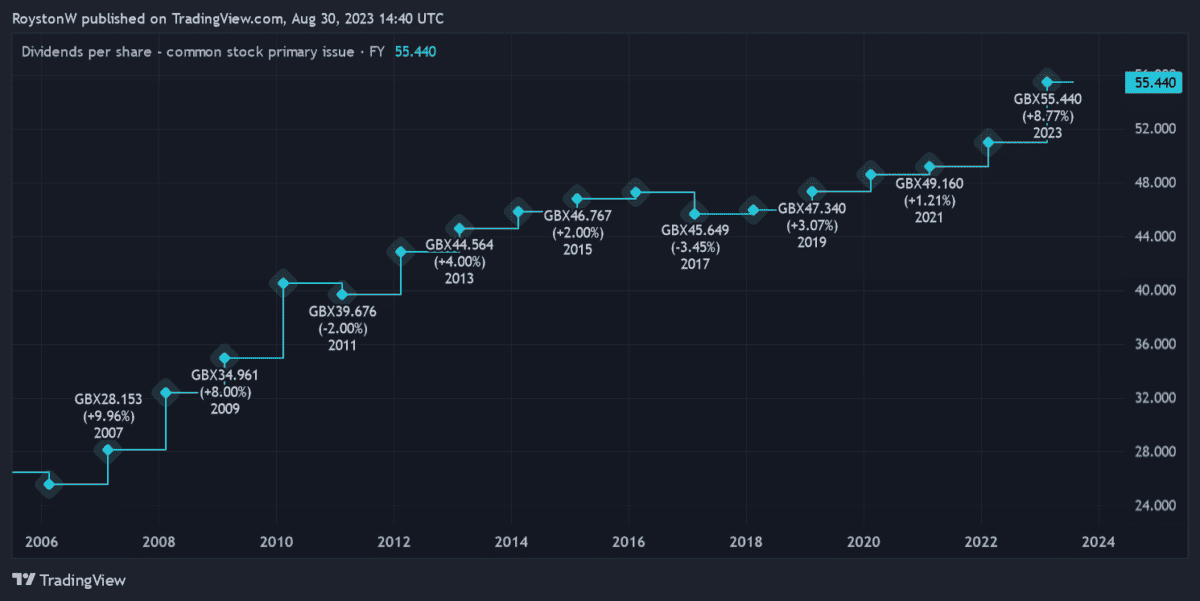
Chart showing dividend growth at National Grid.
Created with TradingView

That said, you’ll notice there have been rare blips when dividends have fallen at the energy transmission business. This reflects the huge sums it has to spend to keep the country’s pylons, power lines, and substations in good working order. It can sometimes put a strain on the balance sheet and, by extension, pull dividends lower.

Big dividend yields

But City analysts don’t foresee any approaching problems for National Grid’s progressive dividend policy. In fact payments are tipped to keep rising for the next three financial years at least (all the way through to March 2026).

So for this financial year the dividend yield sits just below 5.6%, as the chart below shows. It’s a reading that sails past the 3.7% average for FTSE 100 shares.
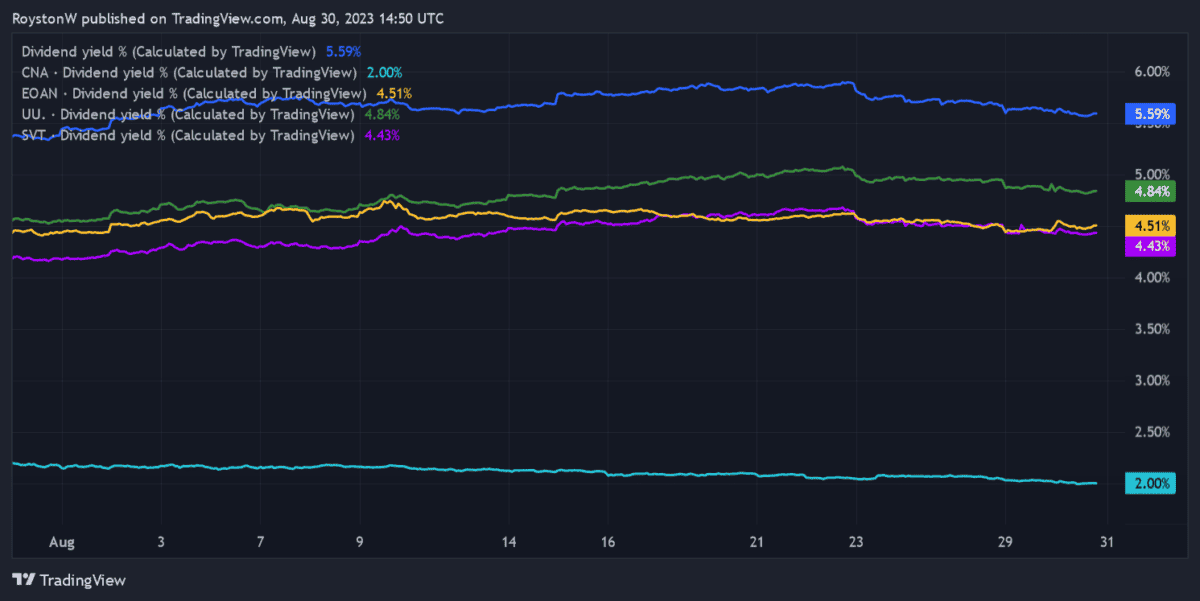
Chart showing National Grid's dividend yield compared with other utilities companies.
Created with TradingView

But this is not all. As the graphic also shows, the company’s yield also beats those of other UK utilities United Utilities, Severn Trent, and Centrica. It also comes in ahead of German energy giant E.ON‘s 4.51% forward-looking yield.

Should I buy National Grid shares?

There’s no guarantee that National Grid will pay these predicted dividends, of course. City forecasts can often fall flat, and the company’s large net debt (£41bn worth as of March) — allied with the rising cost of servicing it — merit serious attention from investors.

However, I believe the FTSE firm’s defensive operations and solid cash flows put it in great shape to meet analyst expectations. As a long-term investor there are other things I like about National Grid shares, including:

  • The company’s UK monopoly, which protects it from competitive threats
  • Its heavy investment in renewable energy
  • The likely absence of severe regulatory threats in the near future

Like any stock, National Grid has its risks. But I think the potential rewards on offer make it a top stock to buy for a second income.


Royston Wild has no position in any of the shares mentioned. The Motley Fool UK has no position in any of the shares mentioned. Views expressed on the companies mentioned in this article are those of the writer and therefore may differ from the official recommendations we make in our subscription services such as Share Advisor, Hidden Winners and Pro. Here at The Motley Fool we believe that considering a diverse range of insights makes us better investors.

More on Investing Articles

Sunrise over Earth
Investing Articles

Meet the ex-penny share up 109% that has topped Rolls-Royce and Nvidia in 2025

The share price of this investment trust has gone from pennies to above £1 over the past couple of years.…

Read more »

House models and one with REIT - standing for real estate investment trust - written on it.
Investing Articles

1 of the FTSE 100’s most reliable dividend stocks for me to buy now?

With most dividend stocks with 6.5% yields, there's a problem with the underlying business. But LondonMetric Property is a rare…

Read more »

Investing Articles

Is 2026 the year to consider buying oil stocks?

The time to buy cyclical stocks is when they're out of fashion with investors. And that looks to be the…

Read more »

ISA coins
Investing Articles

3 reasons I’m skipping a Cash ISA in 2026

Putting money into a Cash ISA can feel safe. But in 2026 and beyond, that comfort could come at a…

Read more »

US Stock

I asked ChatGPT if the Tesla share price could outperform Nvidia in 2026, with this result!

Jon Smith considers the performance of the Tesla share price against Nvidia stock and compares his view for next year…

Read more »

Investing Articles

Greggs: is this FTSE 250 stock about to crash again in 2026?

After this FTSE 250 stock crashed in 2025, our writer wonders if it will do the same in 2026. Or…

Read more »

Investing Articles

7%+ yields! Here are 3 major UK dividend share forecasts for 2026 and beyond

Mark Hartley checks forecasts and considers the long-term passive income potential of three of the UK's most popular dividend shares.

Read more »

Hand is turning a dice and changes the direction of an arrow symbolizing that the value of an ETF (Exchange Traded Fund) is going up (or vice versa)
Investing Articles

2 top ETFs to consider for an ISA in 2026

Here are two very different ETFs -- one set to ride the global robotics boom, the other offering a juicy…

Read more »