
We have some exciting news to share! The Motley Fool UK has now become an independent, UK-owned company, led by our long-serving UK management team — Mark Rogers, Chris Nials and Heather Adlington. In practical terms, it’s the same team you know, now fully focused on serving our UK readers and members.

Just as importantly, our approach remains unchanged: long-term, jargon-free, and on your side. We’ll be introducing a new name and brand over the coming weeks — we're very excited to share it with you and embark on this new chapter together!

Are BP shares undervalued? Here’s what the charts say!

The fluctuation of BP shares is highly correlated to the price of energy. But the stock trades at a discount to its supermajor peers. So, why is this?

| More on:

The content of this article was relevant at the time of publishing. Circumstances change continuously and caution should therefore be exercised when relying upon any content contained within this article.

You’re reading a free article with opinions that may differ from The Motley Fool’s Premium Investing Services. Become a Motley Fool member today to get instant access to our top analyst recommendations, in-depth research, investing resources, and more. Learn More.

Young Asian man drinking coffee at home and looking at his phone

Image source: Getty Images

BP (LSE:BP) shares have remained relatively flat this summer, with a buyback policy making up for an earnings disappointment. In terms of performance, BP has largely been performing in line with other oil supermajors. However, its valuation indicates a significant discount. Let’s explore.

Performance

BP reported a significant earnings miss on August 1. Profit for the quarter came in at £1.8bn, down from $8.2bn in the first quarter. The earnings per share followed suit, experiencing a notable descent from $27.74 to $14.77.

However, this wasn’t hugely surprising. BP was the last of the supermajors to report earnings. ExxonMobil and Shell noted profits falling by 56%, while TotalEnergies said earnings fell by 49%.

Falling earnings across the sector reflected softening demand for hydrocarbons products and narrowing margins across the value chain. During the quarter oil prices fell 10% and natural gas prices by almost 30%.

Of course, this highlights a risk of investing in BP, as well as its peers. And if the environment deteriorates, and energy prices fall, the stocks could tumble.

Dividends and buybacks

In its recent earnings report, BP announced a plan to repurchase $1.5bn worth of shares before the Q3 results announcement later this year. This amounts to about 1.4% of the shares that were available at the time of the announcement. Notably, BP has reduced the number of its shares by 8.4% over the past 10 years, a pivotal aspect of its investment strategy.

BP’s dividend yield stands at 4.12%, which is higher than the average for the index. This dividend is also quite dependable. The company has only cut it twice in the last 15 years. The first time was after the Deepwater Horizon oil spill, when BP had to pay fines. The second time was during the pandemic. Additionally, its coverage ratio is 4.24 times, indicating that, based on previous earnings at least, the dividend seems sustainable.

Valuation

BP has historically had the lowest gross profit margin of the supermajors, standing at 30.7% at the end of Q1. This may not be the case for long, however. BP highlighted in its Q2 report that the acquisition of TravelCenters of America – a deal that will add a network of 288 sites located on US highways – should almost double its global convenience gross margin.

However, more importantly, when we look at valuation metrics, BP retains a significant discount. At present, BP’s P/E stands at 5.9, with a forward P/E of 6.5 based on projected earnings for the year.

As we can see in the chart below, this represents a significant discount versus peers. It’s also a discount versus BP’s five-year average P/E of 8.3.
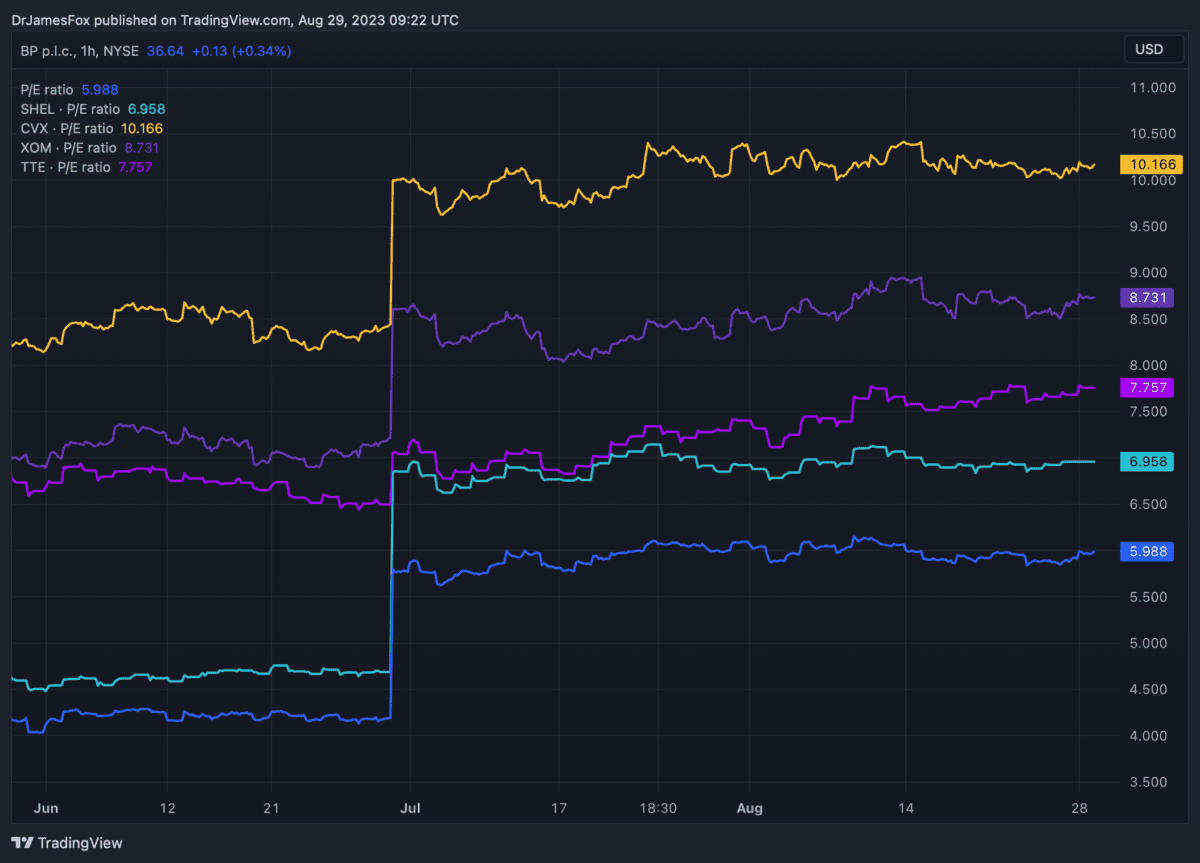
Created at TradingView

We can see that Shell is the closest company by valuation, and this highlights the discount afforded to UK stocks. But we also know that debt is another reason for the relatively low valuation.

BP’s debt-to-equity ratio is around 0.59 – Exxon 0.2, Chevron 0.14, and Shell 0.44. In turn this is a drag on profitably. However, it’s evident that this does not fully account for the discount. As such, BP appears undervalued.


James Fox has no position in any of the shares mentioned. The Motley Fool UK has no position in any of the shares mentioned. Views expressed on the companies mentioned in this article are those of the writer and therefore may differ from the official recommendations we make in our subscription services such as Share Advisor, Hidden Winners and Pro. Here at The Motley Fool we believe that considering a diverse range of insights makes us better investors.

More on Investing Articles

Businessman with tablet, waiting at the train station platform
Dividend Shares

After years of pain, is the Diageo share price looking up?

For almost five years, the Diageo share price has delivered nothing but pain to long-suffering shareholders. But I see early…

Read more »

Thoughtful man using his phone while riding on a train and looking through the window
Investing Articles

Should I dump Duolingo from my ISA and buy Palantir stock instead?

These two AI-powered software stocks have been heading in very different directions, making me wonder if I should sell one…

Read more »

Warren Buffett at a Berkshire Hathaway AGM
Investing Articles

Warren Buffett just sounded an alarm to the stock market

Last week Warren Buffett used a six-letter word that should give investors pause for thought. But is the Oracle of…

Read more »

Investing Articles

Here are the lazy passive income streams paying me while I sleep

Find out which passive income stocks this writer owns, as well as one from the FTSE 100 index that he's…

Read more »

View of Lake District. English countryside with fields in the foreground and a lake and hills behind.
Investing Articles

How much do you need in an ISA to aim for a £2,613 monthly second income

Harvey Jones explains how a spread of FTSE 100 shares held in an ISA could generate enough second income to…

Read more »

A senior man and his wife holding hands walking up a hill on a footpath looking away from the camera at the view. The fishing village of Polperro is behind them.
Investing Articles

9 dividend-paying FTSE 100 shares to target a huge ISA retirement income!

Royston Wild explains how a diversified portfolio of FTSE 100 shares can deliver a strong (and growing) passive income in…

Read more »

Front view of a young couple walking down terraced Street in Whitley Bay in the north-east of England they are heading into the town centre and deciding which shops to go to they are also holding hands and carrying bags over their shoulders.
Investing Articles

£20,000 in an ISA? This passive income stock could give you £3,271 in dividends in 2025 and 2026

This passive income stock carries yields of 7.8% for 2026 and 7.9% for next year. So what makes it one…

Read more »

happy senior couple using a laptop in their living room to look at their financial budgets
Investing Articles

Plan to fund your retirement with just the State Pension? Good luck with that!

The UK's State Pension is ranked as one of the worst among the world's developed economies. Consider this alternative to…

Read more »