
Why is the FTSE 100 struggling to hit 8,000 again?

Having hit a record high of 8,000 points in February, the FTSE 100 (INDEXFTSE:UKX) has now dropped back down to 7,600 points. Why is that?

The content of this article was relevant at the time of publishing. Circumstances change continuously and caution should therefore be exercised when relying upon any content contained within this article.

You’re reading a free article with opinions that may differ from The Motley Fool’s Premium Investing Services. Become a Motley Fool member today to get instant access to our top analyst recommendations, in-depth research, investing resources, and more. Learn More.

Portrait of elderly man wearing white denim shirt and glasses looking up with hand on chin. Thoughtful senior entrepreneur, studio shot against grey background.

Image source: Getty Images

The FTSE 100 had started the year on an encouraging note, hitting new highs in February. Nonetheless, stubborn inflation has trampled its progress, with Britain’s main index consolidating to lower levels since. So, why is it having so much trouble hitting and maintaining 8,000 points?
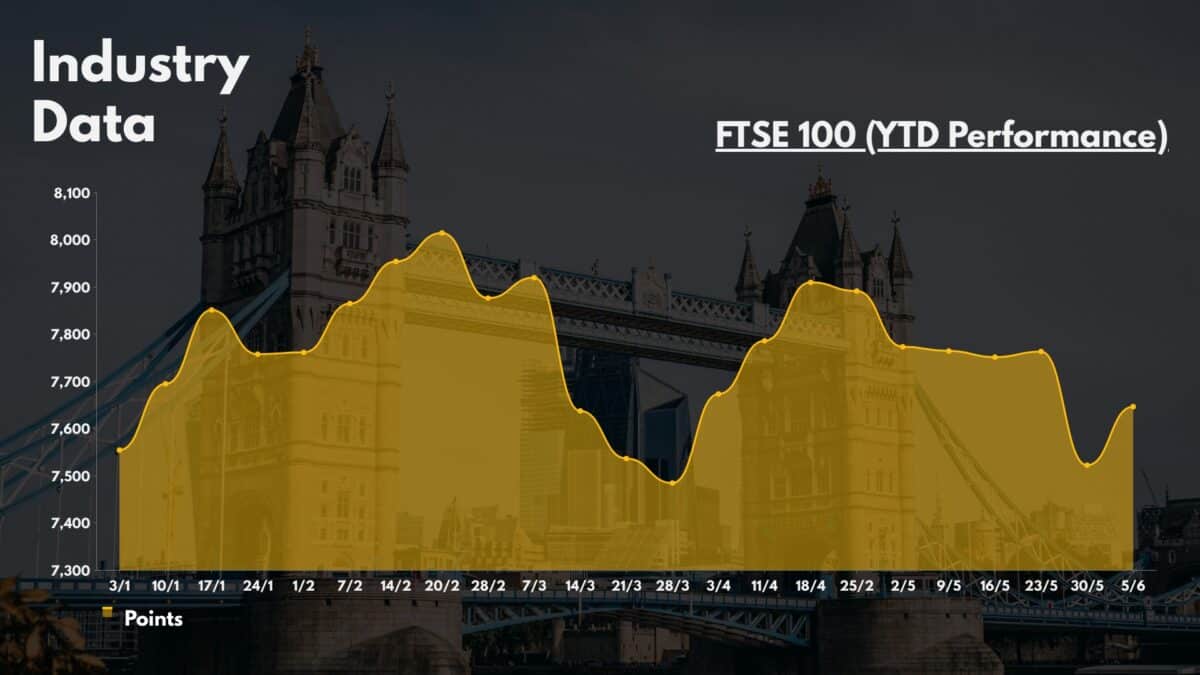
FTSE 100 (YTD Performance)
Data source: Google Finance

Inflated expectations

What caused the FTSE 100 to even hit 8,000 points to begin with? At that time, there was hope that inflation was indeed transitory, and that it was going to start plunging in the months to come. This would likely have caused the Bank of England to pause its rate-hiking cycle and cut rates later this year.

The theory is that rate cuts would eventually ease pressures on household income, subsequently encouraging spending and boosting stock prices. However, the opposite has come to pass instead, as inflation remains stickier than expected.

April’s CPI inflation print may have shown a modest drop, but the figure still came .5% hotter than forecast. As such, the FTSE 100 dropped a staggering 300 points in just a few days. Markets are now anticipating the central bank to only stop raising rates at 5.5%, from the 4.5% previously projected.

This isn’t good news for many of the FTSE 100’s top constituents. For instance, banks could see a rise in impairments from higher rates, which would dampen profits. Higher rates will also further spending in consumer staples and discretionary items, which will affect demand for material and industrials.

SectorWeight in FTSE 100
Consumer staples17.9%
Financials17.8%
Materials13.4%
Industrials12.2%
Healthcare11.7%
Energy9.5%
Consumer discretionary6.9%
Communications4.3%
Real estate1.4%
Technology1.4%
Data source: Global Investment Strategy

A pounding from foreign exchange

Another aspect that isn’t being discussed nearly enough is the prospect of further rate hikes strengthening the British pound sterling (GBP). A stronger GBP is beneficial in terms of getting cheaper imports, which will help to ease inflationary pressures.

That said, it’s not exactly a plus point for many FTSE 100 companies. This is because Britain’s top companies generate most of their profits from outside the UK. A more expensive pound could mean lower profits as conglomerates have to convert their earnings back into GBP.

All of the above cumulate and serve as tailwinds to many companies’ bottom lines. Hence, it’s no surprise that the FTSE 100 has been struggling to gain enough momentum to hit 8,000 points since February.

Are FTSE 100 shares worth buying?

On that basis, one could argue that this isn’t the best time to buy shares in the UK’s premier index. Nonetheless, I hold a contrarian view. I firmly believe that there’s no better time to buy UK shares than today.

It’s crucial to point out that the UK stocks have a habit of rebounding after every dip. Over the past year alone, the FTSE 100 has dipped a total of 10 times, and has rebounded every single time. And as Warren Buffett once said, buy when others are fearful.

In fact, there are a number of FTSE shares currently trading at tremendous discounts, with some of them even trading below book value. And considering that the FTSE 100 is currently trading below its long-term average P/E ratio of 15, I’d make the case that there’s no better time to buy UK shares than today.


John Choong has no position in any of the shares mentioned. The Motley Fool UK has no position in any of the shares mentioned. Views expressed on the companies mentioned in this article are those of the writer and therefore may differ from the official recommendations we make in our subscription services such as Share Advisor, Hidden Winners and Pro. Here at The Motley Fool we believe that considering a diverse range of insights makes us better investors.

More on Investing Articles

piggy bank, searching with binoculars
Growth Shares

1 UK share I’d consider buying and 1 I’d run away from on this market dip

In light of the recent stock market dip, Jon Smith outlines the various potential outcomes for a couple of different…

Read more »

Burst your bubble thumbtack and balloon background
Investing Articles

AI may look like a bubble. But what about Rolls-Royce shares?

Bubble talk has been centred on some AI stocks lately. But Christopher Ruane sees risks to Rolls-Royce shares in the…

Read more »

Black woman using smartphone at home, watching stock charts.
Investing Articles

Will the BAE Systems share price soar 13% by this time next year?

BAE Systems' share price continues to surge as the Middle East crisis worsens. Royston Wild asks if the FTSE 100…

Read more »

Portrait of pensive bearded senior looking on screen of laptop sitting at table with coffee cup.
Investing Articles

Is this a once-in-a-decade chance to bag a 9.9% yield from Taylor Wimpey shares?

Taylor Wimpey shares have been hit by a volatile share price and cuts to the dividend. Harvey Jones holds the…

Read more »

Chalkboard representation of risk versus reward on a pair of scales
Investing Articles

Way up – or way down? This FTSE 250 share could go either way

Can this FTSE 250 share turn its fortunes around? Or has its day passed? Our writer looks at both sides…

Read more »

Front view of aircraft in flight.
Investing Articles

Should I buy Rolls-Royce shares after the 9% dip?

Up a mind-blowing 1,040% in five years, Rolls-Royce shares are taking a well-deserved breather. Is this my chance to be…

Read more »

Businesswoman calculating finances in an office
Investing Articles

Legal & General’s share price just fell 6%, pushing the dividend yield to 9%. Time to consider buying?

Legal & General's share price is now about 14% below its 2026 high. As a result, the dividend yield on…

Read more »

This way, That way, The other way - pointing in different directions
Investing Articles

Which are the best stocks to buy ahead of a potential market crash?

Should investors follow Warren Buffett and stop buying stocks to build cash reserves? Or are there better ways to prepare…

Read more »