
The FTSE 100: should I catch a falling knife?

Should I panic and run for the hills when a market like the FTSE 100 is falling? Or should I keep calm and carry on investing?

The content of this article was relevant at the time of publishing. Circumstances change continuously and caution should therefore be exercised when relying upon any content contained within this article.

Bronze bull and bear figurines

Image source: Getty Images

You’re reading a free article with opinions that may differ from The Motley Fool’s Premium Investing Services. Become a Motley Fool member today to get instant access to our top analyst recommendations, in-depth research, investing resources, and more. Learn More.

Key Points

  • The FTSE 100 is not in correction or bear market territory
  • Investors tend to overreact to declines and underreact to gains
  • Markets typically go up for longer and more frequently than they go down

The FTSE 100 is rising today. But, since last Wednesday it has fallen 7%. Looking back to the most recent high of 8,014, which hit on 20 February 2023, the FTSE 100 is down 8%.

Explanations as to why this has happened are plentiful and I won’t be repeating them here. What I want to work out is what I should be doing when the markets are not in rude health.

Stock market crashes and corrections

When it comes to stock market movements, there are a few terms that the investing community agree on. These are:

  • Crash: an abrupt, typically double-digit percentage drop which occurs over hours or days
  • Correction: a decline of 10% to 20% from a recent high, typically over weeks to months
  • Bear market: a drop of more than 20% from a recent high, typically measured over months to years
  • Bull market: a rise of more than 20% from a recent low, typically measured over weeks to months

Right now, the FTSE 100 is not quite crashing, and it’s not correcting or in a bear market. But as someone who keeps an eye on financial news, it certainly feels like it is.

Type “bull market” into a Google news search and 9,260,000 results are delivered. Search for “bear market” and the results are doubled to 18,100,000. Panic-inducing headlines are more common than their converse. Bad news, it appears, sells more. And I likely consume more of it, whether I want to or not, compared to more positive headlines.

Economists Daniel Kahneman and Amos Tversky discovered that people feel more pain losing £200 than they will joy when gaining £200. They called this phenomenon ‘loss aversion’. Those Google news search results suggest that headlines that warn of pain get more attention. I certainly find myself checking my portfolio when markets are dropping. I am certain I overact to declines and underreact to gains.

Catching the FTSE 100

According to Forbes, bear markets last 289 days and happen every 5.4 years on average. Bull markets are longer (973 days on average) and occur more frequently. The average length of bull markets is 973 days and they occur more frequently.
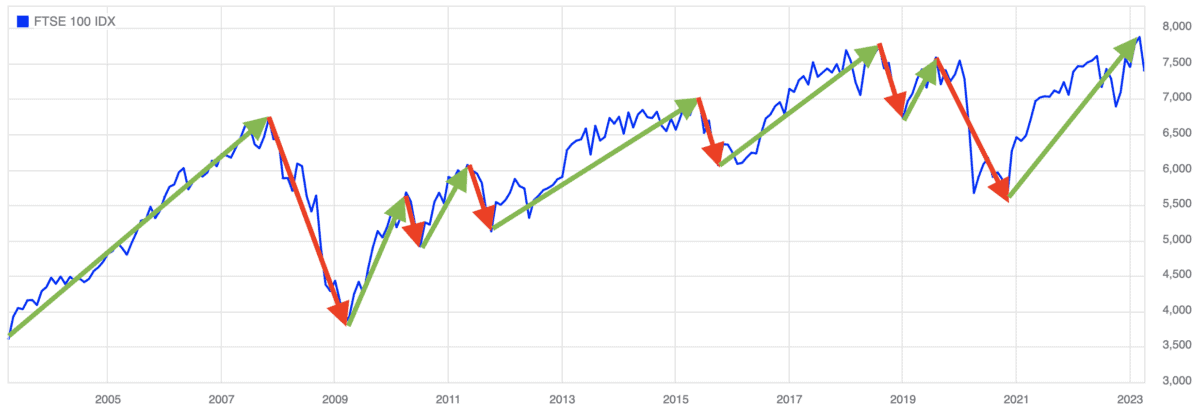
The blue line is raw FTSE 100 price data. The green arrows show gains of 10% or more from a recent low, and the red arrows show losses of 10% or more from a recent high. Notice that green arrows are marginally more frequent and tend to be longer than red ones. Source: London Stock Exchange.

A graph of the FTSE 100 price since 2003 backs this up. Measure moves of 10% or more and the periods of gain are more frequent and cumulatively last longer than the periods of loss.

Since I regularly invest my spare money, then I am more likely to be buying at higher and higher prices. And I will do this quite happily. Yet when markets drop, I will want to stop investing. I won’t want to catch a falling knife, because I will likely get cut, right?

Well, maybe I will. But I could be buying at lower prices ahead of a transition to a rising market. That’s something I should be doing. And given I have decades before I need to start drawing my investment portfolio it makes sense that I do just that.


James McCombie has no position in any of the shares mentioned. The Motley Fool UK has no position in any of the shares mentioned. Views expressed on the companies mentioned in this article are those of the writer and therefore may differ from the official recommendations we make in our subscription services such as Share Advisor, Hidden Winners and Pro. Here at The Motley Fool we believe that considering a diverse range of insights makes us better investors.

More on Investing Articles

Older couple walking in park
Investing Articles

How much do I need in my ISA for a £1,000 monthly passive income?

Picking high-income stocks in an ISA can be a route to securing long-term passive income. And here's one with a…

Read more »

Smiling white woman holding iPhone with Airpods in ear
Investing Articles

Prediction: in 12 months the surging Aviva share price and dividend could turn £10,000 into…

Aviva's share price has beaten the broader FTSE 100 over the last year. But can the financial services giant keep…

Read more »

Portrait of elderly man wearing white denim shirt and glasses looking up with hand on chin. Thoughtful senior entrepreneur, studio shot against grey background.
Dividend Shares

I love FTSE 100 dividend shares, but do I buy this FTSE 250 loser?

Over the past year, the UK's FTSE 100 has thrashed the once-mighty US S&P 500 index. With value investing back…

Read more »

Investing Articles

How much do you need in an ISA to target a £2,000 monthly second income?

Harvey Jones crunches the numbers to see how much investors need in a Stocks and Shares ISA to generate a…

Read more »

Passive income text with pin graph chart on business table
Investing Articles

Should investors consider Legal & General shares for passive income?

As many investors are chasing their passive income dreams, our writer Ken Hall evaluates whether Legal & General could help…

Read more »

ISA coins
Investing Articles

How to transform an empty Stocks and Shares ISA into a £15,000 second income

Ben McPoland explains how a UK dividend portfolio can be built from the ground up inside a Stocks and Shares…

Read more »

Investing Articles

I asked ChatGPT if it’s better buy high-yielding UK stocks in an ISA or SIPP and it said…

Harvey Jones loves his SIPP, but he thinks a Stocks and Shares ISA is a pretty good way to invest…

Read more »

DIVIDEND YIELD text written on a notebook with chart
Investing Articles

How much do you need to invest in dividend shares to earn £1,500 a year in passive income?

As the stock market tries to get to grips with AI, could dividend shares offer investors a chance to earn…

Read more »