
Share your opinion and earn yourself a free Motley Fool premium report!

We are looking for Fools to join a 75 minute online independent market research forum on 15th / 16th December.

To find out more and express your interest please click here

Are Lloyds shares still a buy for passive income?

Despite an uncertain outlook for FTSE bank stocks, I feel Lloyds shares are still strong picks for investors who are focused on dividends.

| More on:

The content of this article was relevant at the time of publishing. Circumstances change continuously and caution should therefore be exercised when relying upon any content contained within this article.

Middle-aged lady in wheelchair writing on whiteboard

Image source: Getty Images

You’re reading a free article with opinions that may differ from The Motley Fool’s Premium Investing Services. Become a Motley Fool member today to get instant access to our top analyst recommendations, in-depth research, investing resources, and more. Learn More.

Lloyds (LSE:LLOY) shares have had a mixed reaction after the company reported its full-year results on Wednesday. Like the rest of its FTSE peers, the bank offered a rather uncertain outlook for the year ahead. Nonetheless, I think it’s still a solid stock to hold for passive income.

Interesting results

We got a bit of a mixed bag when Lloyds shared its full-year figures. Q4 looked rather impressive as the bank beat analysts expectations on almost all fronts. Unfortunately though, Q4’s higher-than-expected impairment charges were a sore point.

MetricsConsensusQ4 2022Q4 2021Growth
Net interest income (NII)£3.55bn£3.64bn£2.89bn26%
Net interest margin3.16%3.22%2.57%0.65%
Impairment charges£380m£465m-£532m187%
Net profit£1.21bn£1.52bn£0.42bn262%
Return on tangible equity (ROE)12.5%16.3%2.9%13.4%
Data source: Lloyds

What’s more, the outlook for the year ahead wasn’t great. The firm predicted the net interest margin to be no greater than 3.05%, below the 3.2% that peers Barclays and NatWest are expecting. This means that profit margins could be lower in 2023.

Additionally, both underlying profit and profit after tax were weaker compared to the prior year. This was disappointing given its earnings potential in a high-interest environment. This was due to 2022’s impairments being much higher than last year’s credit release. As such, even though NII (the interest the bank generates on financial assets, minus the interest it pays on its liabilities) improved substantially, it was offset by its increase in bad debt.
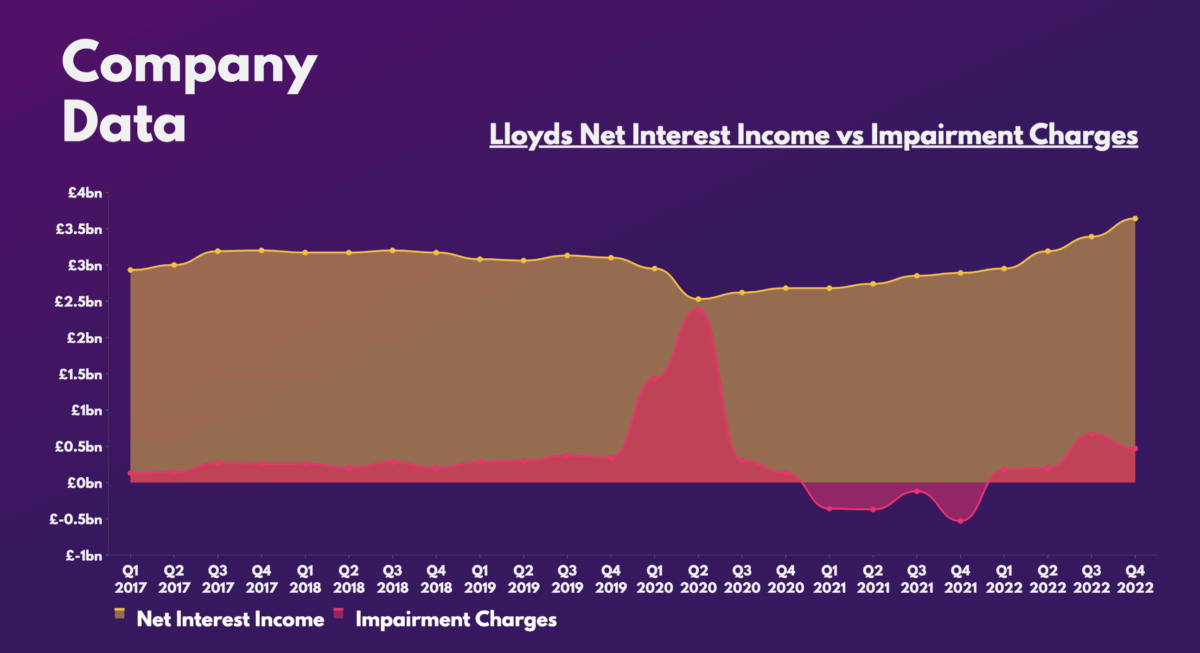
Lloyds Net Interest Income vs Impairment Charges.
Data source: Lloyds

Nonetheless, there were still plenty of positives to take away from the report. Impairments seem to be stabilising while NII continues to grow. So, provided the Bank of England continues to leave interest rates elevated throughout 2023, profit margins have the potential to creep back up. This would be a positive for Lloyds shares and its passive income potential.

Stable income?

Most importantly though, the lender reported a final dividend of 1.6p per share. This brings the group’s dividend yield to 4.6% in 2022. Although not stellar compared to the likes of commodity giants and housebuilders, it’s still a respectable yield to earn some passive income.
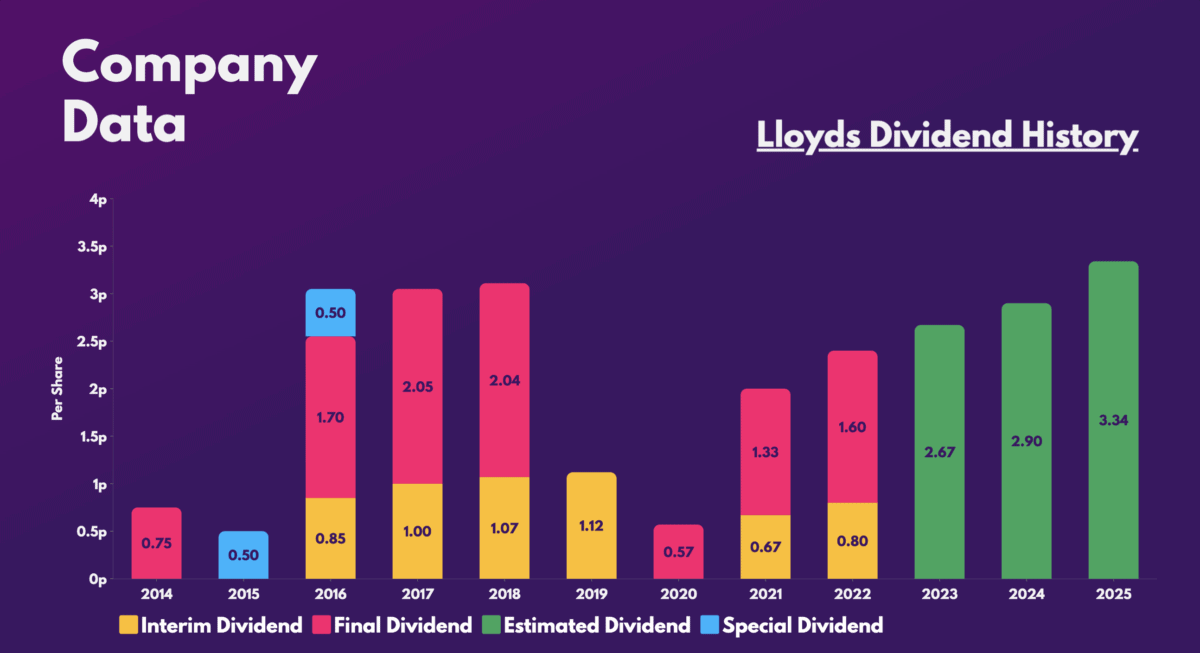
Lloyds Dividend History.
Data source: Lloyds

What could leave investors excited, however, may be the forward yields. The Black Horse bank’s CET1 ratio (which compares a bank’s capital against its assets) is currently above its 12.5% target at 14.1%. And it plans to return the excess value to shareholders by 2024, starting with a £2bn stock buyback programme.

Ultimately, Lloyds shares at this stage may prove to be a bargain if the economy and the housing market don’t continue to sink from here. Impairments could start to taper off, releasing some credit reserves, and improving returns. And with economic data being less gloomy than had been imagined, investors could see higher payouts moving forward.

A balancing act

Lloyds has a reputation of overpromising and underdelivering. Hence, I believe the board has done well to lower expectations for the year ahead. With the latest economic data showing some promise, I still rate Lloyds, and see it being a potential winner in 2023 in terms of share price growth and returns to shareholders.

After all, the stock’s valuation multiples and average price target (65p) mean it could be a lucrative investment. In fact, Jefferies, Citi, and Barclays still rate the stock a ‘buy’. Thus, I’ll be loading up on more shares for my portfolio to capitalise on the potential to earn more passive income.

MetricsLloydsIndustry average
Price-to-book (P/B) ratio0.70.7
Price-to-earnings (P/E) ratio6.89.8
Forward price-to-earnings (FP/E) ratio7.16.8
Data source: Google Finance

Citigroup is an advertising partner of The Ascent, a Motley Fool company. John Choong has positions in Lloyds Banking Group Plc. The Motley Fool UK has recommended Barclays Plc and Lloyds Banking Group Plc. Views expressed on the companies mentioned in this article are those of the writer and therefore may differ from the official recommendations we make in our subscription services such as Share Advisor, Hidden Winners and Pro. Here at The Motley Fool we believe that considering a diverse range of insights makes us better investors.

More on Dividend Shares

A pastel colored growing graph with rising rocket.
Investing Articles

I’ve made this much from 417 shares in this FTSE 100 dividend income gem since 2020…

My £10k investment in this FTSE 100 heavyweight has grown hugely since 2020. With dividends up and the shares still…

Read more »

Businessman hand stacking money coins with virtual percentage icons
Investing Articles

Here’s how investors can target £7,570 a year in dividend income from £20,000 in this FTSE 250 media gem

This FTSE 250 star looks very undervalued, but with a 6%+ dividend yield investors could lock in high passive income…

Read more »

DIVIDEND YIELD text written on a notebook with chart
Investing Articles

Collapsing prices and soaring yields! Are these income shares an epic opportunity?

These income shares have taken a massive hit in 2025, but dividends continue to be paid, resulting in massive 9%…

Read more »

DIVIDEND YIELD text written on a notebook with chart
Investing Articles

At 8.6%, this FTSE 100 dividend stock has the largest yield on the index

Our writer takes a look at the highest-yielding FTSE 100 stock. But how sustainable is this return? Could it be…

Read more »

Businessman using pen drawing line for increasing arrow from 2024 to 2025
Investing Articles

Up 95% since January, this FTSE 250 stock is a whisker away from the FTSE 100

This FTSE 250 stock has already nearly doubled year to date, but analysts at JP Morgan Cazenove reckon it could…

Read more »

Workers at Whiting refinery, US
Investing Articles

How many BP shares do I need for a £1,000-a-month passive income?

BP shares are now paying one of the highest FTSE 100 dividend yields. Are they they perfect ticket to a…

Read more »

View of Lake District. English countryside with fields in the foreground and a lake and hills behind.
Investing Articles

With a 3.2% yield, has the FTSE 100 become a wasteland for passive income investors?

With dividend yields where they are at the moment, should passive income investors take a look at the bond market…

Read more »

Fathers Walking With Their Little Boy
Investing Articles

Forget buy-to-let and think about buying REITs for passive income instead!

With tax hikes on buy-to-let, Zaven Boyrazian explains a sneaky loophole for earning rental real estate passive income entirely tax-free…

Read more »