
Should I buy Card Factory at the current share price?

The Card Factory share price looks cheap at a P/E of 5.6, but I have some concerns about this discount card retailer.

| More on:

The content of this article was relevant at the time of publishing. Circumstances change continuously and caution should therefore be exercised when relying upon any content contained within this article.

Portrait of elderly man wearing white denim shirt and glasses looking up with hand on chin. Thoughtful senior entrepreneur, studio shot against grey background.

Image source: Getty Images

You’re reading a free article with opinions that may differ from The Motley Fool’s Premium Investing Services. Become a Motley Fool member today to get instant access to our top analyst recommendations, in-depth research, investing resources, and more. Learn More.

Surely the Card Factory (LSE: CARD) share price can only be heading down? It’s a bricks-and-mortar focused card retailer. Surely the days of taping a couple of pound coins inside a birthday card and popping it in a postbox are in decline?

To my surprise, greetings cards seem far from dead. According to entreptneur.com, millennials spend more on cards than any other generation, including baby boomers. Despite their reputation for being digital savvy, millennials are apt to turn to something a little more personal and tangible when the moment matters.

Millennials like cards

Card Factory’s revenue numbers are in keeping with a market that is in good health, with some obvious caveats. From 2013 to 2020, total sales rose from £300m to £452m. There was a lockdown-induced slump to £285m in 2021. But 2022 revenues hit £364m, and analysts forecast 2024 revenues at £464m, surpassing the pre-pandemic peak.
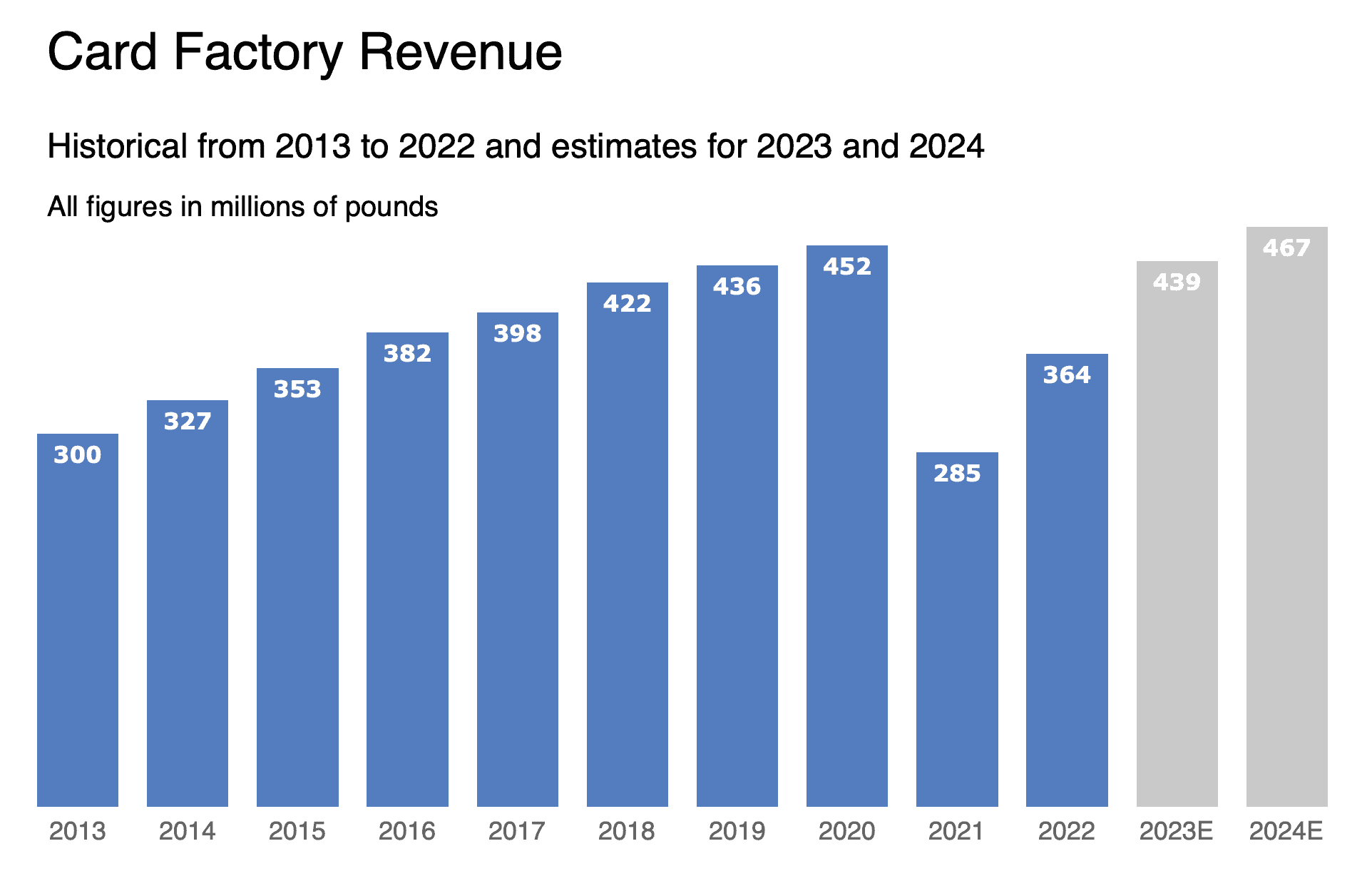
A bar chart showing Car Factory revenue growth from 2013 to 2020, then a dip during the pandemic, but a return to growth after with estimates suggesting revenue will surpass the pre pandemic peak, which if true, should be good for the card factory share price
Source: Card Factory annual reports and analyst consensus estimates via the Financial Times

Card Factory’s volume share of the UK greetings card market hovered around 40% before the pandemic. The lockdowns meant Card Factory lost a chunk of volume market share. However, on each occasion, it bounced back. This pattern is evidence of a brick-and-mortar focus as online-focused competitors were able to scoop up market share when shoppers could not take to the streets.

The average price of a greeting card sold online is £2.50, compared to the £1.50 in a store. Perhaps that’s because online cards tend to be customised, which adds value. Card Factory does offer online orders and shipping on its website. It also has the online-only Getting Personal brand, which caters to the customised online greeting and gift card market. However, this is a small business, averaging about 3.5% of total revenues.
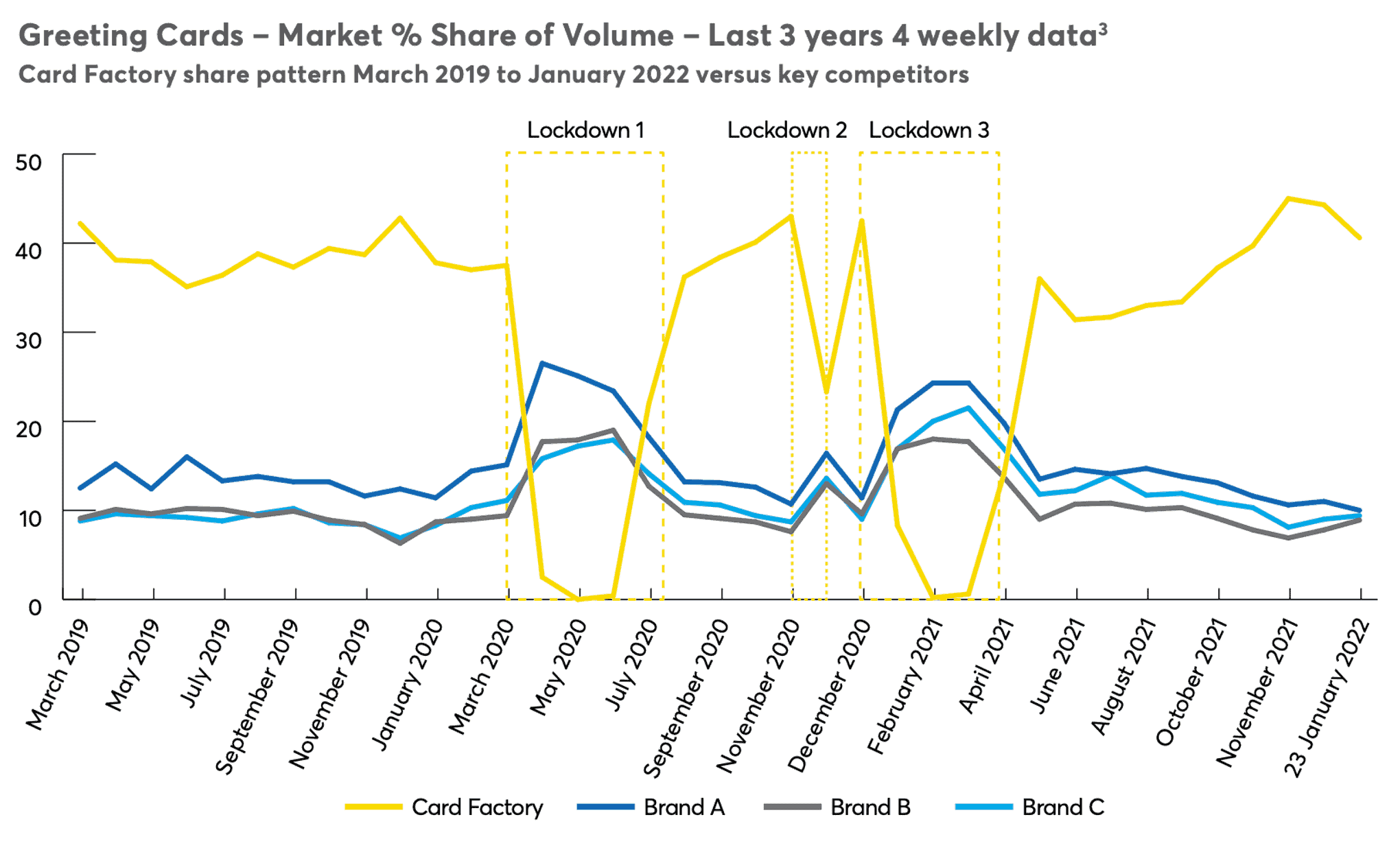
A line chart showing Card Factory greeting card market share by volume from March 2019 to january 2022, there are large reductions in market share corresponding to the three lockdowns that were imposed in the UK to combat the spread of coronavirus
Source: The Greeting Card Market Overview page on the Card Factory website

Card Factory management focuses on volume market share rather than value. That’s because it is a discount retailer. Its value-based market share of the greetings card market averaged 18% from 2013 to 2017.

Card Factory share price

So would I buy shares in Card Factory for my Stocks and Shares ISA? Well, I would not mind exposure to a market liked by a generation starting to enter its peak spending power. Aside from a few pandemic blips, it has maintained a healthy market share and grown its revenues. The company’s cash flow per share usually exceeds earnings per share (EPS). That’s usually a good sign, and it’s cheap, trading at a P/E ratio of 5.6.

But Card Factory is a discount retailer with limited traction online. This shows in its operating margins. They declined from 22% in 2017 to 16.3% in 2020. Then the pandemic hit, and they now sit around 11.6% over the last 12 months. I am concerned that Card Factory is involved in a price war. Yes, its revenues are growing, but its normalised (stripped of extraordinary or one-off items) EPS was 20.1p in 2017, yet analysts expect them to be 8.56p in 2024.

The Card Factory share price will likely follow earnings and operating efficiency trends more than revenue. So I won’t buy until I feel confident Card Factory is not in a discounted race to the bottom.


James McCombie has no position in any of the shares mentioned. The Motley Fool UK has no position in any of the shares mentioned. Views expressed on the companies mentioned in this article are those of the writer and therefore may differ from the official recommendations we make in our subscription services such as Share Advisor, Hidden Winners and Pro. Here at The Motley Fool we believe that considering a diverse range of insights makes us better investors.

More on Investing Articles

Older couple walking in park
Investing Articles

How much do I need in my ISA for a £1,000 monthly passive income?

Picking high-income stocks in an ISA can be a route to securing long-term passive income. And here's one with a…

Read more »

Smiling white woman holding iPhone with Airpods in ear
Investing Articles

Prediction: in 12 months the surging Aviva share price and dividend could turn £10,000 into…

Aviva's share price has beaten the broader FTSE 100 over the last year. But can the financial services giant keep…

Read more »

Portrait of elderly man wearing white denim shirt and glasses looking up with hand on chin. Thoughtful senior entrepreneur, studio shot against grey background.
Dividend Shares

I love FTSE 100 dividend shares, but do I buy this FTSE 250 loser?

Over the past year, the UK's FTSE 100 has thrashed the once-mighty US S&P 500 index. With value investing back…

Read more »

Investing Articles

How much do you need in an ISA to target a £2,000 monthly second income?

Harvey Jones crunches the numbers to see how much investors need in a Stocks and Shares ISA to generate a…

Read more »

Passive income text with pin graph chart on business table
Investing Articles

Should investors consider Legal & General shares for passive income?

As many investors are chasing their passive income dreams, our writer Ken Hall evaluates whether Legal & General could help…

Read more »

ISA coins
Investing Articles

How to transform an empty Stocks and Shares ISA into a £15,000 second income

Ben McPoland explains how a UK dividend portfolio can be built from the ground up inside a Stocks and Shares…

Read more »

Investing Articles

I asked ChatGPT if it’s better buy high-yielding UK stocks in an ISA or SIPP and it said…

Harvey Jones loves his SIPP, but he thinks a Stocks and Shares ISA is a pretty good way to invest…

Read more »

DIVIDEND YIELD text written on a notebook with chart
Investing Articles

How much do you need to invest in dividend shares to earn £1,500 a year in passive income?

As the stock market tries to get to grips with AI, could dividend shares offer investors a chance to earn…

Read more »