Share your opinion and earn yourself a free Motley Fool premium report!

We are looking for Fools to join a 75 minute online independent market research forum on 15th / 16th December.

To find out more and express your interest please click here

Why is the FTSE 100 lagging the Dow Jones and the S&P 500?

The Dow Jones and S&P 500 both made new all-time highs yesterday, but the FTSE 100 is still well short of recovering its market-crash losses. James J. McCombie looks into it.

The content of this article was relevant at the time of publishing. Circumstances change continuously and caution should therefore be exercised when relying upon any content contained within this article.

You’re reading a free article with opinions that may differ from The Motley Fool’s Premium Investing Services. Become a Motley Fool member today to get instant access to our top analyst recommendations, in-depth research, investing resources, and more. Learn More.

Yesterday the Dow Jones Industrial Average closed above 30,000 for the first time. That is a remarkable turnaround, given that the Dow slumped to under 19,000 in March this year. From its March low of under 2,250, the S&P 500 index has risen to over 3,600.

Both the S&P 500 and the Dow are back above their pre-market crash highs. Meanwhile, the FTSE 100, while still well over 1,000 points above its market crash lows, is well shy of its pre-crash highs.

And it’s not just the FTSE 100. Both the French CAC 40 and the German DAX also sit below their pre-crash highs and lag their American counterparts.

Why is the S&P 500 outperforming?

In the US, unemployment benefits were increased in light of the coronavirus pandemic. In the UK and Europe, firms were given support to pay wages to furloughed staff. One theory is that allowing people to lose their jobs in the US means they can, over time, move into more profitable parts of the economy. In Europe and the UK, furloughing staff in otherwise unprofitable areas of the economy, and keeping ailing firms alive, might hold up the creation of more productive jobs and place a drag on the economy.

The spectre of Brexit is still hanging over the UK and Europe. Uncertainty around the future relationship between the UK and Europe will be a headache for businesses looking to plan for the future on both sides of the channel. Investors might also be lacking confidence. This is not positive for the FTSE 100 and European stock markets.

A weakening US dollar, against both the pound and euro, is also favourable for profits of American firms and its stock markets. A weaker dollar means foreign profits converted back to dollars are increased. That’s good for US markets. However, since the dollar is weaker, the pound and euro are stronger, so any US profits will shrink in pound and euro terms. That isn’t good for European markets.

FTSE 100 lacking tech stocks

I think the main reason the FTSE 100 lags both the S&P 500 and the Dow is down to the type of stocks in it. In the chart below, the sector weightings of the FTSE 100 and the S&P 500 are compared. The S&P 500 has significantly more tech exposure than the FTSE 100. The FTSE 100 has much more exposure to energy (including oil and gas stocks) and financials (which includes banks).
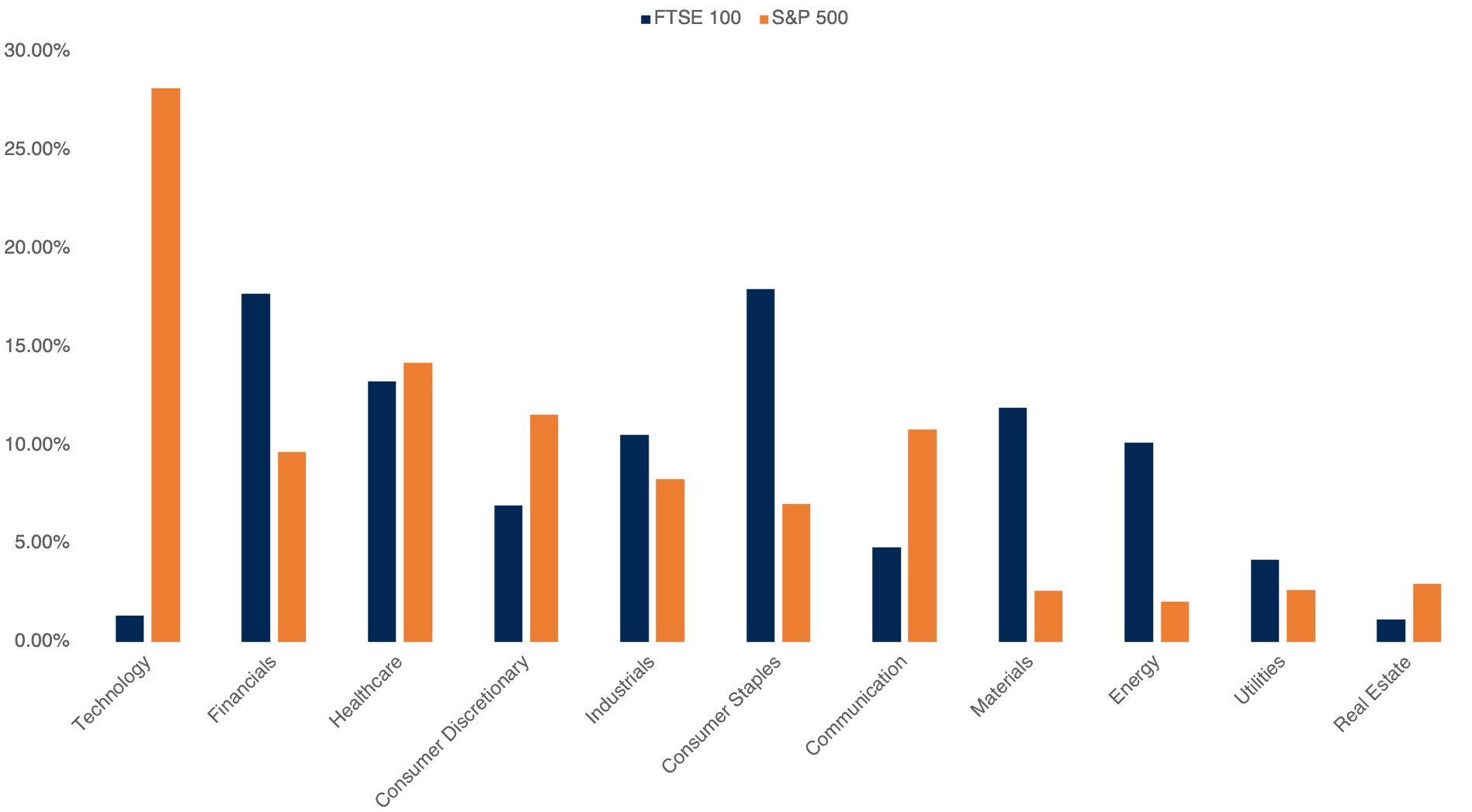
A chart showing FTSE 100 and S&P 500 sector weightings

Source: Author’s own calculations

Tech stocks have been on a tear this year. Banks and oil majors have suffered. Of all the reasons offered, I think the fact that the FTSE 100 is underexposed to the best performing sectors and overexposed to the worst explains its underperformance best. The Dow, although often considered stodgy and old economy-focused, has the likes of Microsoft and Apple in it.

Unless the structure of the FTSE 100 changes, then it will likely continue to underperform the S&P 500. However, that does not mean all FTSE 100 stocks are laggards. Some, like Ocado and Scottish Mortgage Investment Trust, are up 90% over a year.  So, picking the right stocks can make a huge difference to returns. And let’s not forget that over the last 10 years, the FTSE 100’s dividend yield has been a little under around 4% on average. The S&P 500’s average yield is closer to 2%. So, income investors might find the FTSE 100 a fertile hunting ground.


James J. McCombie owns shares of Scottish Mortgage Inv Trust. The Motley Fool UK has no position in any of the shares mentioned. Views expressed on the companies mentioned in this article are those of the writer and therefore may differ from the official recommendations we make in our subscription services such as Share Advisor, Hidden Winners and Pro. Here at The Motley Fool we believe that considering a diverse range of insights makes us better investors.

More on Investing Articles

Person holding magnifying glass over important document, reading the small print
Investing Articles

Just released: our top 3 small-cap stocks to consider buying in December [PREMIUM PICKS]

Small-cap shares tend to be more volatile than larger companies, so we suggest investors should look to build up a…

Read more »

This way, That way, The other way - pointing in different directions
Investing Articles

Is the unloved Aston Martin share price about to do a Rolls-Royce?

The Aston Martin share price has inflicted a world of pain on Harvey Jones, but he isn't giving up hope…

Read more »

Surprised Black girl holding teddy bear toy on Christmas
Investing Articles

How much do you need in a Stocks and Shares ISA to raise 1.7 children?

After discovering the cost of raising a child, James Beard explains why he thinks a Stocks and Shares ISA is…

Read more »

smiling couple holding champagne glasses and looking at camera at home with christmas tree
Investing Articles

A Santa rally could take the FTSE 100 to 10,000 and beyond!

If the FTSE 100 enjoys yet another big Santa rally then the long-awaited and tantalisingly close 10,000 mark could be…

Read more »

UK coloured flags waving above large crowd on a stadium sport match.
Investing Articles

2 investment trusts from the FTSE 250 worth digging into for passive income

Plenty of FTSE 250 investment trusts offer dividend growth potential over the long run. So why does this writer like…

Read more »

Warhammer World gathering
Investing Articles

The Games Workshop share price is up 38% in a year. Is there any value left?

The Games Workshop share price has risen by more than a third in a year. Our writer considers what might…

Read more »

Young female business analyst looking at a graph chart while working from home
Investing Articles

This AI growth stock could rise 60%-70%, according to Wall Street analysts

This growth stock has lagged the market in 2025. However, Wall Street analysts expect it to play catch up next…

Read more »

Surprised Black girl holding teddy bear toy on Christmas
Investing Articles

Prediction: here’s where the red-hot Lloyds share price and dividend yield could be next Christmas

Harvey Jones has done brilliantly out of the Lloyd share price over the last year. Now he's wondering whether he'll…

Read more »