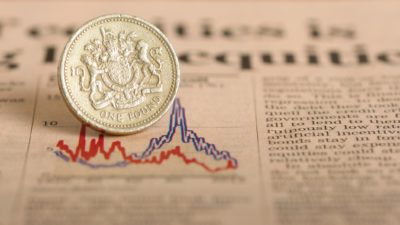
The forecasters and futurologists are already hard at work – even though most of us are still grappling with the grim reality of the present.
A 34% quarter-on-quarter contraction in GDP for the three months ending 30 June? It’s incredible, but that’s the figure from the Office for Budget Responsibility.
And even though it is currently forecasting a sharp recovery in the third quarter, just as startling is its estimate of a 13% year-on-year overall contraction in GDP for 2020. To put that in context, that’s far worse than the financial crisis of 2008-2009, or either world war – or, for that matter, the Spanish flu epidemic of 2018.
The public sector deficit? Let’s not even go there.
Pain points
Right now, most investors are nursing heavy hits to their portfolios. As I write these words, the Footsie is down around 2,000 points from its mid-January levels.
Income investors – like me – are also seeing huge cuts to dividend income. Again, as I write these words, almost a third of each of the FTSE 100 and FTSE 250 constituents have announced a suspension or reduction in their dividend payments to shareholders.
Meanwhile, gilt yields and interest rates are on the floor. Across a range of its savings accounts, banking giant HSBC is paying interest of just 0.01%.
E-commerce is the future
As I say, the futurologists are hard at work. And to be sure, post-coronavirus, the world will be a very different place.
It may seem trite to say so, but a sustained period of lockdown is likely to leave a lasting impression on both business behaviour and consumer behaviour.
E-commerce, for instance, will have received quite a fillip – and Amazon won’t be the only beneficiary. Up to this point, my wife and I had never bought online groceries, although we’d dabbled with veg boxes and wine deliveries. But across the country, thousands of people – just like us – are discovering just how convenient home delivery can be.
It’s not without irony. Back in the 1950s, when I was growing up, home delivery was much more the norm, and supermarkets were the brave new world.
No longer: round here, a local butcher delivers meat, but in a refrigerated van, not on a bicycle.
Business-as-usual won’t be business as usual
Business? Many businesses are shuttered, their employees furloughed. It seems reasonable to assume that not all will re-open. Some retailers have already called in the administrators.
Across the country, huge numbers of people are discovering the realities of working from home. Video-conferencing has never been more popular. And again, it seems reasonable to assume that some businesses will permanently re-think their need for office space. Working from home won’t become the new normal, but smaller offices might.
And that’s before factoring in the impact of recession – even if, as forecasters hope, the downturn is sharp, but short.
The next two or three years, in short, are likely to be challenging.
Investors’ secret weapon
From an investment point of view, figuring out a response is tough. What has been startling is the pandemic’s impact on so many industries.
Put another way, it’s no surprise to see cinemas, pubs and restaurants shuttered. But it has been surprising to see the extent of the impact on other industries: banking, insurance, utilities, manufacturing, commercial property, and defence, for example.
So it’s worth reminding ourselves of investment’s ‘secret weapon’ – the tool that we have available to us to help us through times of extreme uncertainty.
No, I’m not talking about cabernet sauvignon. I’m talking about diversification.
Think differently
Put simply, diversification is how we spread risk. Because right now, in my judgement, now is not the time for highly concentrated portfolios.
Instead, it’s a time for broadly based portfolios – maybe stretching across different countries, but certainly stretching across different industries, different sectors of the economy, different companies, and different investment paradigms.
‘Investment paradigms’? By that, I mean this: if you’re a growth investor, buy a few income shares. If you’re an income investor, leaven the portfolio with a few growth shares.
In short, it’s time to take a long hard look at what you own, and ask a question that’s all too-rarely asked. Not: ‘What do I own?’, but ‘What don’t I own?’