Why a Cash ISA could be your biggest retirement savings mistake

The stock market crash may have put off investors and turned them towards Cash ISAs. I think this is a mistake and could make their retirements poorer.

The content of this article was relevant at the time of publishing. Circumstances change continuously and caution should therefore be exercised when relying upon any content contained within this article.

You’re reading a free article with opinions that may differ from The Motley Fool’s Premium Investing Services. Become a Motley Fool member today to get instant access to our top analyst recommendations, in-depth research, investing resources, and more. Learn More.

Cash ISAs can have their place in an investment plan, but banking on them to build wealth for retirement could be a mistake. A Cash ISA could be ideal for depositing money that may be needed at a moment’s notice, and the nominal value of the investment will not go down. But they offer little in the way of growth potential, and may not keep pace with inflation.

Betting on a Cash ISA to fund a comfortable retirement could leave an investor very disappointed. Because of the current low-interest-rate environment, Cash ISAs are struggling to beat inflation. That means the money in a Cash ISA can lose purchasing power.

It has been suggested that the low-interest rates faced today are a result of the financial crisis of 2007–09, and that, eventually, interest rates should begin to return to ‘normal’.
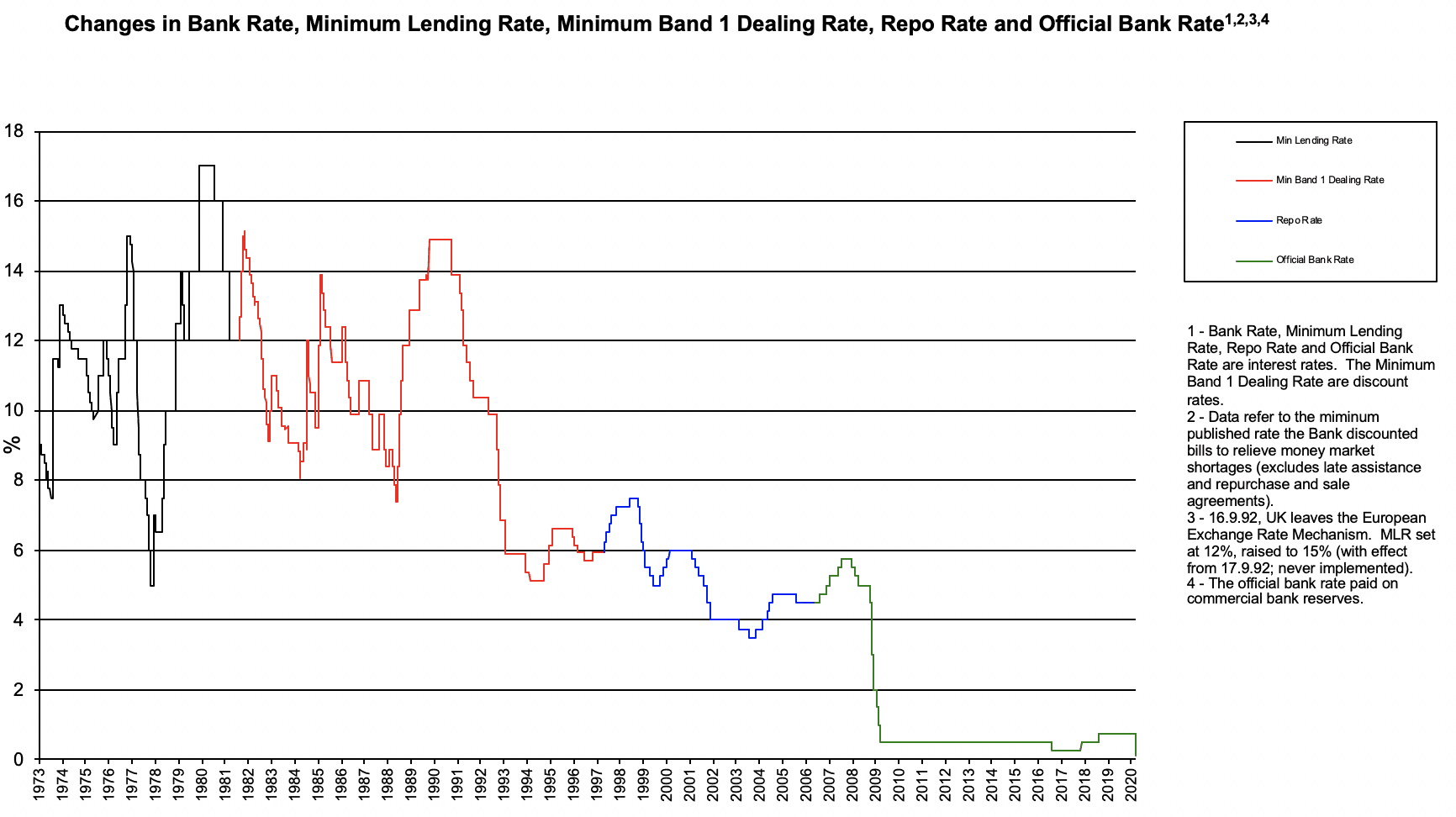
Bank of England historical rates

The chart above was produced by the Bank of England.

The financial crisis did prompt rate slashing, but interest rates had been declining for decades before that. There is no requirement for rates to be above inflation and no reason to suggest that today’s low rates are not the new normal.

Market growth

Investing in the stock market is a cornerstone of retirement planning. Stocks and shares have historically delivered significantly higher returns than Cash ISAs when the investment horizon is long enough.

As I said earlier, Cash ISAs would be ideal for ensuring that the £1,000 put in today is still there in a year or two. Investing in the stock market, via a Stocks and Shares ISA or a SIPP is not without risk. This is particularly true for short-term investments.

Money put to work in the stock market needs to be left alone for perhaps 10 year. Saving for retirement is a great case for stock market investing.

The FTSE All-Share index represents at least 98% of the stock market capitalisation of all UK companies. The index also had an average dividend yield of 3.4% between 1995 and 2020. Investing £1,000 in this index for 10 years at a time between 1995 and 2020 had a 98.9% success rate.

To beat inflation, assumed to be 2% per year, a £1,000 investment needs to grow to at least £1,219 over 10 years. On average, a £1,000 10-year investment made between 1995 and 2020 would have grown to £1,881. Investing in the FTSE All-Share index would have beaten inflation 92% of the time.

The 1.1% of 10-year investments that were losers began around the 1999 market peak and ended in the depths of the financial crisis. It is comforting to know that extending the investment horizon by a year or two did reverse the losses.

Cashing out

For those trying to build serious wealth for retirement, investing in the stock market is a sensible choice. Right now, the stock markets are in a slump but don’t let this put you off. As we have seen, investing when the market is peaking is something to avoid. This latest crash is an opportunity to increase the odds of long-term success. It will always be a mistake to rely on a Cash ISA to build retirement wealth.


James J. McCombie has no position in any of the shares mentioned. The Motley Fool UK has no position in any of the shares mentioned. Views expressed on the companies mentioned in this article are those of the writer and therefore may differ from the official recommendations we make in our subscription services such as Share Advisor, Hidden Winners and Pro. Here at The Motley Fool we believe that considering a diverse range of insights makes us better investors.

More on Investing Articles

Investing Articles

I asked ChatGPT to settle the ISA v SIPP debate once and for all. It said…

Instead of working out whether an ISA or SIPP is the better tax wrapper, Harvey Jones called the robots in.…

Read more »

Middle-aged white male courier delivering boxes to young black lady
Investing Articles

Amazon shares: overpriced or a possible bargain?

Christopher Ruane thinks Amazon shares look pricier than he normally likes -- but also reckons they could be a potential…

Read more »

Female Tesco employee holding produce crate
Investing Articles

In a jittery market, could Tesco shares be a defensive choice?

Could Tesco shares be a safe haven in nervous markets, given that consumers always need to eat? Our writer is…

Read more »

British coins and bank notes scattered on a surface
Investing Articles

How much might £10,000 in Rolls-Royce shares soon be worth? Let’s ask the experts

Do Rolls-Royce shares look like a good buy after recent price falls? City analysts still appear bullish, but global events…

Read more »

Queen Street, one of Cardiff's main shopping streets, busy with Saturday shoppers.
Investing Articles

Take a deep breath! £10,000 invested in Greggs shares a year ago is now worth…

Someone who bought Greggs shares a year ago is nursing a paper loss. Our writer digs into the reasons why…

Read more »

Mature black woman at home texting on her cell phone while sitting on the couch
Investing Articles

Whatever happened to the stock market crash?

The stock market refuses to crash, despite the Iran war. But Harvey Jones says lots of FTSE 100 shares have…

Read more »

Petrochemical engineer working at night with digital tablet inside oil and gas refinery plant
Investing Articles

BP’s share price will keep surging in 2026, according to this broker

BP’s share price is in a strong upward trend right now. And one City brokerage firm seems to believe that…

Read more »

Picture of an easyJet plane taking off.
Investing Articles

These 4 red flags mean I’m avoiding easyJet shares like the plague!

easyJet shares have slumped by around a quarter during the past month. Does this represent a dip-buying opportunity? Royston Wild…

Read more »