
The FTSE 100 exploded higher yesterday (8 April), gaining 2.5%. The catalyst for this jump was obviously the two-week ceasefire announced between the US/Israel and Iran.
Strangely enough, this is partly a repeat of what happened exactly a year ago. On 9 April 2025, President Trump paused his reciprocal tariff increases, sending the S&P 500 up 9.5% (one of its best days ever). The FTSE 100 quickly went higher too.
As such, anyone who invested a year ago would have made one of the best-timed index investments ever. On 9 April, the FTSE 100 had finished the day languishing at 7,679. Fast forward to close of play on Wednesday when it was at 10,608!
Therefore, a £20,000 investment made a year ago in a FTSE 100 index tracker fund would now be worth around £27,680.
That’s before dividends. With an accumulating fund like Vanguard FTSE 100 ETF (LSE:VUKG), where the dividends are reinvested, the return would be roughly £28,500. A 42.5% total return!
Time in the market
As mentioned, such a barnstorming return in this space of time is rare, as is the ability to accurately time such an investment.
It’s often talked about, but it’s worth repeating that most of the stock market’s best days come closely after the worst days. Missing out on a few of the big up days can have a devastating impact on long-term returns.
The chart below shows the S&P 500, but the same applies to the FTSE 100. Missing the best 10 days over the last 20 years would have resulted in a significantly lower return.
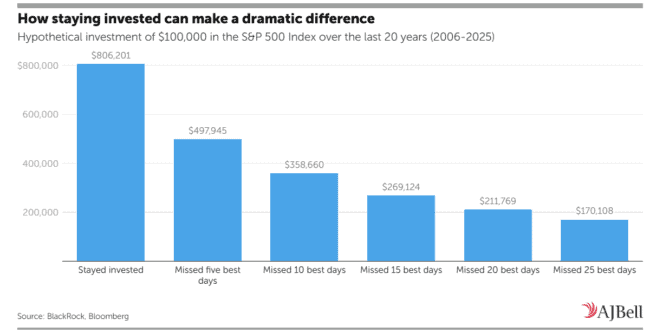
To me, this shows how staying invested — and buying when there’s market panic — can really pay off. As the old investing adage says, its “time in the market, not timing the market” that produces the best results.
Value on offer?
Returning to the FTSE 100 tracker ETF above, is it still worth a look after rocketing almost 43% in a year? I think it is, even though a fair amount of risk still exists due to high inflation and the potential for the Iran war to resume.
As noted, this fund reinvests dividends to supercharge the compounding process. And even the recent surge, the FTSE 100’s trailing dividend yield is still around 3%.
What’s more, when I look at the top of the index, I really like some of the stocks. For example, AstraZeneca has a world-class portfolio of oncology drugs, with a pipeline of more than 100 Phase III studies ongoing.
Looking ahead, AstraZeneca is betting heavily on antibody-drug conjugates. These are often called ‘biological missiles’ because they deliver high-dose chemotherapy directly to cancer cells while sparing healthy ones. AstraZeneca is far from the lumbering pharma giant of old!
Elsewhere, Rolls-Royce is set to benefit from rising global travel, higher defence spending, and potentially small modular reactors (SMRs). HSBC is nicely positioned to benefit from the high-growth markets of Asia and the Middle East.
The FTSE 100 also still looks cheap, trading at around 17.5 times earnings. And it offers extremely cheap exposure to data/tech stocks like Experian, Sage, RELX, London Stock Exchange Group, Rightmove, and Autotrader.
If and when fears around AI extinction subside, I believe some (or all) of these shares have the potential to re-rate higher.