
With a SIPP, today’s market wobble could open up a rare window for long-term investors. For basic-rate taxpayers, every contribution is boosted by 25% through government tax relief.
At the same time, falling share prices are pushing dividend yields on blue-chip stocks higher. Over decades, locking in these elevated yields — combined with that upfront tax boost — can make a significant difference to the size of a retirement pot.
Could this be one of those rare moments that makes a lasting difference to a SIPP?
Please note that tax treatment depends on the individual circumstances of each client and may be subject to change in future. The content in this article is provided for information purposes only. It is not intended to be, neither does it constitute, any form of tax advice. Readers are responsible for carrying out their own due diligence and for obtaining professional advice before making any investment decisions.
Long-term approach
Compounding is an investor’s best friend. It drives long-term wealth building, and early gains, particularly when the market dips and dividend yields rise, can have the biggest impact on your SIPP.
When you buy shares during a wobble, you lock in future cash flows at higher yields. Dividends from that moment can buy more shares over time, adding compounding power even if prices later recover.
Consistency also matters. The chart below shows how investing £5,000 a year — boosted to £6,250 with tax relief — could grow over 20 years at different returns.
A conservative 7% return reaches £255k. With today’s elevated yields, a 9% return could take it to £320k, while an optimistic 10.5% scenario rises to £380k.
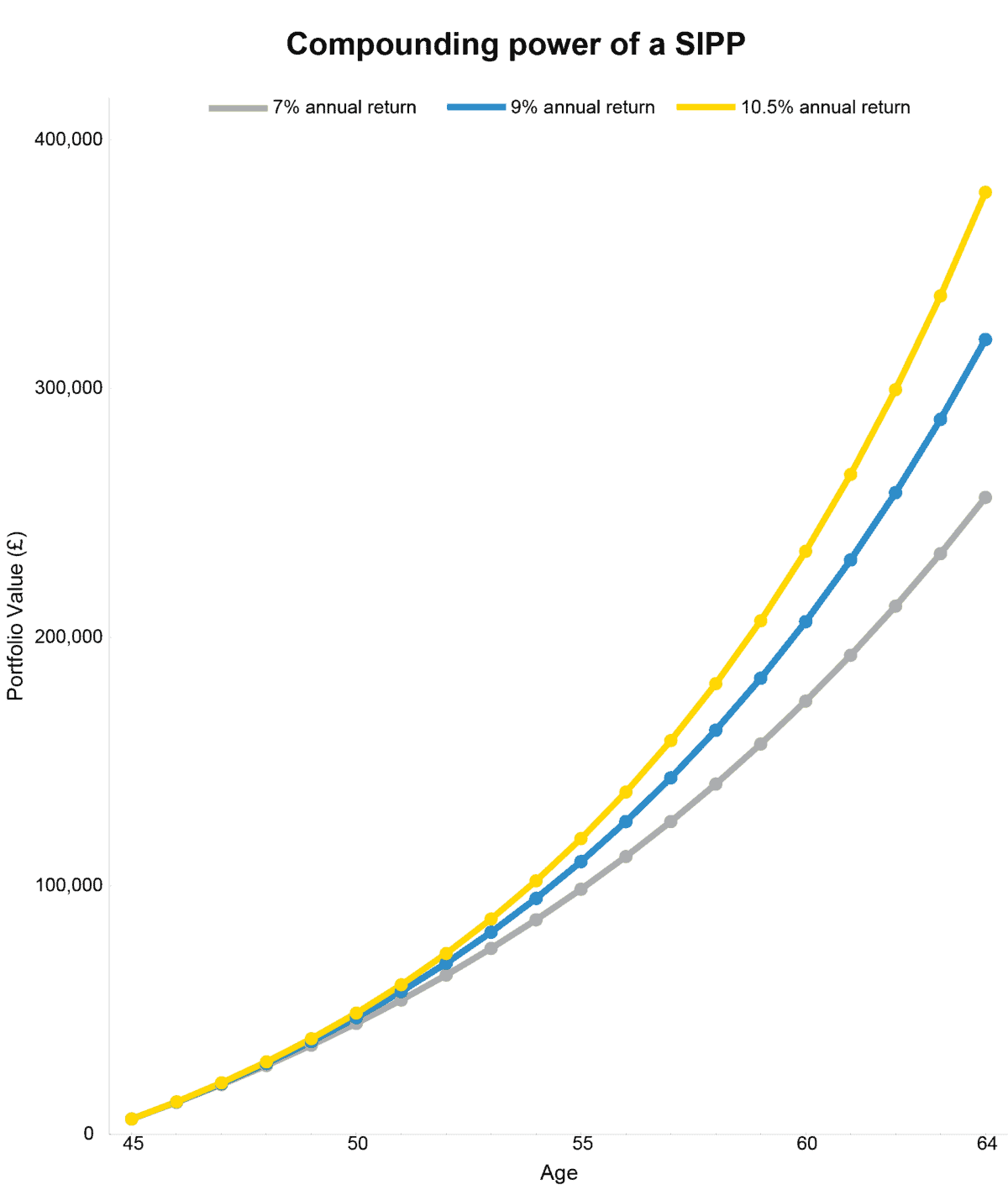
Chart generated by author
Even in wobbly markets, discipline and patience can turn short-term dips into long-term advantage — a reminder of why today’s environment could be a rare opportunity for SIPP investors.
A standout dividend payer whose already bumper yield has been rising amid the market sell-off is Legal & General (LSE: LGEN).
9% dividend yield
The market may have been disappointed by FY25 results, but I see plenty of promise.
Core profit rose 6% and earnings per share climbed 9%, helping to support a 2% increase in the dividend. After the recent sell-off, that’s pushed the yield up to a chunky 9%.
What really stood out, though, was the £1.2bn share buyback — the largest in the company’s history — signalling confidence in future cash flows.
Looking ahead, the company is well positioned to benefit from long-term growth trends. Demand from pension schemes to offload risk remains strong, creating a steady pipeline of business.
In fact, the company has visibility on £17bn of potential deals, including 10 transactions worth over £1bn that could complete in 2026.
Risks to keep in mind
A prolonged conflict in the Middle East could weigh on markets. Rising energy prices risk slowing global growth and pushing inflation higher, which has already unsettled equities and bonds .
For an asset manager like Legal & General, that matters. Falling markets can reduce assets under management, while weaker economic conditions may hit demand for pensions and investment products.
At the same time, insurers are heavily exposed to bond markets. If corporate credit conditions deteriorate in a downturn, that could put pressure on investment returns and, in turn, cash flows.
The bigger picture
Market wobbles can feel uncomfortable. But for long-term investors using a SIPP, they can quietly shift the odds.
Higher yields locked in today don’t just boost income now — they shape how a portfolio compounds over decades. And as the earlier chart shows, even small differences in returns can lead to a significantly larger pot over time.
In that context, periods like this aren’t just noise. They’re moments that can have a lasting impact on long-term wealth.